
When you plan to travel to Budapest and Hungary for a few days, it is useful to learn a few useful Hungarian words. Don’t worry, most young Hungarians speak English, and almost everybody working in tourism and hospitality speaks English very well (in Budapest for sure). However, some basic Hungarian will come in handy. Personally, I speak a bit of Hungarian and I have used pretty much my entire vocabulary during my trips to Budapest and around Hungary. For this article, though, I will leave the floor to my friend Giulia, who lives in Hungary as an expat.
This article was originally written by Giulia Dal Pont for her former blog Travelling Sunglasses. It has been revised, updated, and expanded for Paola Everywhere.
Table of Contents
Essential Hungarian Words and Phrases for Travellers
In this post, you will learn a few simple Hungarian phrases and words that will make Hungarians like you! The Hungarian language is one of the most difficult in the world, so there is little point in learning full sentences, or questions and answers, if you spend just a few days in Hungary.
Instead, a few greetings and common Hungarian words will show the locals that you are interested in them and respectful of the local culture: the perfect attitude to start a conversation or receive a smile in return.
Giulia’s Experience Learning Hungarian as an Expat in Budapest
When I moved to Hungary in 2014, I thought I could learn the language quickly, just like I had done with English and Spanish. I quickly realised I was wrong.
I joined group classes where I learned some basic grammar and everyday vocabulary. It was really hard, and it made little sense to me. Afterward, any new word would rarely stay in my head for long. Colleagues and Italian-Hungarian tandem classes kept me practising, but I didn’t progress much.
You know why? It’s because almost everybody I encountered spoke enough English, or I knew enough Hungarian to get by. We understood each other, even though I could not form a full sentence in Hungarian, and I understood maybe one in five words they said.
I remember I was at the supermarket, looking for yeast to bake a cake, but I could see only yeast for bread. I said two Hungarian words to a kind lady: “Sorry, cake?” I pointed at the wall of mysterious products, and smiled. She helped me right away!
Long story short: a couple of Hungarian words and a smile on your face will make a difference during your trip to Budapest or Hungary.
Just remember a few easy rules:
- In Hungarian, you speak the way you write (as opposed to English), so you can give it a try and pronounce the words you see. People may smile at your pronunciation, and then they will help you!
- There are lots of accents on vowels, but you can skip them. You should still be understood
- Don’t take it for granted that people speak English: after all, you are a guest in their country! Be polite and first ask if they speak English
- Always keep a smile on your face!
Basic Hungarian Greetings and Polite Expressions
Say these useful Hungarian phrases to everybody: hotel staff, waiters, bus drivers, tour guides, shop assistants. They are basic, polite words that will create a good vibe around you.
- Jó napot = good day (pronounced yo na-pot) but say “jó reggelt” before 9:00 am (pronounced yo reh-gelt)
- Jó estét = good evening (pronounced yo esh-tet) (from when it gets dark)
- Jó éjszakát = good night (pronounced yo ey-sa-kat) (when you actually go to bed)
- Szia = hi, hello when greeting someone (pronounced see-yah, very informal). Just remember “szia” is singular. Say “sziasztok” to greet many people
- Hello = hello when greeting and also bye when going away (pronounced hello, very informal)
- Viszlát = goodbye (pronounced vees-lat, formal). The full, polite version is “viszontlátásra” and only a very patient Hungarian will help you learn it!
- Igen = yes (pronounced ee-gen with hard “g” like “get”)
- Nem = no (pronounced nem)
- Köszi = Thank you (pronounced kew-si, consider the “ö” sounds like the “o” of “colonel”, informal). The full, polite word is “köszönöm“, pronounced kew-sew-newm
- Bocsi = sorry (pronounced bo-chi, informal). The full, polite word is “bocsánat“, or “elnézést“
- Egészségedre = cheers when drinking, bless you when sneezing, and I hope you enjoyed your meal when you emptied your dish. This may sound hard, but it’s guaranteed to produce smiles and appreciation! (Pronounced eh-geh-sheh-geh-dreh).
Only after you have greeted someone, you can go ahead with asking for help or information. Here’s the most useful sentence in Hungarian:
- Beszél angolul? = do you speak English? (Pronounced beh-sel ahn-go-lool). This is tricky because Hungarians downplay their language skills! They may answer “a little” but actually speak well. I recommend using a strong English accent, otherwise they may try to answer you in Hungarian.
Useful Hungarian Words to Compliment Food and People
Use these simple Hungarian words to describe the food you are eating or what you saw during the day, even when the local person is speaking to you in English. A smile is guaranteed!
- Nagyon finom = delicious (pronounced nah-jon fee-nom)
- Nagyon kedves = very kind (tell them when they help you with directions) (pronounced nah-jon ked-vesh)
- Nagyon szép = gorgeous (pronounced nah-jon sep, with a long “e” like in “saint”)
- Budapest nagyon szép város = Budapest is a very beautiful city (pronounced Budapesht nahjon sep vahrosh)
- Király = cool! (Pronounced kee-rah-y). Literally, it means “king”. Use it as appreciation for a good and complete answer, or when you learn something interesting.
Hungarian Words for Transport, Streets and Public Signs
I bet you will use Google Maps or something similar, so you should be quite independent as you get around Budapest. However, just in case your battery is dead, or the app shows you indications in Hungarian, or if you simply prefer to read the signs in front of you, here are some useful Hungarian words to understand the city around you.
- Utca, út, körút = street, avenue, ring boulevard (pronounced uzza like “pizza”, uut, ko-root)
- Tér, tere = square (pronounced ter, teh-reh)
- Híd = bridge (pronounced heed)
- Busz = bus (pronounced boos)
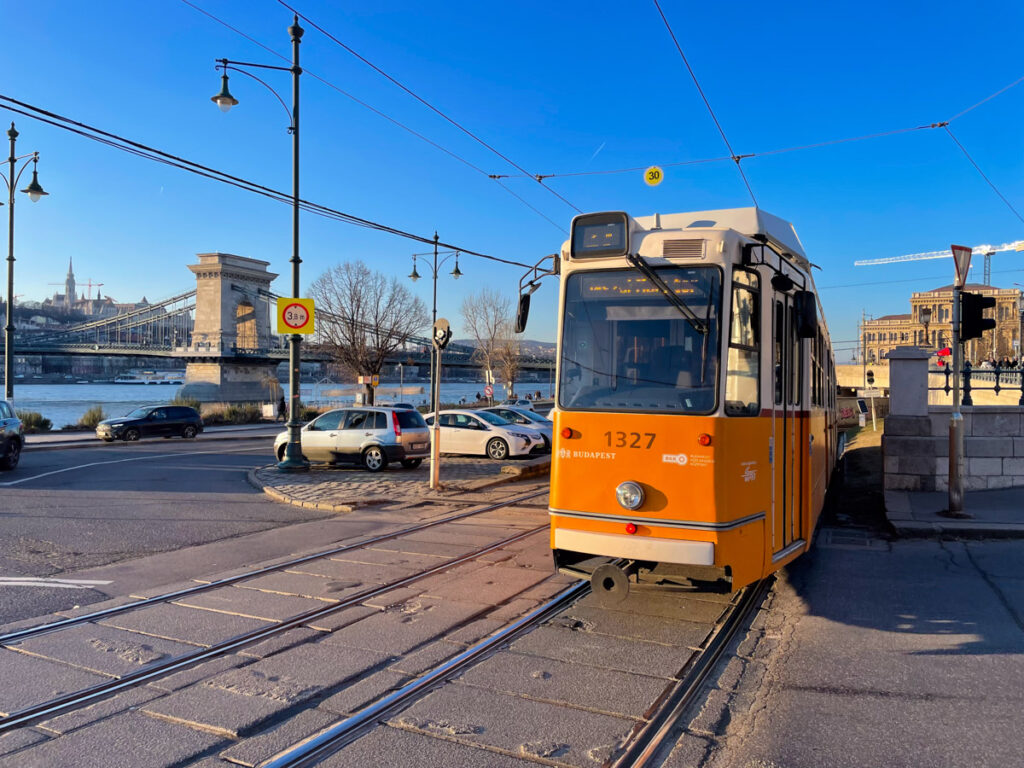
- Villamos = tram (pronounced vil-la-mosh)
- Metro = underground, subway, metro (pronounced metro)
Budapest is generally a polite and orderly city, and following a few local habits will make your experience smoother. Always cross the street on the zebra crossing and wait for the green light, even when the road looks empty. On public transport, including buses, trams and the metro, it is customary to let passengers exit before boarding and to offer your seat to older passengers, pregnant women or anyone who may need extra assistance.
Smoking is allowed only outdoors and usually not close to restaurant entrances. Public spaces are generally clean, so throwing rubbish into bins is expected. Rules regarding public drinking occasionally change, so if you are unsure whether alcohol is allowed in a specific area, ask a local or check the latest information.
Useful Hungarian Words for Shops
These simple Hungarian words will help you understand signs, menus and payment options while travelling around Budapest and Hungary.
- Nyitva = open (pronounced neet–va)
- Zárva = closed (pronounced zahr–va)
- Bejárat = entrance (pronounced beh-yah-raht)
- Kijárat = exit (pronounced kee-yah-raht)
Language geeks, see how it works? Járat means to go, be means in and ki means out!
- Bankkártya = credit card (pronounced bahnk-kaar-tya)
- Készpénz = cash (pronounced kes-penz)
Watch out for signs that say “csak bankkártya” or “csak készpénz“, as they accept card only or cash only.
Hungarian Food and Drink Words Every Tourist Should Know
If you’re adventurous with local foods and you like to find restaurants for locals, there probably won’t be an English menu, and the waiters’ English could be very basic.
Here are a few Hungarian words for survival:
- Étterem = restaurant (pronounced eh-teh-rem)
- Víz = water (pronounced veez)
- Bor = wine (pronounced bor)
- Sör = beer (pronounced shewr, with the “o” sound of “colonel”, or similar to “sure” in British English)
- Kávé = coffee (pronounced kaa-veh)
- Csirke = chicken (pronounced chir-keh)
- Marha = beef (pronounced mahr-ha, push out air like when laughing at the “ha”)
- Vegetáriánus = vegetarian (pronounced with hard “g”). Try asking this and they should point you towards a suitable dish
- Krumpli/burgonya = potatoes (pronounced kroom-plee/boor-go-nya)
- Saláta = salad (pronounced shah-lah-tah)
In Hungary, it is customary to leave a 10% tip at the end of your meal, even to the bartender when you get your drink at the counter. However, some establishments include it as “service” in the bill (look for “szervisz” at the end of the receipt) and in that case it is not expected to leave a 10% tip.
In order to receive extra good service at your hotel, leave 2000 HUF (that’s €4-5) at check-in!
Would you like to learn more Hungarian words? Let me know in the comments!
