During my trip to Lyon, I almost skipped the Museum of Lugdunum, and that would have been a mistake. If you are not particularly interested in archaeology, Roman statues, artefacts and ancient mosaics can easily start to look quite similar. The real surprise, however, is the architecture of the museum itself: a huge underground concrete structure built directly into the Fourvière hill. Elevated walkways, spiral ramps and interactive installations make the experience surprisingly engaging. Lyon’s Roman history feels far more immersive than in a traditional archaeological museum.
Table of Contents
Roman Lyon: When Lugdunum Was the Capital of the Three Gauls
Although people immediately associate Lyon with its Roman past, Lugdunum actually had Celtic origins and was inhabited by Gallic populations long before the arrival of the Romans. The Roman city stood on the hills overlooking the confluence of the Rhône and Saône rivers, in what is now Lyon’s historic centre.
Thanks to its strategic position, Lugdunum became one of the most important commercial centres in Roman Gaul. It was also the capital of the Three Gauls: Aquitania, Belgica and Lugdunensis. The Council of the Gauls, an assembly with important political and religious functions, met here in Lyon. Delegates participated in the imperial cult, maintained political relations with the emperor. They also expressed opinions on taxation across the Gallic territories.
Lyon was also home to a vast monumental complex known as the Sanctuary of the Three Gauls. It stood on Croix-Rousse Hill, although nothing visible remains today. The imperial cult honoured Rome and the emperor, but it was above all a sign of political loyalty to Roman authority rather than purely a religious practice.
Today, the Roman Theatres are the most important remains of Lugdunum’s public architecture. The area has become a public park where visitors can walk among ancient stone seating areas. The most important artefacts are displayed inside the Museum of Lugdunum.
What to See Inside the Museum of Lugdunum in Lyon
The Museum of Lugdunum, also known as the Gallo-Roman Museum of Fourvière, stands next to the Roman Theatres of Fourvière and tells the story of Roman Lyon, when the city was one of the most important centres in Gaul.
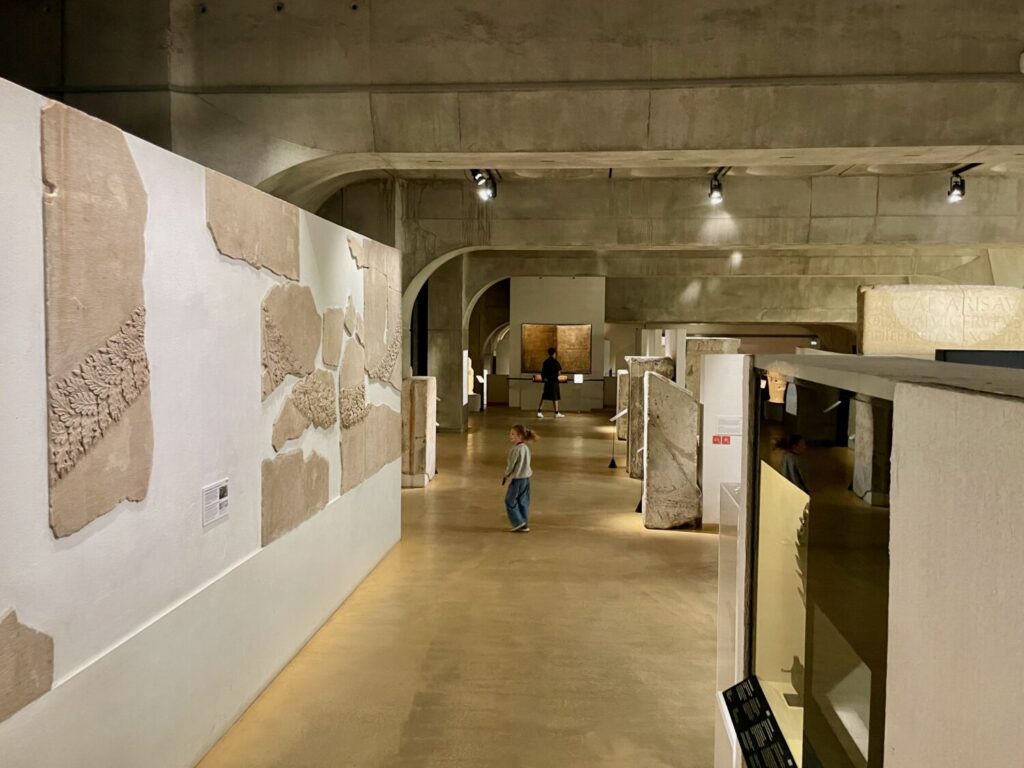
In contrast with the Roman ruins outside, the museum follows an original underground route inside a brutalist concrete structure. Walkways, ramps and huge glass windows guide visitors through statues, artefacts and ancient mosaics.
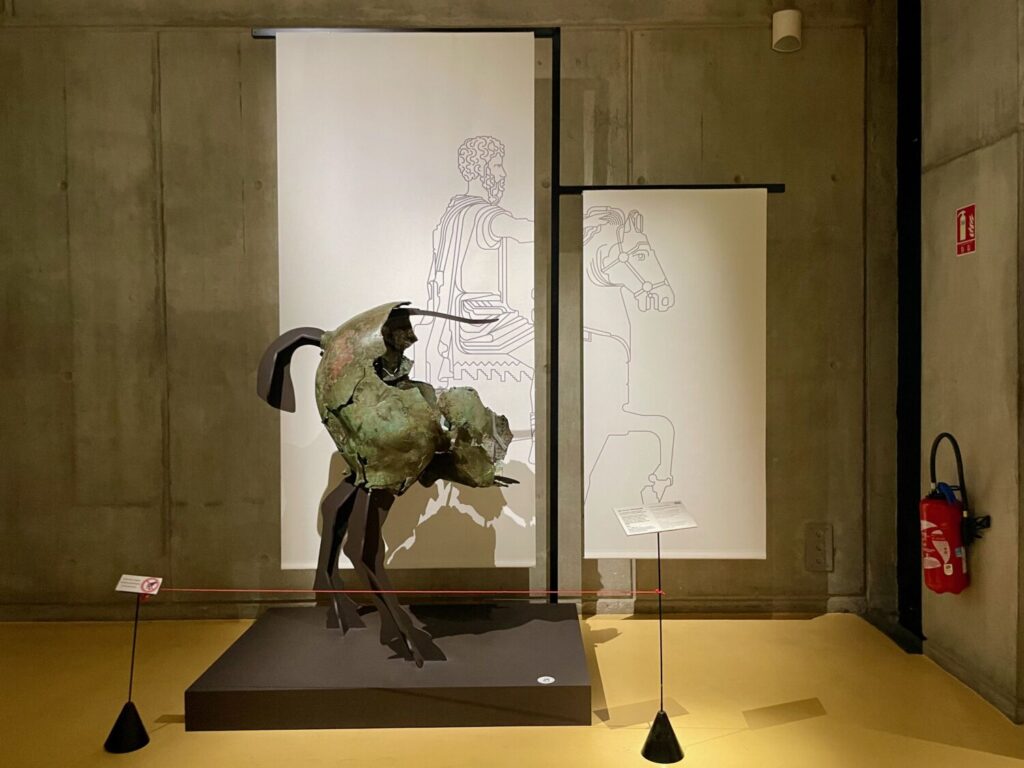
The collection includes statues, jewellery, everyday objects, sarcophagi, inscriptions and mosaics. There are also interactive installations and large-scale models reconstructing ancient Lugdunum. The museum’s most famous object is the Claudian Tablet, a rare Roman bronze inscription recording Emperor Claudius’ speech on the political rights of the Gallic elites.
The Brutalist Underground Architecture of the Museum of Lugdunum
Personally, the architecture impressed me far more than the Roman artefacts themselves. Architect Bernard Zehrfuss designed the building, which opened in 1975. From outside, it is almost invisible because it was built directly into the Fourvière hill.
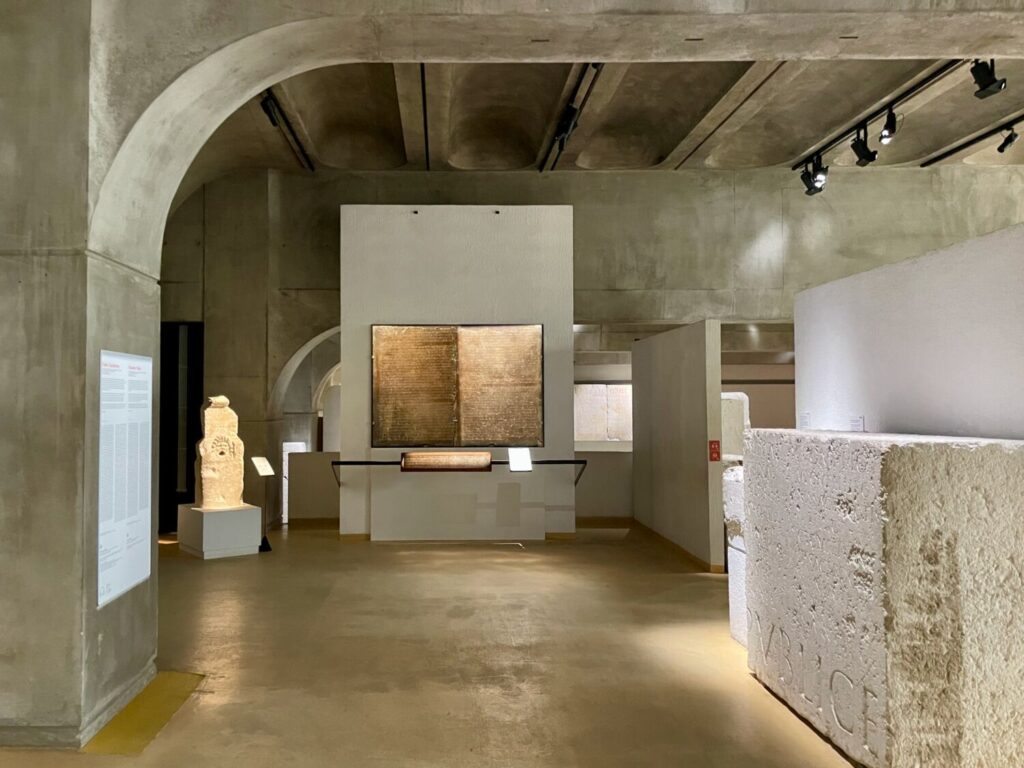
The structure was conceived as a huge underground concrete “cathedral”. The museum is built around enormous slanted porticoes, monumental pillars and flying buttresses. These structures literally support the hill above the building. In order to construct it, engineers created a gigantic retaining wall around one hundred metres long. It surrounds the museum on three sides and holds back the hillside terrain.
The visitor route follows a large concrete ramp spiralling down through the different exhibition levels while adapting to the natural slope of the hill. The structure almost resembles a bunker, with raw concrete surfaces illuminated by panoramic windows overlooking the Roman Theatres.
The contrast between modern concrete and ancient artefacts works surprisingly well. In some areas, the museum feels more like a contemporary architectural installation. It hardly resembles a traditional archaeological space. For this reason alone, you might appreciate it even if Roman history is not usually your favourite subject.
The Claudian Tablet and Emperor Claudius’ Speech on Roman Citizenship
The most important artefact inside the Museum of Lugdunum is the Claudian Tablet, discovered during the sixteenth century on the Croix-Rousse hill. This large bronze inscription records part of the speech delivered before the Roman Senate in AD 48 by Emperor Claudius.
During his speech, Claudius defended the right of Gallic elites to access the Roman Senate. The emperor, who was born in Lyon, promoted the extension of Roman citizenship across conquered territories. Today, the tablet represents one of the most important historical symbols of Roman Lyon, but also an extremely modern political decision for its time.
Roman Mosaics and Circus Games at the Museum of Lugdunum
Alongside statues and Roman artefacts, the Museum of Lugdunum also displays several exceptionally preserved mosaics. One of the museum’s most famous mosaics depicts circus games, complete with chariots, horses and spectators sitting in the stands.
Others portray mythological scenes, animals, geometric decorations and moments from everyday Roman life. Among the decorative motifs, you can also spot swastikas. In the Roman and Greek worlds, this ancient symbol was associated with fortune and the sun, long before its twentieth-century appropriation.
Temporary Exhibitions at the Museum of Lugdunum in Lyon
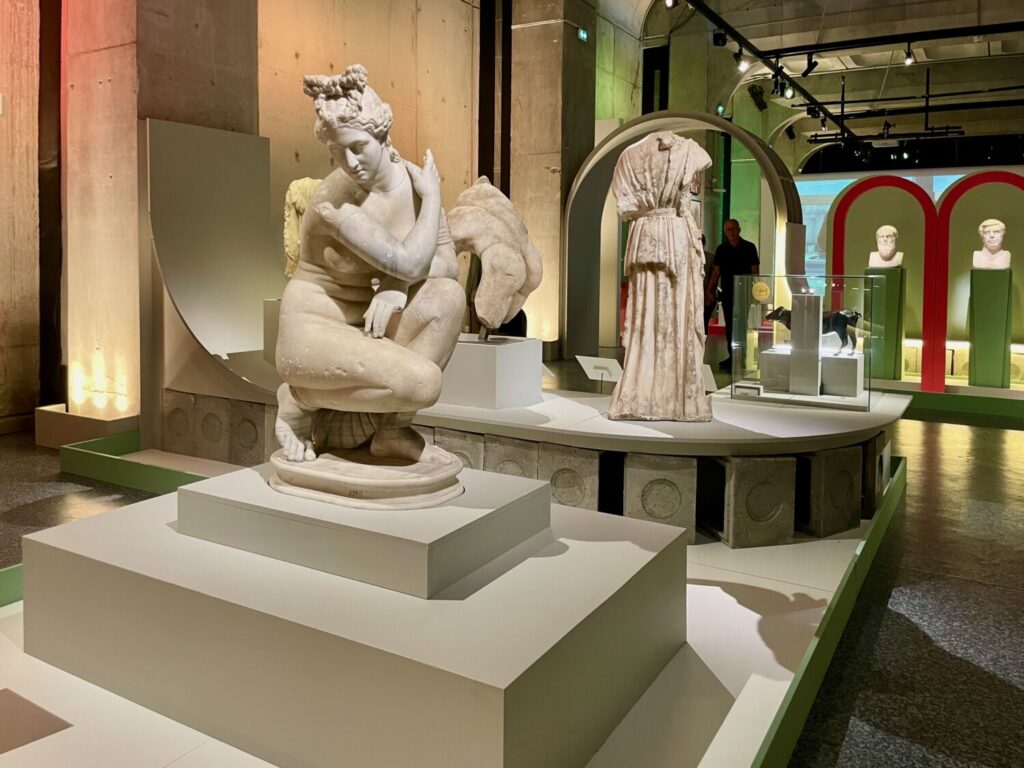
The ground floor of the Museum of Lugdunum hosts temporary exhibitions that change regularly throughout the year. During my visit, the exhibition included loans from several European museums. Some works were particularly interesting because they illustrated the aesthetic taste of Roman art. Access to the temporary exhibitions is included in the museum ticket, as the permanent and temporary exhibition areas are directly connected.
Visiting the Museum of Lugdunum With Children
The Museum of Lugdunum is surprisingly suitable for children. The museum feels much easier to explore than many traditional archaeological museums.
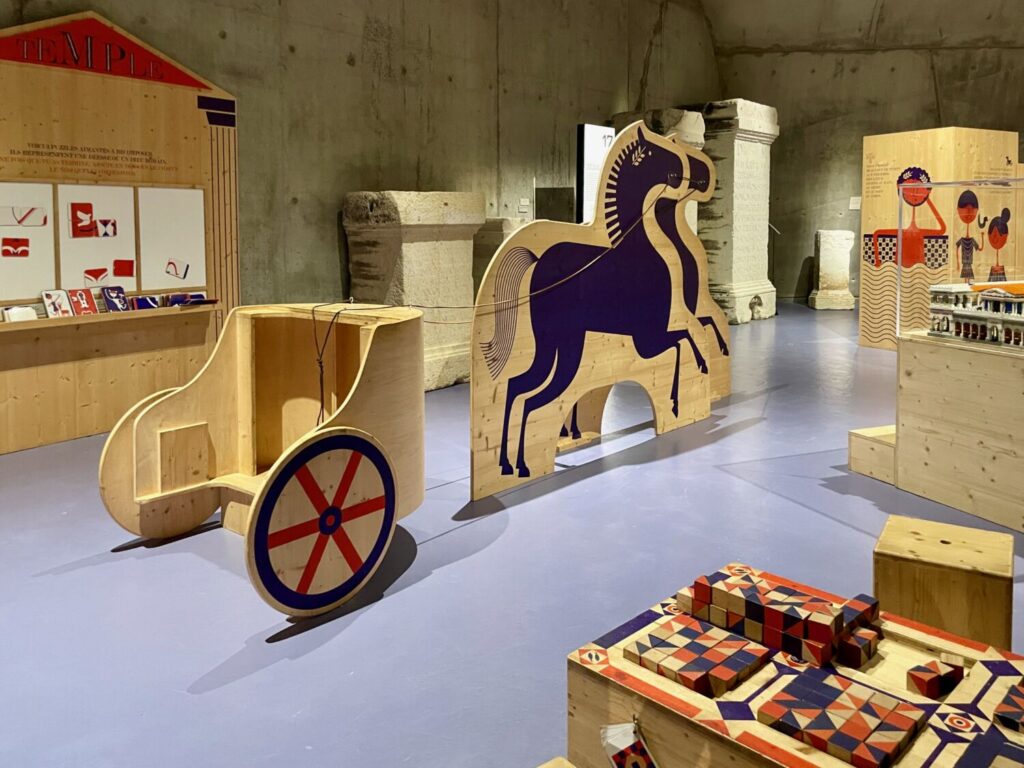
An entire area halfway through the museum route is dedicated to children. It includes wooden games, Asterix books and LEGO reconstructions of the Roman circus and thermal baths district. Large models of the Roman city and hands-on objects make the visit far more engaging for families.
The Roman Theatres of Fourvière in Lyon
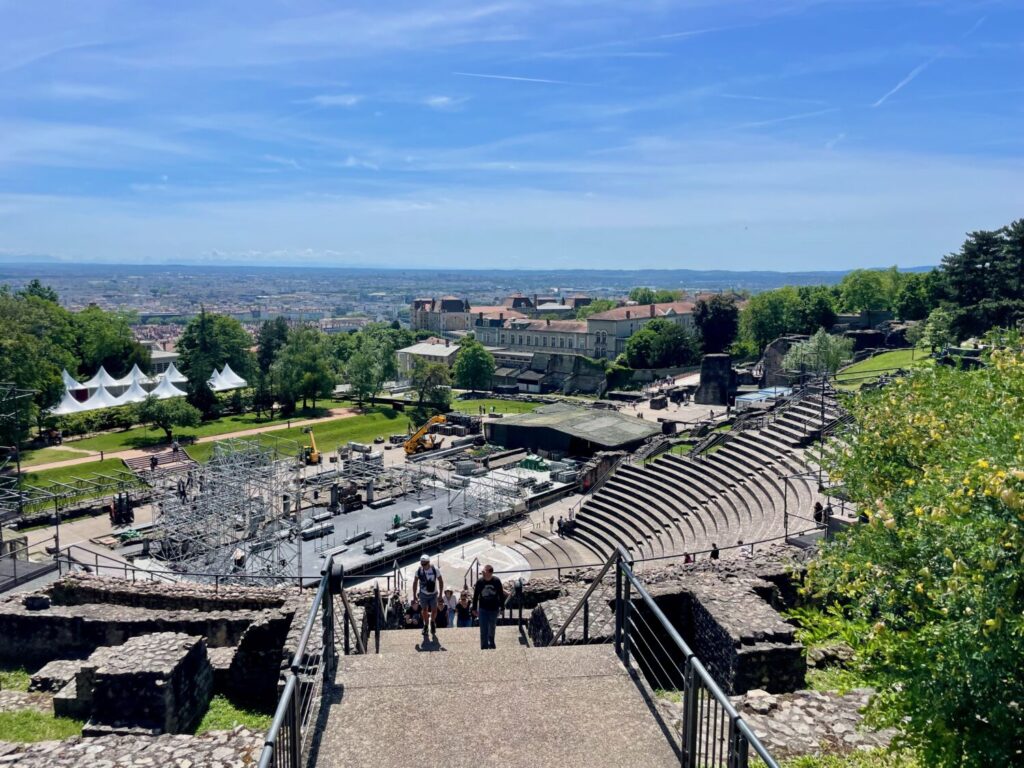
Next to the Museum of Lugdunum, you can visit the Roman Theatres, once the centre of public life in Roman Lyon. The main theatre could host around 10,000 spectators and was used for comedies, theatrical performances, dances and public ceremonies. The smaller odéon was mainly dedicated to music, poetry and public recitations.
Today, the archaeological area forms a pleasant public park integrated into the city. You can freely walk among ancient seating areas, Roman ruins and panoramic views across Fourvière Hill. During summer, the theatres still host concerts, performances and cultural festivals. Their original public function has survived for almost two thousand years.
Useful Tips for Visiting the Museum of Lugdunum
To visit the Museum of Lugdunum properly, I recommend allowing between one and a half and two hours. If the weather is good and you also want to explore the Roman Theatres outside, consider adding at least another hour.
You can visit the museum and theatres more quickly if you are short on time, but the archaeological complex is far more impressive and scenic than most visitors expect. You will probably end up wanting to explore certain sections in greater depth.
The museum route itself is not particularly large, but it includes several interactive installations, mosaics and large models of the Roman city. For some objects, such as the Claudian Tablet or the major mosaics, you may want to spend extra time reading the information panels or listening to the audio guide included with the entrance ticket.
Opening Hours of the Museum of Lugdunum and the Roman Theatres
The Museum of Lugdunum is open from Tuesday to Friday from 11:00 to 18:00, while at weekends it opens from 10:00. The museum is closed on Mondays.
The Roman Theatres of Fourvière, freely accessible outside the museum, have different opening hours depending on the season. From May to September, the archaeological area is open from 7:00 to 21:00, while during winter it closes earlier at 19:00.
Tickets for the Museum of Lugdunum
Tickets for the Museum of Lugdunum cost €7 when temporary exhibitions are taking place. During periods without temporary exhibitions, the ticket price drops to €4.
Admission is included in the Lyon City Card, which also covers many other museums in Lyon as well as unlimited public transport.
If you plan to visit several attractions or use the metro, trams and funiculars during your stay in Lyon, it is the most convenient option. You can read my detailed Lyon City Card review to see how it works and how much money I saved during my trip.
How to Get to the Museum of Lugdunum and the Roman Theatres
The Museum of Lugdunum is located on Fourvière hill, next to Lyon’s Roman Theatres, one of the city’s most important archaeological sites. You can easily reach it using the F2 funicular to Minimes Théâtres Romains station or on foot from the historic district of Vieux Lyon, although the uphill walk is quite steep.
I would strongly recommend combining your visit to the Museum of Lugdunum with the Roman Theatres and the Basilica of Fourvière, located only a few minutes away on foot. This allows you to explore some of Lyon’s most interesting historical areas within half a day.
Lugdunum – Musée et Théâtres Romains
Museum of Lugdunum – Gallo-Roman Museum of Fourvière
17 Rue Cleberg, 69005 Lyon
Why the Museum of Lugdunum Is Worth Visiting Even if You Do Not Love Roman History
My visit to the Museum of Lugdunum genuinely surprised me, and I think it is worth visiting even if Roman history is not usually your main interest. The most impressive part is probably the building itself, with its spiral concrete route, brutalist architecture and contemporary exhibition design.
Before going there, I was seriously considering skipping it, but fortunately I changed my mind because it was only a short walk from the Basilica of Fourvière and I had some spare time before a guided city tour. In the end, I was very glad I visited. The Museum of Lugdunum is far more impressive in person than it appears online. It turned out to be one of the most surprising museum spaces I visited in Lyon.
