In my work for Fly Free Airways, I deal with private aviation and luxury travel. It is a fascinating, very particular sector, where I bring the same sensitivity and curiosity I put into my own trips. However, a reply to one of our newsletters made me reflect on luxury, private aviation and responsible tourism.
Many people automatically consider an exclusive trip unethical. However, the responsibility of a trip does not depend on its price. It depends on the choices that shape its impact on the environment and local communities.
Table of Contents
Luxury travel and responsible tourism: why price is not the point
This reflection began when a recipient of the Fly Free Airways newsletter replied rather sharply. She told me how much she detested private jets and the people who use them. It made me think about the widespread link between luxury and irresponsible behaviour.
It is as if spending a lot on a trip meant consuming too much or caring little for others. Yet showing off and being able to spend are two different things.
To me, her hatred of luxury travel looks like an ideological position, not a concrete reflection on sustainable tourism. A cheaper trip does not necessarily support a local community or the territory better. The price of a room does not decide whether a person respects a destination. A noisy, disrespectful tourist who ignores local rules can cause problems whatever their budget.
The cost of a trip is not an indicator of its sustainability. Sustainable tourism considers the economic, social and environmental impacts of tourism, not how much you spend on holiday. Responsible tourism instead focuses on the concrete choices of travellers, operators and other parties involved. This applies whether they work in the luxury or low-cost segment.
The Global Sustainable Tourism Council (GSTC) explains well that responsible and sustainable tourism are related but not identical concepts. Neither of them depends on price. This applies to a hotel room as much as to a flight.
Sustainable luxury hotels: two examples from Siem Reap, Cambodia
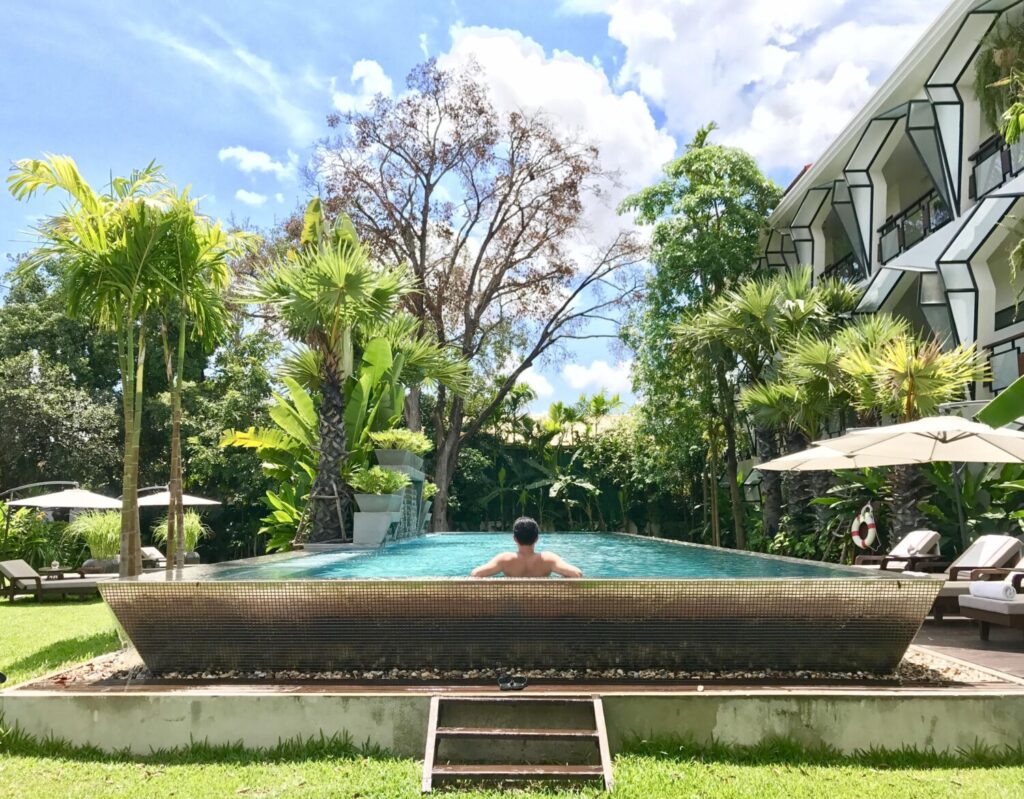
Sustainability can exist in a luxury trip too. In fact, high-end hospitality includes places that invest concretely in their local area. One example is the boutique hotel Shinta Mani Angkor in Siem Reap, Cambodia.
The hotel grew out of a free hospitality school for young Cambodians from disadvantaged backgrounds. Vocational training is still an integral part of the project today. The hotel also links part of its activity to the Shinta Mani Foundation programmes. These cover education, health, clean water and community development.
Another example is Jaya House River Park, also in Siem Reap. This upscale hotel has almost eliminated single-use plastic, using water refill systems and promoting the Refill Not Landfill project. It also employs only Cambodian staff. It supports environmental and community initiatives, including planting native trees and educational projects for local children.
Someone with a large budget does not simply look for the most luxurious hotel or the best-known brand. They can use their spending power to stay in places that add value to the experience and to the place where they are located.
Moreover, a high room price is not necessarily luxury for its own sake. It can reflect the many choices behind that positioning and, above all, what the spending helps to support.
Sustainable tourism standards: why environmental impact does not depend on price
Dividing tourism into categories based only on cost is therefore not very useful. A responsible trip is judged by its choices, not by its final bill. A property can invest in local training, buy from local suppliers, reduce waste and protect natural resources. Another, perhaps cheaper, may have a completely different model.
In hotels of the Hilton chain, for example, I have always found sparkling and chilled drinking water dispensers. In other properties, aimed at guests with smaller budgets, I still found plastic bottles and single-use toiletries. This too shows, in its small way, that price is not enough to judge a property’s impact.
International standards on sustainable tourism consider several areas. These range from environmental impact and resource management to economic and social benefits for communities. The Global Sustainable Tourism Council mentioned earlier, for example, recognises standards applicable to hotels, tour operators and destinations.
Sustainable aviation: how winglets, new aircraft and airlines are reducing their impact
Talking about travel and sustainability, we must also consider the environmental impact of flights, and it would make no sense to hide it. This is even more true of private aviation, one of the most visible expressions of luxury travel. At the same time, I find it reductive to dismiss every industry investment in greater efficiency as mere greenwashing. Aviation too is trying to reduce its impact through more efficient technologies, materials and procedures.
The raised wingtip, called a winglet or sharklet depending on the manufacturer, is now established technology. Airbus cites fuel savings of up to 4% for A320s fitted with sharklets. Boeing credits the new 737 MAX winglets with an efficiency gain of up to 2%. These percentages do not make an aircraft a zero-impact vehicle. But they are concrete improvements that, applied for years and on a large scale, can have a significant effect.
Beyond winglets, there is also the development of new-generation aircraft that consume less, like the Airbus A320neo family. One example is Condor, which is renewing its short- and medium-haul fleet. It is replacing older A320s, A321s and Boeing 757s with new A320neo and A321neo aircraft.
The same applies to seemingly smaller choices: EVA Air has introduced alternatives to plastic and uses metal cutlery even in economy. An airline that changes materials, operating procedures or onboard systems bears costs and faces complex organisational processes. Not everything has to be presented as an ecological revolution. Sometimes it is simply a matter of gradual improvements, which become important precisely because they are applied for years and at scale.
Recognising aviation’s impact does not mean automatically considering the trip that flight makes possible irresponsible. The flight is one part of the journey, not the measure of the whole journey. People will keep travelling, tourist demand will continue to exist, and even an economy trip still generates an impact.
The question we should ask ourselves becomes how to build those trips and what value they generate once at the destination. The destination, length of stay, accommodation, activities, suppliers and the relationship with the local community all belong to the same system. Stopping at the means of transport alone means missing an important part of the discussion.
Small group travel and overtourism: spreading visitor flows and local value
A destination does not experience tourism in the same way when it receives a few hundred visitors or millions of people. Large flows can create economic opportunities, but also pressure on infrastructure, resources and daily life. How visitors are distributed greatly affects their impact.
Avoiding the concentration of tourists and large groups in the busiest destinations can be a responsible choice. Taking small groups to lesser-known areas also spreads spending across different territories. This does not make a small group automatically sustainable. But it can create different conditions from a large group organised along standardised lines.
Not by chance, the trips I organise always involve very small groups, with a maximum of eight participants. This choice is also linked to the exclusivity of the experience. It lets me build itineraries that are hard to offer to large numbers. It also makes experiences with smaller properties and local operators possible.
The experience can include an archaeological guide, a traditional pharmacy visit or a meal with a local family. In this way, the trip does not merely consume a destination. It creates economic relationships with the people who live there every day.
As a result, tourism can become a form of local economic redistribution. Part of the spending can remain in local communities through services, products and activities run directly on the ground. This happens when the supply chain is built with care.
Of course, these choices also have a hidden cost: the time needed to select properties and operators personally. Building a local supply chain with real value takes more than picking a supplier from a catalogue. You need to meet the people you work with and understand how they operate, which is reflected in the final price.
The real value of private aviation: freedom, privacy and the meaning of luxury travel
I come back to luxury, because this is the concept that made me reflect on the episode. If I could afford to fly privately, I would. Not so much for luxury itself, nor necessarily for comfort. Some scheduled airlines’ business class cabins are even more comfortable than private jets.
For me, the real value of private aviation would be the freedom to organise the journey. I could leave when I want, from the nearest airport. I could avoid connections and manage intermediate stops as I need.
Privacy would add to this, and for many people it is a fundamental part of the service. From my professional experience in the sector, a private flight is not the showing off of influencers. It is the convenience of travelling with their own family or colleagues and arriving rested at the destination, whether for a holiday or for work.
I do not find it scandalous that someone values this possibility highly and can afford it. Consequently, I do not think a trip becomes irresponsible just because it is expensive or offers exclusive services. In the same way, a cheap trip does not automatically become responsible. Price tells you how much an experience costs, not how sustainable it is.
To assess a trip, you need to look at its concrete features. Who organises it, which properties it chooses and which operators it involves all matter. So do where it takes travellers and what relationship it creates with the destination. The means of transport is also part of the assessment, but it is not the only element.
Responsible travel without perfection: how to make mindful choices
The sustainability debate easily risks turning into a contest between virtuous travellers, like the usual tourist versus traveller quarrel. Personally, I do not find this approach particularly useful. I fly and work in the tourism industry, and I also deal with private aviation. I believe it is possible to design trips more respectful of destinations and local communities.
I see no necessary contradiction between these things. I can acknowledge aviation’s impact without demonising people who fly. I can appreciate luxury without considering it automatically virtuous. I can also choose an exclusive service when I recognise its value, while still questioning the consequences of my choice.
For me, the most interesting meaning of responsible tourism lies in awareness. It does not mean looking for a perfect trip, because one probably does not exist. It means better understanding the consequences of your choices of destinations, properties, experiences and operators.
We can recognise a trip’s problematic aspects without turning them into a moral issue. We can commit to making it as sustainable as possible. No trip can be completely free of impact, whether luxury or low-cost.
