
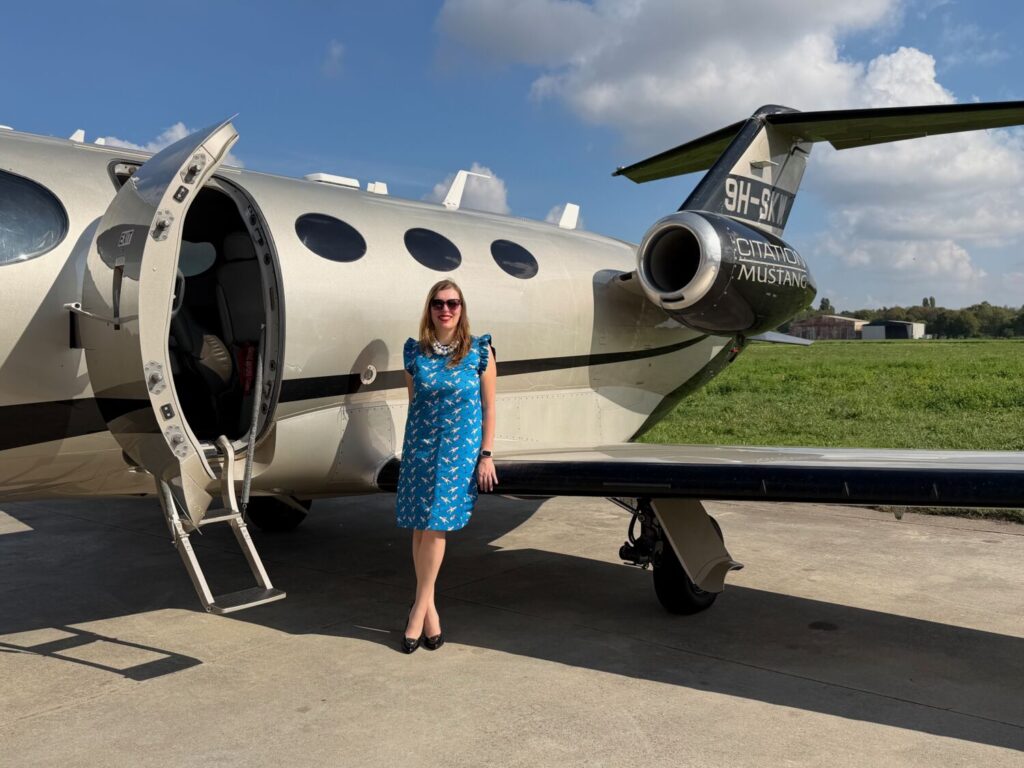
Flying privately is very expensive, but my work at Fly Free Airways gave me the chance to step aboard a Cessna Citation Mustang. It was an incredible experience. In this article, I tell you what it feels like to fly on a private jet. I also explain what makes it one of the most compact private jets on the market.
Table of Contents
Cessna Citation Mustang: Key Technical Features
The Mustang is a very light jet. This means a smaller, lighter aircraft that is simpler to handle and cheaper than traditional jets. It belongs to the Citation 510 series, which Cessna produced from 2006 to 2017. About 480 aircraft were built.
It can fly as high as 41,000 feet, which is very high indeed. Two Pratt & Whitney Canada PW615F engines give it a cruising speed of 630 km/h (about 390 mph). It reaches that altitude in about 27 minutes, which is remarkable for its category.
The maximum range, meaning the distance it can fly, is 2,222 kilometres (about 1,380 miles) on the data sheet. With four passengers on board, however, the real range is lower, because extra weight increases fuel consumption. Pilots calculate range and fuel before every flight. If you love aviation, you know this well.
If those calculations do not interest you, the key point is simple. The Mustang can fly between two European cities, such as Rome and London, without a stop. That is impressive for such a compact jet. Medium and long routes, however, may need a technical stop.
Take-Off Distance and Cockpit
The Mustang needs just 948 metres (about 3,100 feet) of runway for take-off in standard conditions. This is no guarantee, because you must always consider operating conditions and runway characteristics. Even so, you can often use smaller airports closer to your final destination. Some are in city centres, like Milan Bresso in my case.
The cockpit has fully digital avionics, usually based on the Garmin G1000 system. It brings instruments, navigation and weather together on large screens. Seeing it active was thrilling for me.
The system calculates coordinates and flight estimates automatically, with intuitive graphics. At flight school, you learn to do this by hand. You use a ruler, a calculator and a paper aeronautical chart.
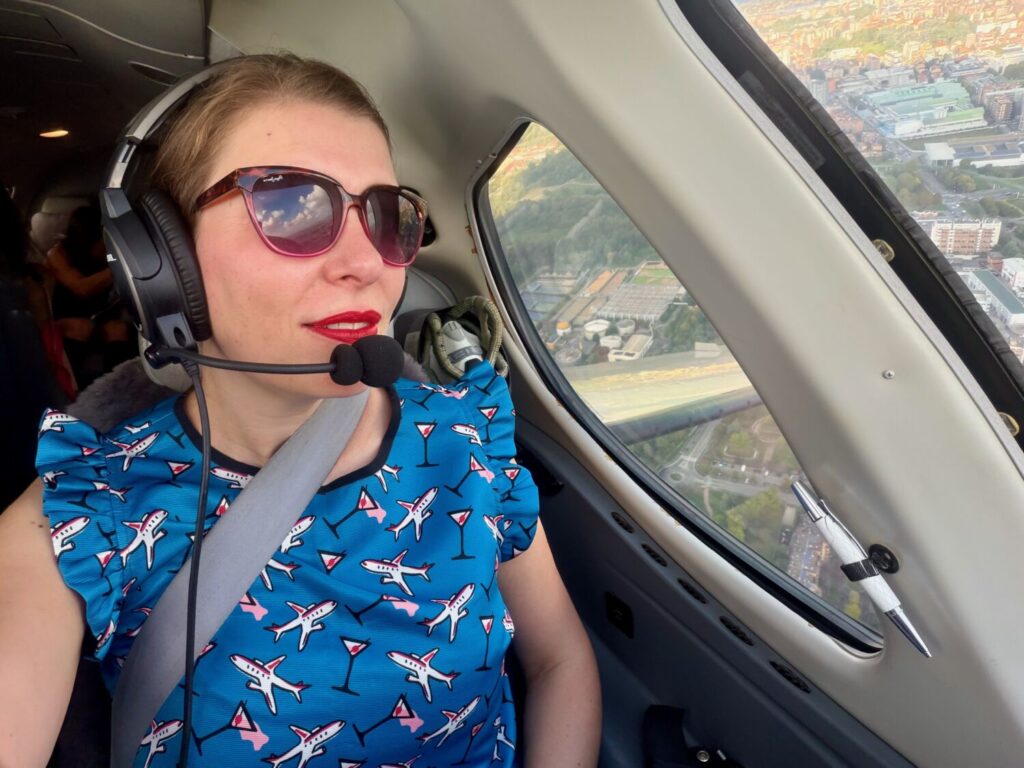
The Mustang is certified for single-pilot operation, which means it can fly with one pilot. Jets usually require two. Mine was a work flight with an operator I already knew, so I could enjoy it from the cockpit.
Clients always travel in the passenger cabin, of course. For me, seeing the flight from this perspective was one of the best perks of my job. I could not touch the controls, though ❤︎
What the Interior of a Cessna Citation Mustang Is Like
If you have never flown privately or work outside the industry, you probably imagine every possible luxury on board. In reality, private jets mainly save time rather than show off wealth. This is especially true of very light jets. Their cabin is fairly small, so you travel in comfort but cannot walk around.
The cabin is 2.97 metres long, 1.40 metres wide and 1.37 metres high. You travel seated and cannot stand up. The leather seats are very comfortable and have fold-out tables, so you can work on a laptop during the flight.
There are three oval windows on each side. Depending on the layout, the cabin seats up to four passengers in club configuration, meaning two pairs of seats facing each other. As with almost every aircraft, you can customise the interior within structural limits.
On the aircraft I flew, there was no fixed central table, as seen in some online photos. There was no lavatory either. In the standard layout, the toilet is often an emergency chemical one behind the cockpit, separated by a curtain. Its presence and type vary with the configuration.
I have never seen a proper separate bathroom on one. This is why very light jets are recommended only for short flights. Their range may be greater, but comfort is limited.
My Experience Flying on a Cessna Citation Mustang
Flying is a true passion of mine, so stepping aboard a Cessna Citation Mustang was thrilling, even as a passenger. One thing nobody imagines about private jets is that they are noisy. The cabin is pressurised and very comfortable. Even so, vibrations and noise are noticeable, so factor this in.
In return, the Mustang felt very stable compared with other small aircraft. I flew on a slightly cloudy day, at around 2,000 feet. I only realised we had passed through clouds from what I saw outside the window. I felt no turbulence at all.
Of course, this is my personal experience on one specific flight. The absence of turbulence depends on weather conditions, and no aircraft can guarantee it. Even so, I found the Mustang truly stable.
Advice from an Aviation Broker: When to Choose the Mustang
A very light jet like the Cessna Citation Mustang is chosen above all for the freedom to leave where and when you want. This is true of all private flights. Thanks to its size, you can depart from a secondary airport or a city centre.
People who choose this aircraft are not looking for a large, luxurious cabin. They want to organise the journey around their own needs. It is therefore used mainly for business trips. Personally, I have proposed it for Milan–Rome, Turin–Bucharest, Milan–London and similar routes.
It also works well for holidays, but the hold fits only about three standard suitcases. You must therefore check the maximum weight allowed for the flight carefully. As always, the choice of aircraft should reflect the client’s needs, not just the number of seats.
How Much It Costs to Fly on a Cessna Citation Mustang
The cost of a private flight is hard to quantify without a defined route and time. The price can vary enormously, even by a few thousand euros, just by changing departure time and airport. The reason is repositioning, which means moving an aircraft instead of using one already parked at your airport. Repositioning has a considerable impact on the final price.
Other variables come into play as well. In general, the cost depends on flight hours, aircraft availability, airports and contract terms. As a guide, we are talking about thousands of euros per flight hour, with differences between operators and seasons. Taxes and extras are added on top.
Some extras cannot be quantified in advance, such as de-icing, meaning the removal of ice from the aircraft in winter. These are always quoted separately. The Mustang is still fairly economical compared with other private flights. In my experience, I have never quoted less than €15,000 for a short-range return flight on a very light jet.
As you can see, the cost per person is not remotely comparable to a first-class airline ticket. If you see bargain offers online for private flights, including empty legs, they are always far from the final price. Moving a jet costs money. People who fly privately do not look at the price, because they choose it for convenience, privacy and saved time.
