Little known among international tourists, the Goldberger Textile Collection in Budapest is a museum well worth visiting, especially if you are fascinated by costume history. Set inside the historic buildings of the factory that the Goldberger family founded in Óbuda in the eighteenth century, it tells two centuries of industry, innovation and nationalisation through textile collections and original machinery. Among garments you can try on and machines from past centuries, you will discover traditional prints and the Hungarian fashion industry.
Table of Contents
What to See at the Goldberger Textile Collection in Budapest: Garments, Prints and Machinery
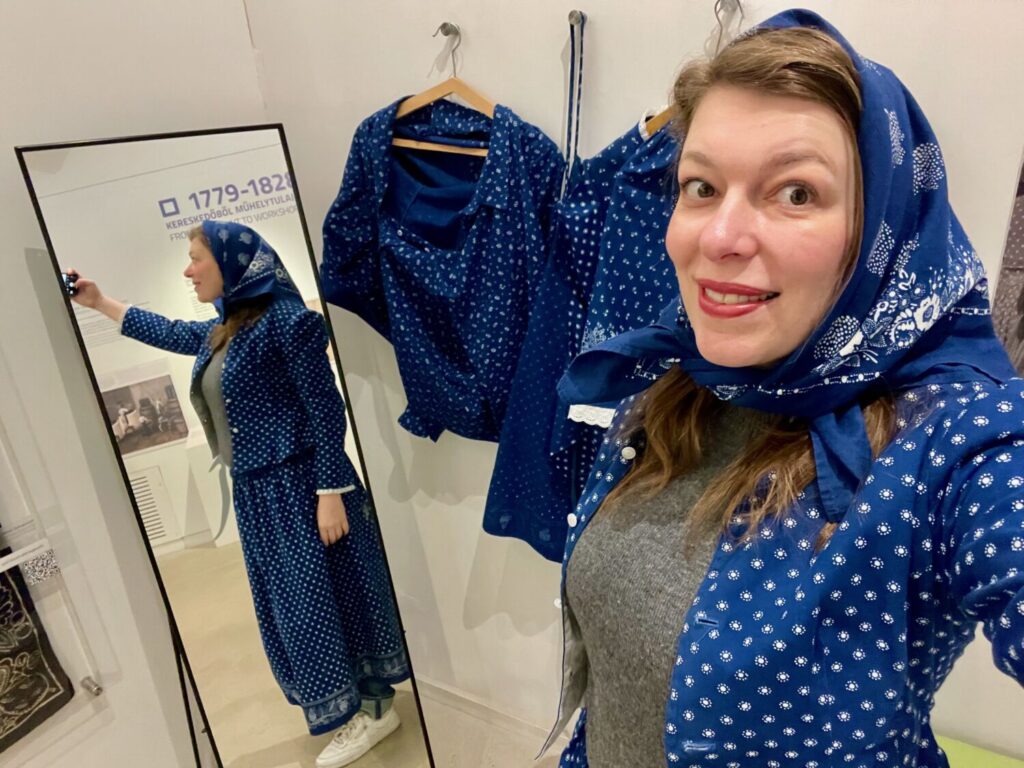
The museum lets you touch almost everything, not just look. You can try on traditional Hungarian garments with their characteristic blue print and handle the fabrics on display. For younger visitors there are interactive stations with materials to touch and experiment with.
The display cases show traditional and modern clothing, telling a story of Hungarian fashion that runs parallel to that of industry, first private and then state-owned. Among the most curious objects are the wooden blocks for decorating the patterns. A video shows the dyeing process for the fabrics. Unfortunately it is only in Hungarian, but the captions are bilingual, in Hungarian and English.
The exhibition opens with indigo dyeing and traditional prints, then moves on to the history of the Goldberger family. Personally, I loved trying on the garments with the typical Hungarian blue print. Some models, despite being more than two centuries old, have a cut that still feels surprisingly modern.
The Goldberger Family and the Textile Factory of Óbuda
The Goldberger factory spans more than two centuries of Hungarian history, from its first artisan dye works to its final closure in 1997. The exhibition retraces it stage by stage, intertwining the story of the family with that of the country.
The Origins in Óbuda: the First Indigo Dye Works
The adventure of Hungary’s most famous textile industry began with the Jewish family that gave it its name. They settled in Óbuda in the first half of the eighteenth century, taking advantage of the incentives for merchants and craftsmen.
In 1784 Ferenc Goldberger set up, in the courtyard of the family home, Óbuda’s first indigo dyeing workshop. The business started with three vats and three printing tables. The raw linen came from Moravia, while a merchant from Pest supplied the indigo.
The family surname comes from the local place name Arany-hegy, meaning golden hill, and the family adopted it in 1787, after a decree by Joseph II required Jewish citizens to take a surname. If you would like to explore the history of the city’s Jewish community, in my article on Jewish Budapest I introduce the most meaningful places to visit.
Nineteenth-Century Expansion: from Workshop to Factory
When Ferenc retired in 1828, his son Sámuel brought new production techniques into the factory and expanded the warehouse, widening the family’s commercial activity as well. In the following decades he was joined by his elder sons, including Fülöp and Zsigmond. The family supported the Hungarian Revolution of 1848, supplying horses and goods to the national cause.
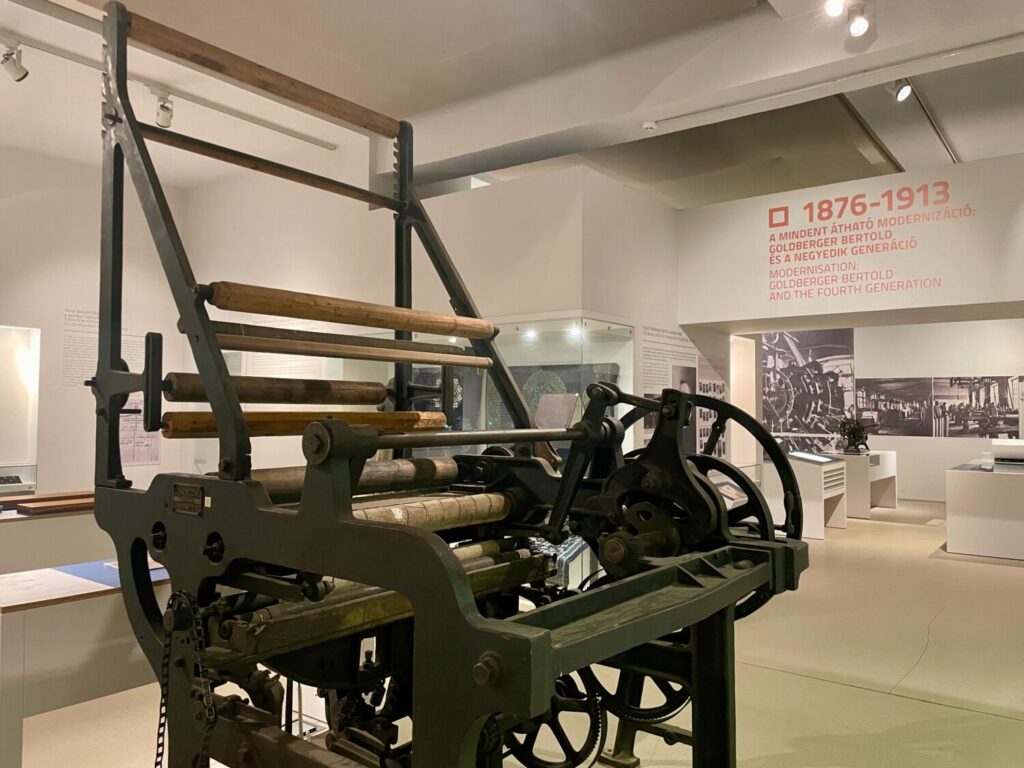
In 1842 the workshop received the title of gyár, meaning factory, a privilege that let it use the imperial eagle. It also exempted the family from military billeting and let them sell throughout the country. The Goldbergers were the first in Hungary to buy a perrotine, the French machine that mechanised printing, in 1845. In 1856 the first steam engine followed, powered by water from the Danube.
The Title of Nobility and the Great Exhibitions
In 1867 Emperor Franz Joseph granted the family a title of nobility. In those same years, under the leadership of Bertold Goldberger, the factory successfully represented Hungary at the great exhibitions of the age. It took part from the First National Exhibition of 1885 to Paris in 1900. Fabrics with motifs inspired by the age of Árpád were particularly admired at the Millennium Exhibition of 1896.
Amid modernisation and growing exports, by the early twentieth century the factory had become the fifth largest in Budapest by number of employees. From 1881 a mutual aid fund provided medical care and benefits to workers. The textile crisis of 1908 nevertheless led to the first organised strikes.
From Vertical Integration to Global Success: Goldberger Fabrics in the Twentieth Century
With Leó Goldberger at the helm from 1913, the family name became known throughout the world. A leading figure in the Hungarian economy between the wars and a member of the Upper House of Parliament from 1932, Leó had already grasped in the 1910s the advantages of a vertically integrated company, less dependent on the raw materials market. The plan was only realised in the 1920s, after the wartime defeat and the Republic of Councils.
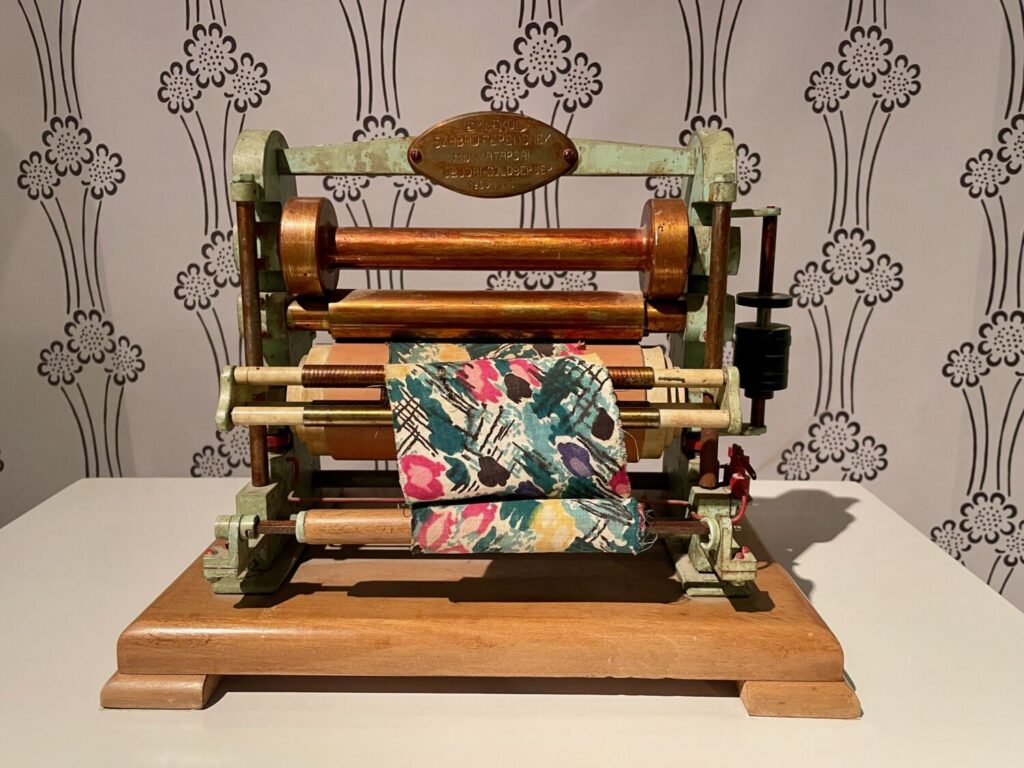
His son Antal ran the new weaving mill, while international experts oversaw spinning and finishing. Exports reached 41 countries, with 57 sales offices and commercial correspondence with 97 nations. A further boost came from rollphoto, a revolutionary photomechanical process that cut the engraving of printing cylinders from weeks to a few hours.
The catalogue thus grew from 650 designs on the market in 1923 to 1,500 designs in 1930, in 18,000 colour variations. To keep pace with European trends, the Goldbergers also founded Hungary’s first textile art department, attended by the factory’s apprentices. It was an investment that strengthened the brand’s international reputation.
Racial Laws, War and Nationalisation: the Decline of the Goldberger Factory
With the Second World War, Hungary’s largest textile factory entered a slow decline. From autumn 1941 the factory’s Jewish employees were called up for compulsory labour service. In March 1944, the day Germany occupied Hungary, Leó Goldberger was arrested. He was deported to Mauthausen, where he died in May 1945.
During the siege of Budapest the plants suffered serious damage, and production resumed in the following years only by processing Soviet cotton on a contract basis. In 1948 the state expropriated the factory, while keeping the Goldberger brand for its international commercial value. The family lost every asset and right connected to the company.
In the 1950s the company was split up and then reunited several times, following the regime’s economic policies, until its final closure in 1997. It is a long and complex story, which the museum presents with great care.
Practical Information for Visiting the Goldberger Textile Collection in Budapest
If you wish to discover two centuries of Hungarian textile industry and see the remarkable prints that shaped the history of fashion, the Goldberger Textile Collection deserves a stop. The museum occupies the original factory buildings in Óbuda, a part of Budapest that tourists rarely visit, and holds authentic collections, workers’ testimonies and historic machinery. The visit takes about an hour and a half, across permanent halls and temporary exhibitions.
Little known and never crowded, the museum lies off the international tourist trail. To be honest, visitors rarely venture beyond the Pest side. Those who make it here are often enthusiasts of textile history or of the painter Vasarely, whose works are displayed in the nearby museum.
Opening Hours of the Goldberger Textile Collection
The museum is open from Tuesday to Sunday, from 10am to 6pm, and closed on Mondays. If you plan to visit during the main Hungarian public holidays, I recommend checking for any changes to the opening hours. You can enter up to one hour before closing. I advise not arriving late, as in my experience Hungarians are generally not very flexible about this.
Tickets for the Textile Collection: Prices, Free Entry and Discounts
A full-price ticket for the Goldberger Textile Collection costs 2,000 HUF, equivalent to €5.00. The reduced ticket, for students aged 6 to 26 and pensioners aged 62 to 70, costs 1,000 HUF, approximately €2.50. If you visit as a family, you can buy a family ticket for four or five people at 3,500 HUF, around €9.00.
Entry is free with the Budapest Card, for children under six and for those over 70. Everyone also enters free on the first Saturday of each month and on the national holidays of 15 March, 20 August and 23 October. You can buy your tickets at the ticket office on the day of your visit, as the museums in Óbuda are never very crowded. Alternatively, you can buy tickets online through Jegymester, a sort of Hungarian GetYourGuide.
How to Get to the Goldberger Textile Collection in Óbuda
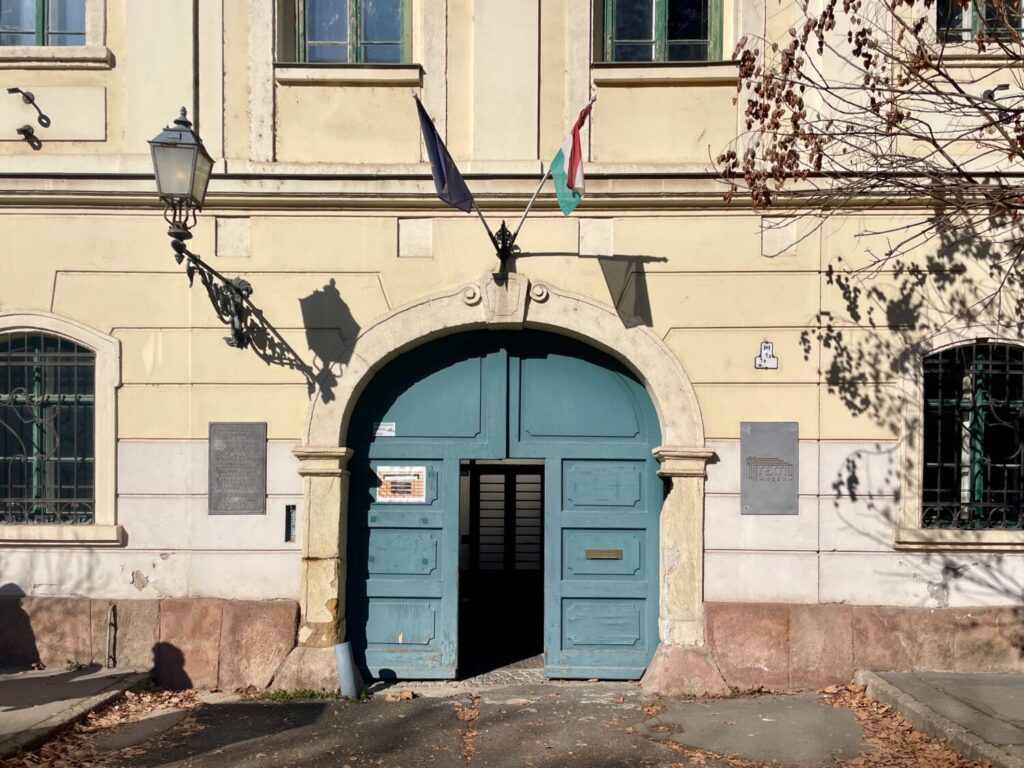
The museum is housed in the historic buildings of the Goldberger factory, in the Óbuda district, and can be reached from central Pest by tram 1 or 1A or by buses 34 and 106. I recommend checking Google Maps for the most convenient route from your location. The entrance is poorly signposted and looks like the door of a private home. If in doubt, my advice is to step through the doorway and ask. Hungarians are usually very kind when you ask for information, probably because they see very few international tourists in this area.
Goldberger Textilipari Gyűjtemény
Lajos utca 136-138, 1036 Budapest
My Experience at the Goldberger Textile Collection: Why You Should Visit
Although I am passionate about traditional art and crafts, particularly Matyó and Kalocsa Hungarian embroidery, I only discovered the Goldberger Textile Collection thanks to the Budapest Card. Despite being truly one of a kind, it is very little known.
I enjoyed the Goldberger Textile Collection far more than I expected. Learning about the Goldberger family, visiting the museum and exploring the textile side were truly fascinating. The classic Hungarian prints on indigo fabric were a particular discovery, because I only knew the embroidery, not the prints. Imagine my delight when, a few months later, I found a textile printing workshop with indigo dyeing at the Skanzen in Szentendre.
I recommend a visit to the Goldberger Textile Collection first and foremost to all fashion history enthusiasts, but also to anyone who loves Hungarian crafts, because the traditional prints are truly captivating. It also suits those who enjoy industrial museums that tell the story of a country through its production. I don’t want to give away too much, but I really did not expect Hungary’s international importance as a producer of printed fabrics.
In conclusion, the Goldberger Textile Collection is a stop off the beaten track, which shows Budapest and Hungarian industrial history from an unusual angle. A little-known museum well worth seeing, especially if you are fascinated by costume history and industrial production.
