
Ho Chi Minh City is Vietnam’s economic capital. When I first visited, it already felt like a city in constant motion, but returning here made that impression even stronger. The skyline keeps changing, with new buildings making the city’s rapid expansion visible. French colonial architecture, lively markets and contemporary cafés exist side by side, creating a layered and evolving city. You will no longer see the traces of the Vietnam War in everyday life, and you need to seek them out deliberately. In this guide, I share what to see in Saigon and how to plan your visit.
PLAN YOUR TRIP TO VIETNAM – 5% discount on your eSIM and travel insurance
For getting around Vietnam with ease, choose a Holafly eSIM: you get unlimited internet, perfect for using Google Maps, Grab or other navigation apps, booking transport on the go, and sharing photos and videos in real time on WhatsApp without worrying about local SIM cards or extra charges.
For extra peace of mind, pair connectivity with Heymondo travel insurance, which covers you in case of medical emergencies, delays or cancellations. A practical solution that lets you focus on exploring Vietnam, rather than dealing with unexpected setbacks.
Table of Contents
Ho Chi Minh City (Saigon): What to Know Before Visiting
Saigon, the city’s historical and colonial name, developed as one of the main administrative centres of French Indochina. The city officially changed its name to Ho Chi Minh City at the end of the Vietnam War in 1975, although people still use both names interchangeably today.
Compared to Hanoi, Ho Chi Minh City feels more dynamic and less institutional. The atmosphere is that of a true metropolis, constantly evolving, where everything seems to move between traffic, shops and daily activities.
The climate is hot and humid for most of the year, so it is best to plan outdoor visits early in the morning or later in the afternoon. During the hottest hours, visiting air-conditioned museums is a good alternative. The city is generally safe to explore independently, even at night, as long as you take normal precautions with your belongings in crowded tourist areas.
Despite being a large and modern city, cash is still widely used in Ho Chi Minh City, as in the rest of Vietnam. This applies to cafés, meals, markets and souvenir shops, with only a few exceptions in hotels and larger establishments.
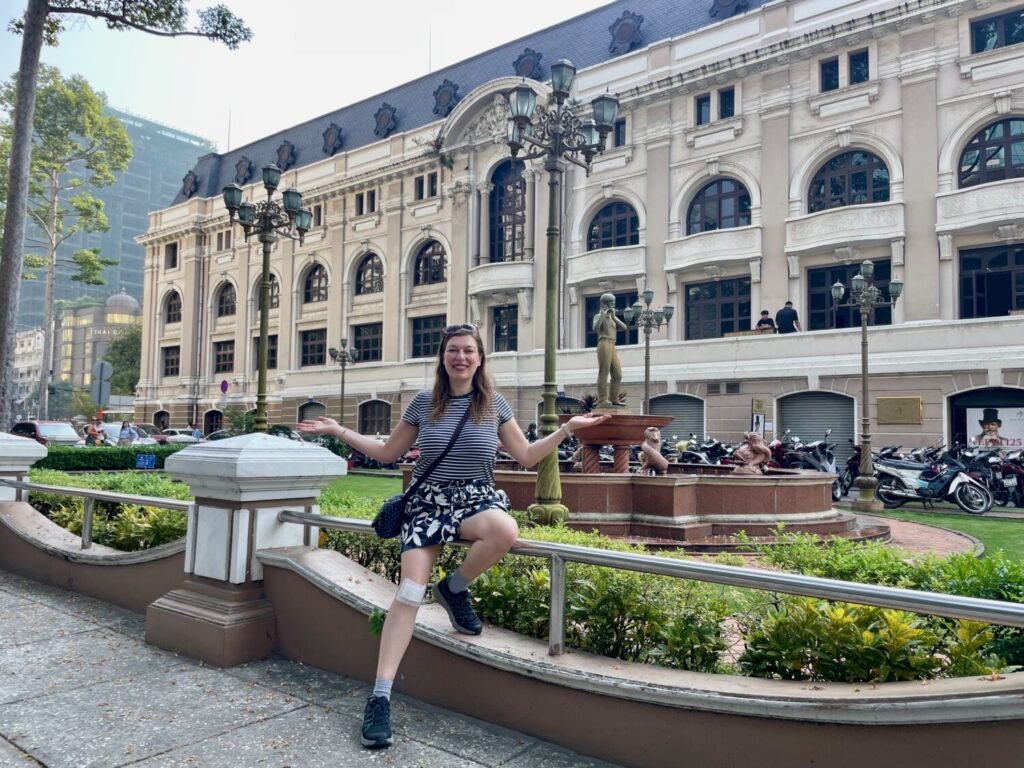
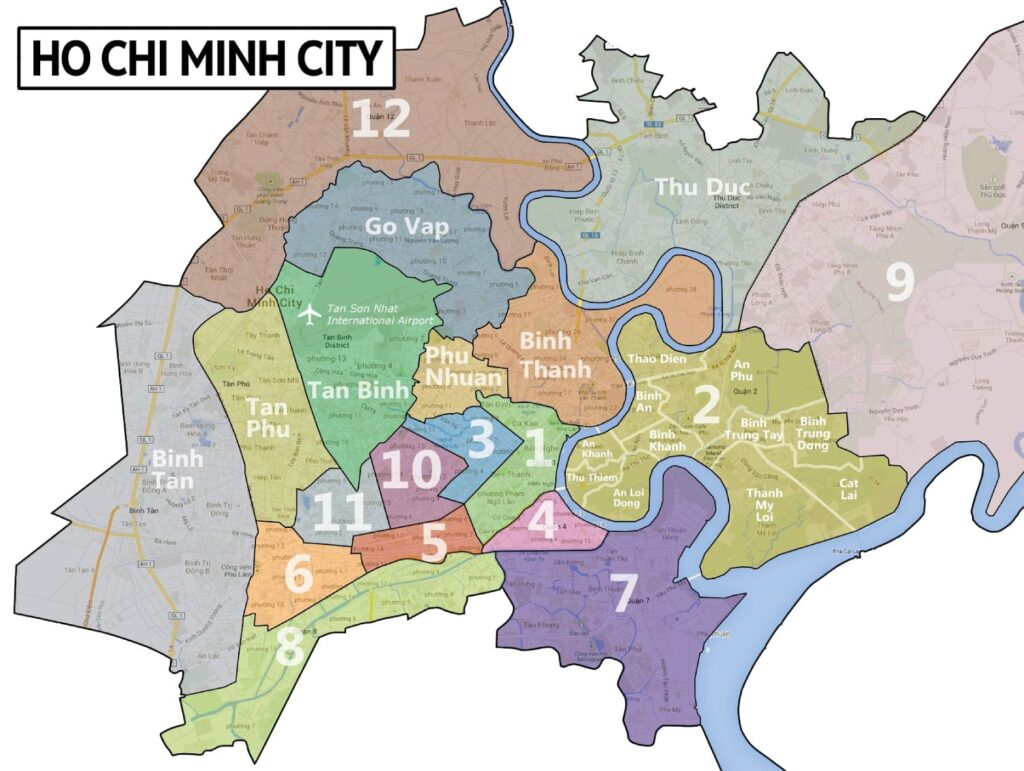
Ho Chi Minh City Districts: A Guide to the Main Areas
Ho Chi Minh City is almost as large as a small province. In 2025, the city was reorganised into 168 administrative units called wards. Saigon roughly corresponds to the central area of the former District 1. However, most guidebooks still refer to the previous system of urban districts, known as quan, which I will also use for convenience.
Most of the main attractions are located in District 1. District 3 features tree-lined streets and neoclassical buildings, with cafés and restaurants that create a more local atmosphere. District 5, known as Cholon, meaning “Great Market”, is the city’s Chinatown, where pagodas and restaurants reflect a mix of Chinese and Vietnamese influences.
Finding your way around Ho Chi Minh City can be less straightforward than it seems. People use the names Saigon and Ho Chi Minh City interchangeably, and street names have changed several times over the years.
After the end of French colonial rule in 1954, many streets lost their original names. Rue Catinat became Tu Do (“Freedom”) and later Dong Khoi (“Uprising”), although some people still use the colonial name. In 1956, the South Vietnamese government introduced further changes to remove references to the Viet Minh.
Even today, it is common to find different names for the same place, including museums. For this reason, I include direct Google Maps links for each attraction in this article, and I recommend always double-checking directions with locals or your hotel if needed.
What to See in Ho Chi Minh City in One Day
One day is enough to get a first impression of Ho Chi Minh City, especially if you focus on District 1. I had already visited the city years ago and seen many of its main sights, but I really appreciated returning with a guided tour. In my experience, a guided visit is the best way to understand what you are seeing and find your bearings.
Our guide from Travel Sense Asia managed to explain a great deal in a short time, optimising the route to include more places without wasting time, including the War Remnants Museum. Choosing a guided tour also allowed me to see more unexpected locations, such as the school featured in The Lover, L’Amant in French, by Marguerite Duras.
If you have limited time, I recommend an itinerary that includes some of the most representative landmarks in Saigon, starting with the Independence Palace, one of the key sites linked to the end of the Vietnam War, with tanks still visible at the entrance. Nearby, you can visit Notre-Dame Cathedral, which is currently under restoration, and the Central Post Office, often associated with Gustave Eiffel, although his studio most likely designed it. Just next to it, you will find the so-called Book Street, lined with bookshops.
You can continue through the city centre, passing the City Hall, the Saigon Opera House and historic hotels such as the Continental and the Caravelle, where foreign correspondents stayed during the war. Among the more unusual places to visit within walking distance is the building at 22 Ly Tu Trong Street, where photographers took one of the most iconic images of the fall of Saigon. A short distance away, the Café Apartment brings together dozens of cafés inside a single building.
Best Things to See in Ho Chi Minh City: Colonial and Modern Landmarks
The historic centre of Ho Chi Minh City still preserves clear traces of its French colonial past. Walking through District 1, you will find yourself surrounded by administrative buildings, historic hotels and tree-lined boulevards that may feel unexpected in a Southeast Asian city. In just a few streets, different eras overlap, from colonial architecture to sites connected to the Vietnam War.
These contrasts reveal a city shaped by layered histories and rapid transformation, where old and new coexist side by side. Exploring this area offers a deeper understanding of how Ho Chi Minh City has evolved over time, blending heritage and modern development within the same urban landscape.
Colonial Architecture in Ho Chi Minh City: City Hall, Opera House and Central Post Office
Among the most recognisable buildings in Saigon is the City Hall, built in French colonial style with an ornate façade. Although you cannot visit the interior, it is worth stopping to admire the building from the outside. On Google Maps, you will find it listed as the People’s Committee of Ho Chi Minh City.
A short distance away stands the Saigon Opera House, built in an eclectic European-inspired style. It hosts the city’s ballet company and symphony orchestra. During my visits, I did not find tours of the interior, but as it is still in use, you can attend a performance by purchasing a ticket.
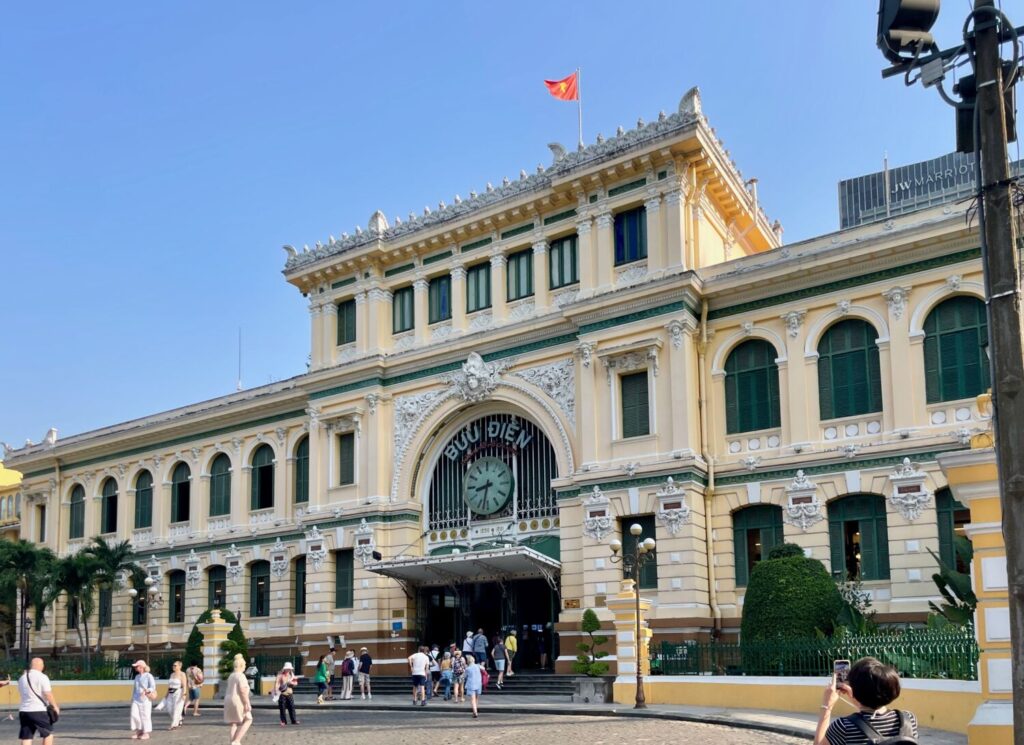
The Saigon Central Post Office is one of the most iconic buildings from the colonial period. It is often associated with Gustave Eiffel, although it was most likely designed by his studio rather than by him directly. Inside, you will find a functioning post office where you can send postcards and buy stamps, even though most people now visit it as a tourist attraction.
Google Maps links:
- City Hall – shown on Google Maps as People’s Committee of Ho Chi Minh City
- Saigon Opera House
- Saigon Central Post Office
Vietnam War Sites in Ho Chi Minh City
Alongside colonial buildings, the historic centre also includes places linked to the Vietnam War. The Hotel Continental, built in 1880 by a French entrepreneur, hosted foreign correspondents during the conflict. International publications such as Newsweek and Time also had offices here.
A short distance away, the Caravelle Saigon, opened in 1959, was one of the most modern and luxurious hotels in the city. Journalists and diplomats gathered here, often on the rooftop terrace, to exchange information about the war. The hotel is also known for the August 1964 bombing, when an explosion damaged room 514 on a floor mainly occupied by foreign correspondents, who were not present at the time.
If you are interested in the history of early war reporting, you can still stay in both hotels, which have been fully renovated.
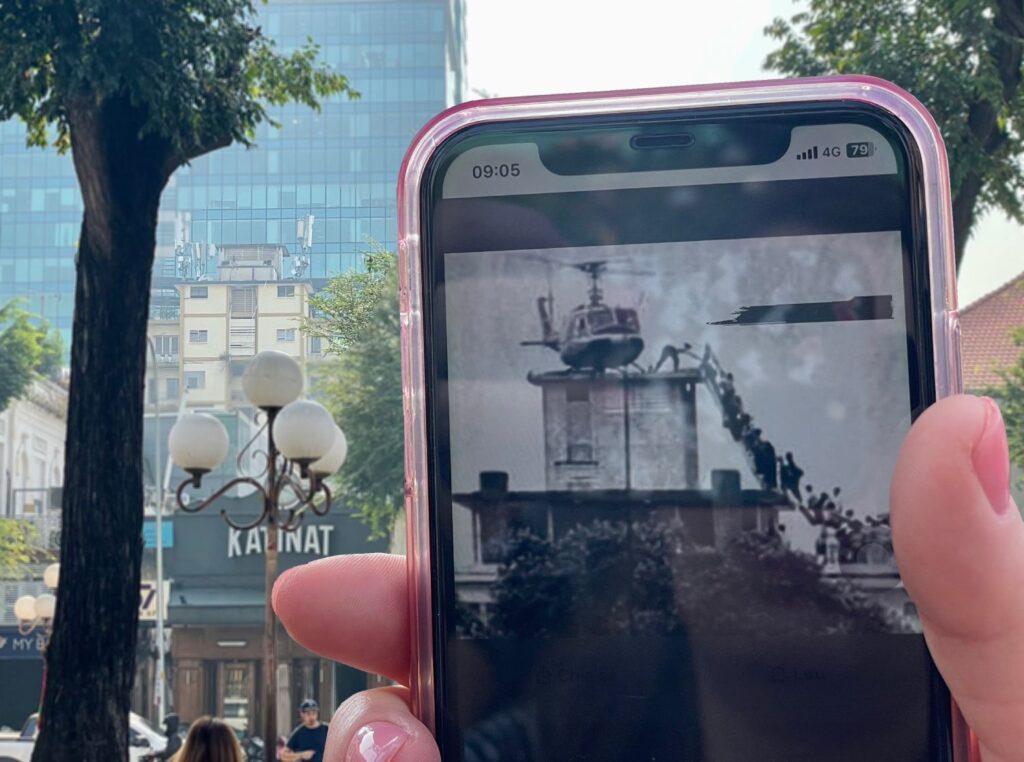
The building that impressed me the most, however, is the one at 22 Ly Tu Trong Street, a simple structure now surrounded by modern skyscrapers. This is where one of the most iconic photographs of the 20th century was taken, symbolising the fall of Saigon in 1975. The image shows a helicopter on the rooftop of a CIA building, with a long line of people waiting to be evacuated.
Google Maps / Booking links:
The Café Apartment and Modern Ho Chi Minh City
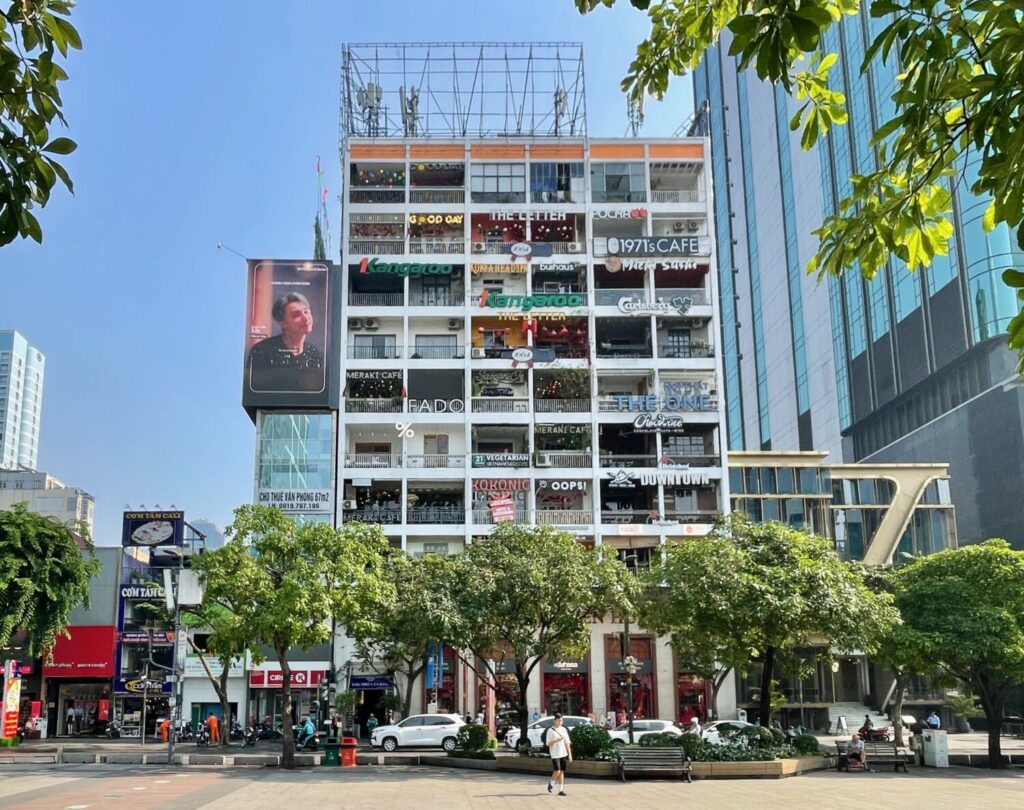
A symbol of modern Ho Chi Minh City is the Café Apartment, one of the most recognisable and photographed places in the city. It overlooks Nguyen Hue Walking Street and is a concrete building dating back to the mid-20th century. For years, it faced the risk of demolition, but today it stands completely transformed. Each balcony hosts a different café, with colourful signs visible from the outside.
Fahasa, one of the city’s main bookstore chains, occupies the ground floor, while a wide variety of venues fill the upper floors. You can easily spend a few hours here, moving from floor to floor and exploring different cafés, restaurants and cocktail bars before choosing where to stop. This is also a way to experience how much the city has changed in recent years, in a space that reflects its contemporary identity.
Not far from the Central Post Office, you will also find Saigon Book Street, a small pedestrian street dedicated to books. Here, bookshops, local publishers and cafés create a quieter and more relaxed atmosphere, offering a break from the traffic and pace of Saigon.
Google Maps links:
Places of Worship in Ho Chi Minh City
In Vietnam, people often practise religion in a daily and personal way, praying to ancestors or local deities at small altars in their homes rather than through visible institutional practices. Despite this, Saigon is home to several places of worship, often hidden among traffic and modern buildings.
Some, such as Notre-Dame Cathedral, reflect a past that no longer exists. Others remain active spaces, where rituals and traditions are still part of everyday life. Temples and pagodas also tell stories of migration and help shape the identity of different neighbourhoods, particularly in areas like Cholon.
Notre-Dame Cathedral Basilica of Saigon
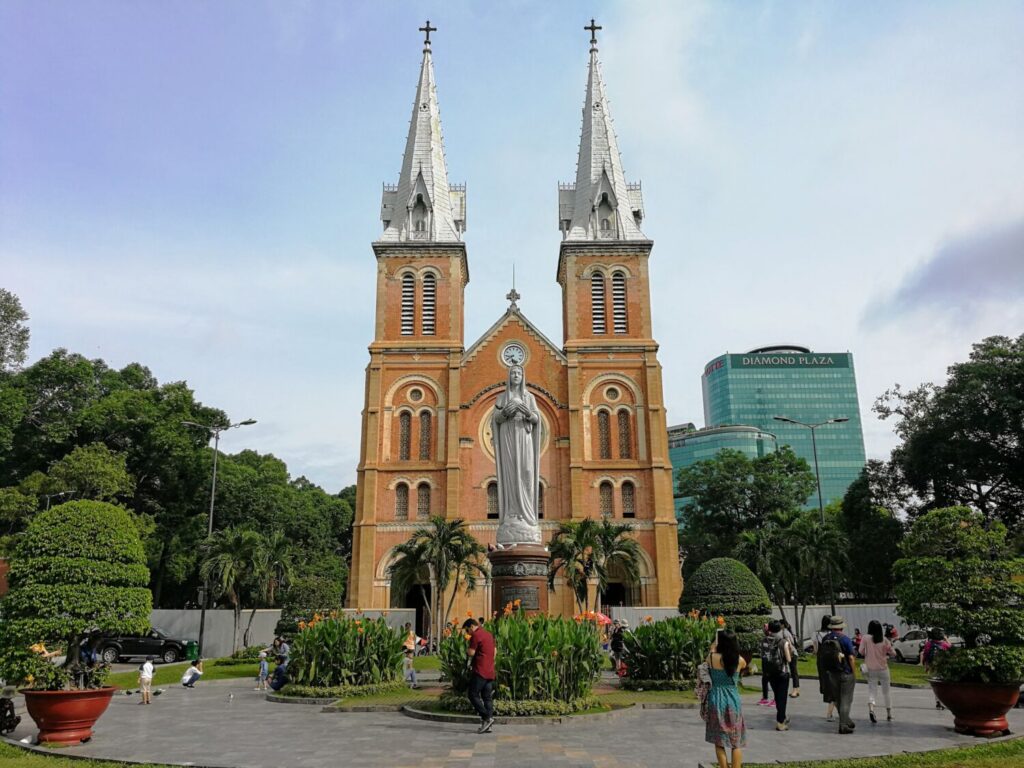
Built between 1877 and 1883 in a neo-Romanesque style, Notre-Dame Cathedral Basilica of Saigon reflects its European influence and colonial past in the centre of the city. Two tall square towers topped with iron spires define the structure, while a statue of the Virgin Mary stands in the square in front. The building survived both the Second World War and the Vietnam War, although it lost its original stained glass windows.
Today, the cathedral is once again under restoration, so you may find it covered in scaffolding. At the time of writing, the completion date remains uncertain, with works taking longer than expected. The photo shown here was taken before the restoration, when the building was fully visible. The Cathedral Basilica of Our Lady of the Immaculate Conception still hosts Catholic services and continues to attract both local worshippers and international visitors.
Google Maps link:
Main Temples and Pagodas in Ho Chi Minh City
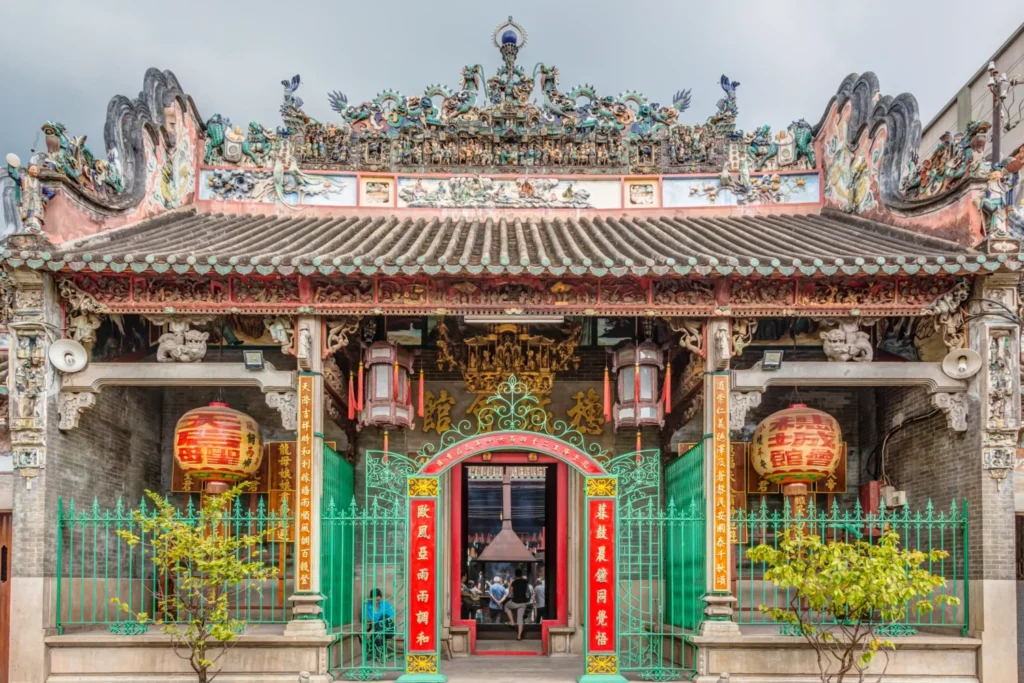
In District 1, where many of the main attractions are located, you can visit the Jade Emperor Pagoda. It is one of the most atmospheric temples in the city, filled with symbolic details and incense-filled interiors. Most pagodas, however, are located in Cholon, the city’s Chinatown, where architecture and decorations reflect strong Chinese cultural influences.
Among the most significant is Thien Hau Pagoda, dedicated to the sea goddess and considered one of the most important temples in the area. Phuoc An Hoi Quan stands out for its elaborate decorations and authentic atmosphere, while Quan Am Pagoda, dedicated to the goddess of mercy, is one of the most frequented by worshippers. Less visited but equally interesting is Tam Son Hoi Quan Pagoda, known for its richly symbolic interiors.
Each pagoda has its own distinctive character, both in its architecture and its symbolism. Visiting Cholon with a local guide can help you understand meanings that are not immediately clear, especially within this richly layered spiritual and cultural context. Even without a guide, simply walking through Chinatown and experiencing the atmosphere, with its incense-filled interiors and quiet rituals, offers a memorable insight into this side of the city.
Google Maps links:
- Jade Emperor Pagoda
- Thien Hau Pagoda
- Phuoc An Hoi Quan Pagoda
- Quan Am Pagoda
- Tam Son Hoi Quan Pagoda
Saigon Central Mosque (Jamia Al-Musulman Mosque)
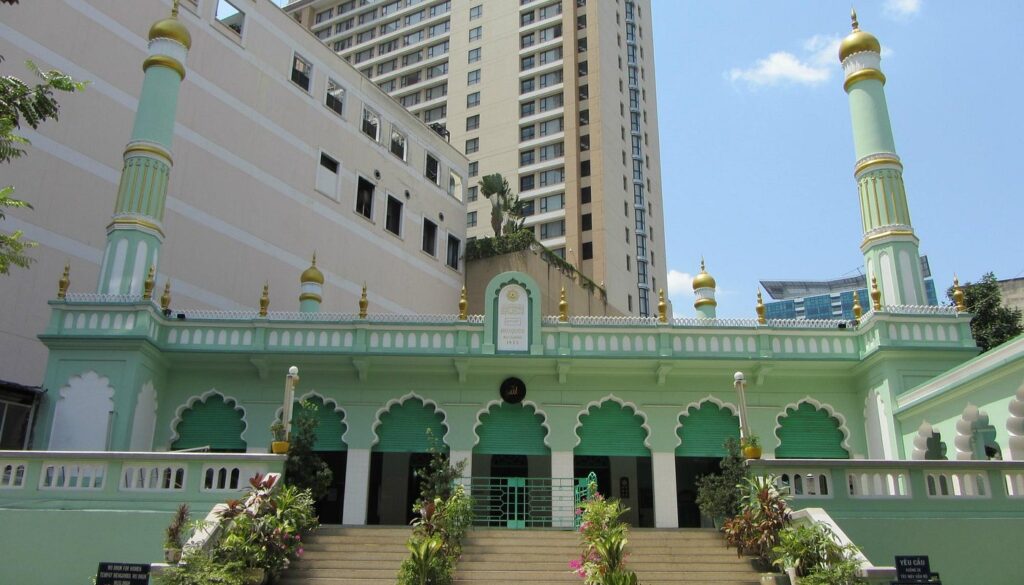
Although Islam is the second largest religion in the world, it has a limited presence in Vietnam. In Ho Chi Minh City, there are just over a dozen mosques, including the Saigon Central Mosque (Jamia Al-Musulman Mosque), the largest in the city.
Indian expatriates built the mosque in 1935, and its location near 22 Ly Tu Trong Street makes it easy to include in your itinerary.
The structure features four minarets, which are no longer in use, and a courtyard with a basin for ritual ablutions before prayer. Inside, the atmosphere is very different from temples and pagodas. The decoration is simple and restrained, in line with Islamic tradition, which avoids representations of human or animal figures.
Google Maps link:
Mariamman Hindu Temple in Ho Chi Minh City
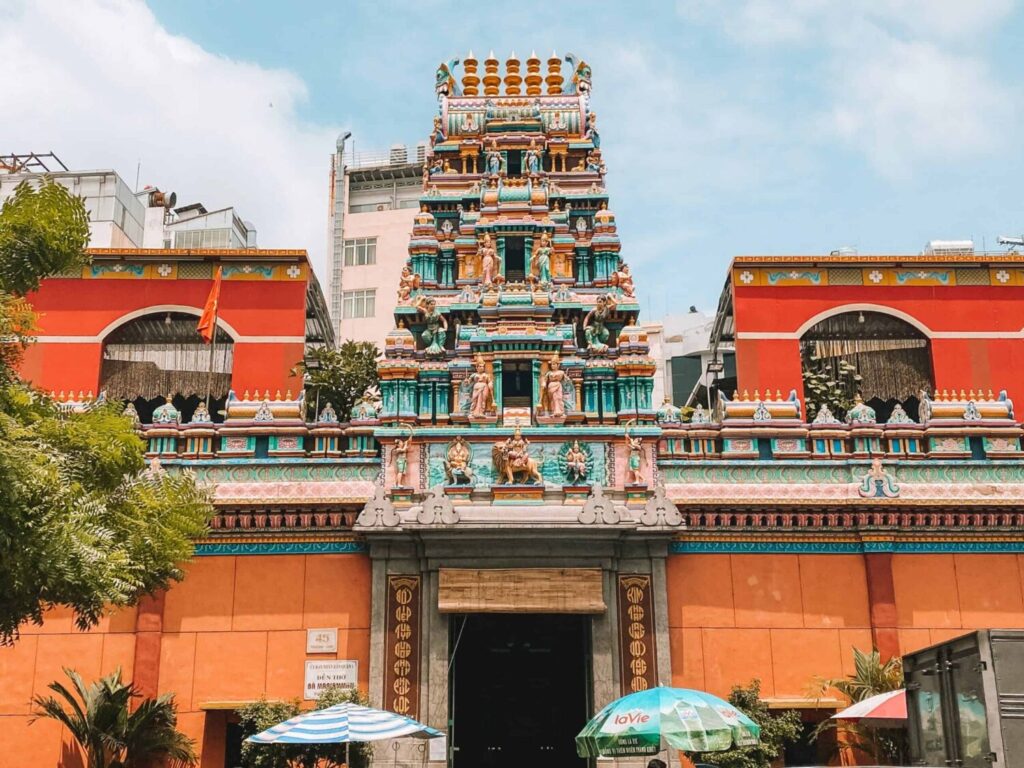
The Mariamman Hindu Temple, built in the late 19th century by a community of Indian merchants from Tamil Nadu, is the only active Hindu temple in Ho Chi Minh City. After reunification, the government confiscated the building and repurposed it as both an incense factory and a seafood export facility, where workers dried fish on the rooftop.
Today, it has returned to its original function as a place of worship. Although the Hindu community in the city is small, Vietnamese and Chinese visitors also frequent the temple, associating it with protective powers and leaving offerings of incense and flowers.
Rich decorations of deities and animals cover the exterior, while inside you will find statues of the goddess Mariamman, along with other accompanying deities. The contrast with nearby pagodas highlights a different religious and cultural influence within the city.
The temple is located close to Ben Thanh Market, making it easy to include in your itinerary while exploring the area.
Google Maps link:
Best Museums in Ho Chi Minh City
Museums in Ho Chi Minh City offer a direct insight into Vietnam’s history, from the colonial period to the war and its contemporary transformation. Among the most significant is the War Remnants Museum, which presents a powerful and strongly one-sided perspective on the conflict.
The Independence Palace, also known as the Reunification Palace, allows you to step inside one of the most symbolic sites in the country’s political history. The Museum of Ho Chi Minh City provides a broader overview of the city’s development over time. Visiting at least one museum offers a deeper understanding of Vietnam’s history and cultural context.
War Remnants Museum
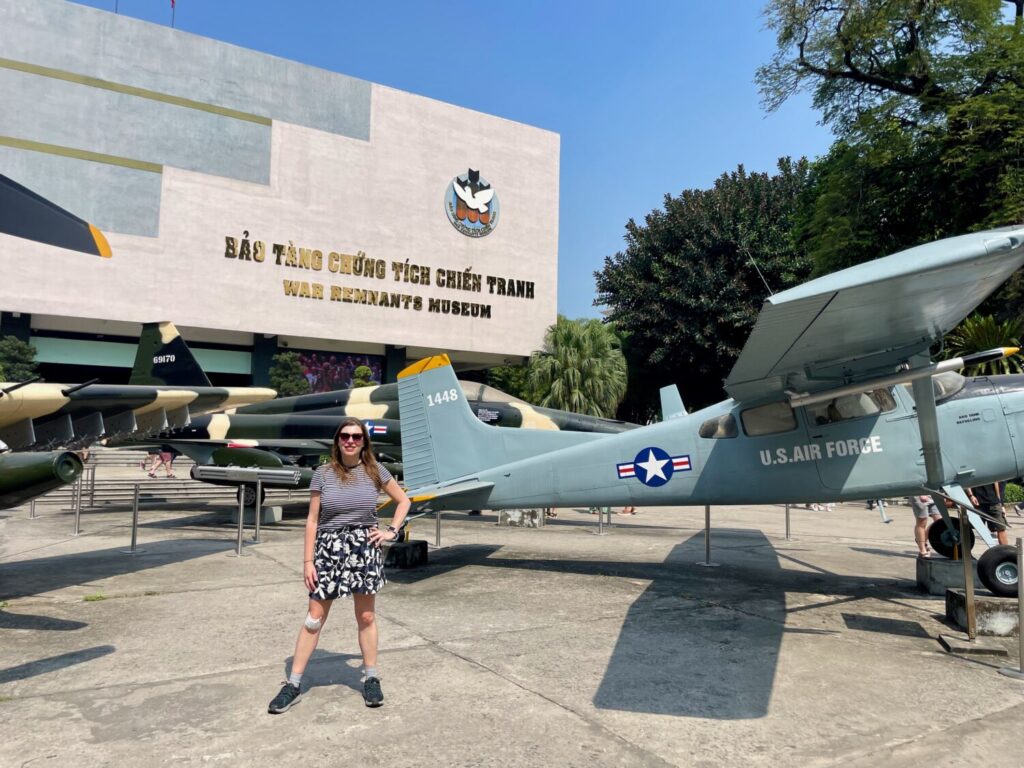
The War Remnants Museum is one of the most intense places to visit in Ho Chi Minh City. Through photographs, documents and military equipment, it presents the Vietnam War from a Vietnamese perspective, with a direct and highly emotional approach.
Many of the images are difficult to look at, but they help convey the real impact of the conflict on the civilian population. The visit requires time and attention, also because of the emotional weight involved. Overall, it offers a powerful and confronting perspective on the war. For a more detailed overview of the exhibits, read my article on the War Remnants Museum.
War Remnants Museum – Bao Tang Chung Tich Chien Tranh
Phuong 6, District 3, Ho Chi Minh 700000, Vietnam
Independence Palace (Reunification Palace)
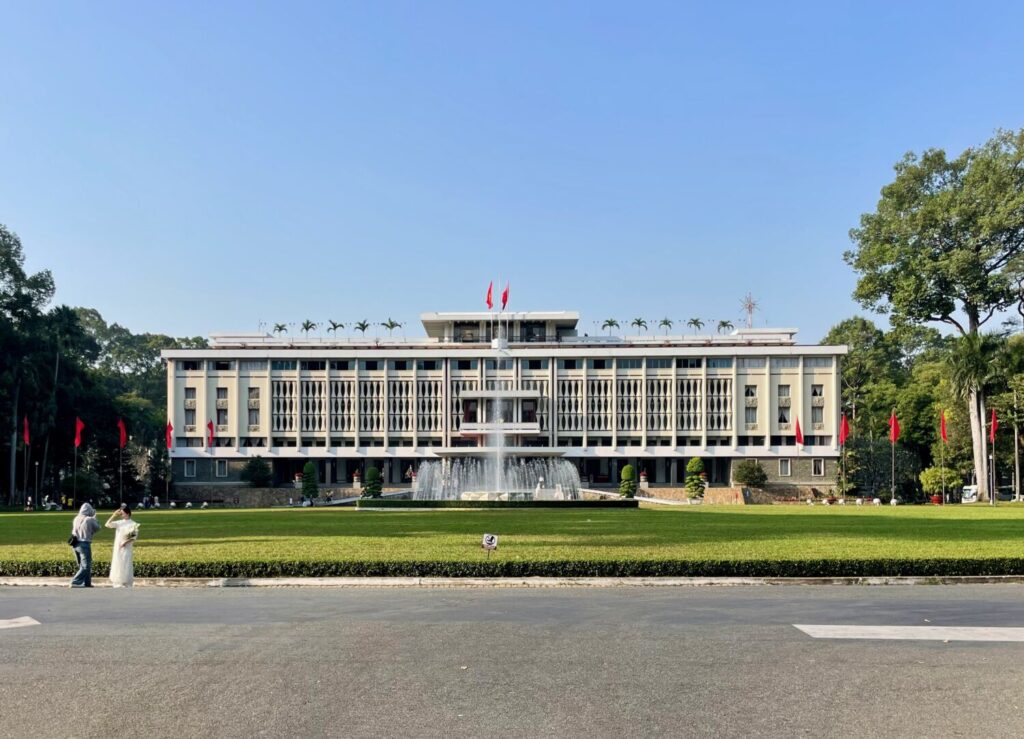
The Independence Palace, also known as the Reunification Palace, marks one of the most iconic moments of the Vietnam War. On 30 April 1975, a North Vietnamese T-54 tank broke through its main gates, marking the fall of Saigon and the end of the conflict. This event signalled the beginning of the country’s reunification and turned the palace into a highly symbolic site in Vietnamese history.
From an architectural perspective, the building combines modern Western elements with traditional Eastern influences. The fountain, for example, is designed as a reflective surface believed to deflect negative energy, while the façade evokes the shape of bamboo and helps regulate the internal temperature.
Inside, you can visit the presidential offices, private apartments and large ceremonial rooms, many of which remain largely unchanged. The underground bunker is the most interesting part, designed to withstand bombings and chemical attacks. It still preserves the command centre and operational rooms used by the South Vietnamese government during the war, offering a direct insight into the political and military context of the period.
Independence Palace – Dinh Doc Lap
Ben Thanh, Ho Chi Minh, Vietnam
Museum of Ho Chi Minh City
The Museum of Ho Chi Minh City is housed in a neoclassical building dating back to 1886, once known as the Gia Long Palace and later used as a Revolutionary Museum. The exhibition traces the city’s history from its early development to the present day, with sections on archaeology, the growth of the commercial port and the administrative organisation of Saigon.
The galleries dedicated to modern history present a deliberately partial perspective, similar to that of the War Remnants Museum. Among the most striking images is the photograph of the monk Thich Quang Duc, who set himself on fire in protest against the policies of President Ngo Dinh Diem. You can see his car at the Thien Mu Pagoda in Hue.
Captions are mostly in Vietnamese, with some documents in French and English. Even so, a basic understanding of history is enough to recognise the importance of the founding of the Communist Party in the Vietnamese revolution.
Beneath the building lies a network of reinforced concrete bunkers and fortified passages connected to the Independence Palace, where President Diem and his brother took refuge in 1963. The tunnels are not open to visitors, partly due to flooding, but in the rear garden you can see a Soviet tank, a Huey UH-1 helicopter and an anti-aircraft machine gun.
Museum of Ho Chi Minh City – Bao Tang Thanh Pho Ho Chi Minh
65 Ly Tu Trong, Sai Gon, Ho Chi Minh, Vietnam
Ho Chi Minh City Fine Arts Museum
Despite its outdated website, which lacks an English version, the Ho Chi Minh City Fine Arts Museum houses one of the most interesting art collections in Vietnam. The exhibits range from lacquered and enamelled objects to paintings by both Vietnamese and international artists. The building itself is remarkable, and the collection is equally worth exploring.
The third floor features the ancient art collection, including sculptures dating back to the 4th century, depicting Vishnu, the Buddha and other deities, alongside artefacts from the Khmer civilisation of Angkor in Cambodia.
If you are interested in more recent history, you can also see works influenced by socialist realism, including officially approved art and propaganda. These often portray heroic figures, red flags and scenes reflecting the political narrative of the period, offering a visual insight into Vietnam’s modern cultural identity.
Ho Chi Minh City Fine Arts Museum – Bao Tang My Thuat Thanh Pho Ho Chi Minh
97 Pho Duc Chinh, Ben Thanh, Ho Chi Minh, Vietnam
Ho Chi Minh City History Museum
The HCMC History Museum is worth visiting for the building alone, a Sino-French style structure built in 1929 by the Société des Études Indochinoises. Just in front of the entrance, you will find the Temple of the Hung Kings, considered the first rulers of Vietnam.
Inside, the collection traces the history of Vietnam from prehistoric times to the Nguyen dynasty, alongside displays on southern Vietnamese cultures and other Asian civilisations. Many of the artefacts on display also come from Angkor Wat in Cambodia, offering a broader regional perspective.
Overall, the museum provides a historical overview that goes beyond the city itself, helping to place Ho Chi Minh City within a wider cultural and historical context.
HCMC History Museum – Bao Tang Lich Su
2 Nguyen Binh Khiem, Ben Nghe, Sai Gòn, Ho Chi Minh, Vietnam
Ho Chi Minh Campaign Museum
Another museum that may interest you, especially if you are interested in history, is the Ho Chi Minh Campaign Museum, dedicated to the military campaign that led to the capture of southern Vietnam. The museum does not have an official website, and its indoor collection remains relatively limited, consisting mainly of panels and photographs with captions in Vietnamese.
The outdoor area is more engaging, with a display of military vehicles from American, Chinese and Soviet forces. Among the aircraft on display are a Cessna A-37 used by the South Vietnamese Air Force and a US-built F-5E Tiger. The tank exhibited here is one of those that broke through the gates of the Independence Palace on 30 April 1975.
Overall, the museum offers a more visual than interpretative experience, with its main interest focused on the outdoor exhibits rather than the indoor displays.
Ho Chi Minh Campaign Museum – Bao Tang Chien Dich Ho Chi Minh
So 2 Le Duan, Ben Nghe, Sai Gon, Ho Chi Minh, Vietnam
Ho Chi Minh Campaign Museum on Google Maps
Best Day Trips from Ho Chi Minh City
Around Ho Chi Minh City, you can plan a variety of day trips or longer excursions, depending on how much time you have. The surrounding region offers a mix of historical sites, natural landscapes and cultural experiences, providing a different perspective compared to the city itself.
Some of the main destinations include:
- Cu Chi Tunnels
- Mekong Delta
- Tay Ninh
- Cat Tien National Park
- Ho Coc
Cu Chi Tunnels: How to Visit from Ho Chi Minh City
The Cu Chi Tunnels are an extensive network of underground passages, used by the Viet Cong during the Vietnam War. Visiting them allows you to see hidden rooms and defence systems built and used during the conflict. Located about 60 km from Ho Chi Minh City, they are one of the most popular excursions from the city, easily reached with organised tours or private transfers.
During the visit, you can enter some tunnel sections that have been widened for visitors. I visited the Cu Chi Tunnels during my first trip to Vietnam and, although it is a very popular attraction, I still found the experience interesting and informative.
Mekong Delta Tour from Ho Chi Minh City: What to Expect
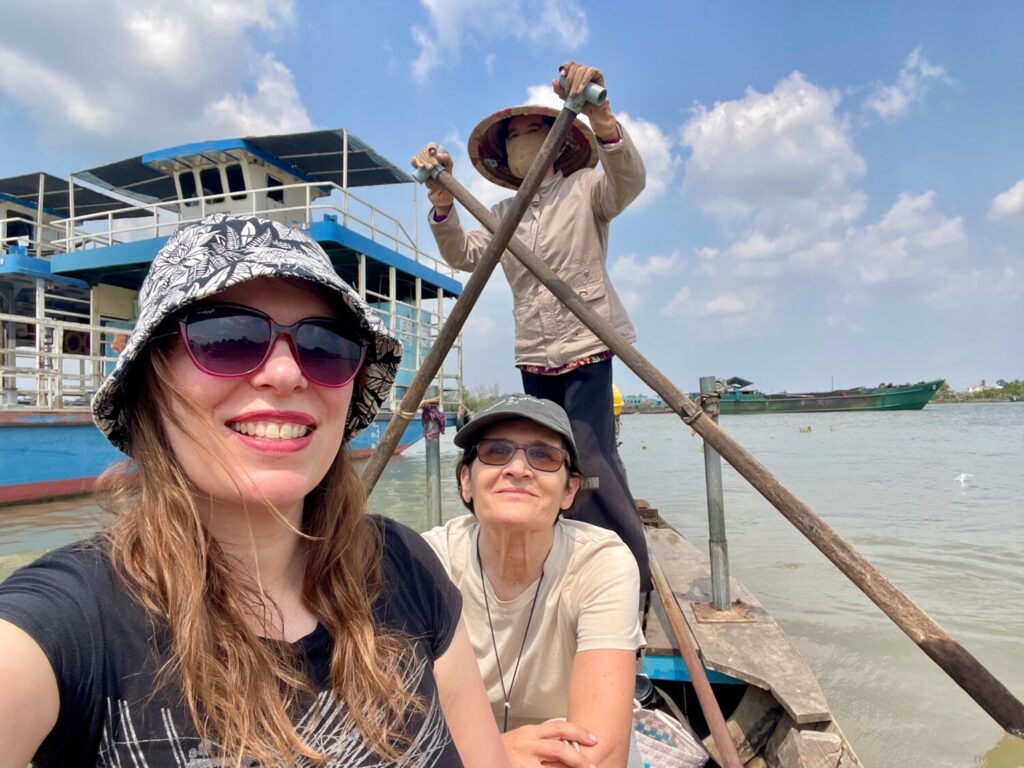
The Mekong Delta is one of the most distinctive and rewarding excursions from Ho Chi Minh City. The landscape changes completely, with waterways, villages and activities centred around river life.
From Cai Be, you can rent a bicycle and explore rural villages, observing daily life along the Mekong. You can visit the Mekong Delta on a day trip, as I did, or over several days if you prefer a slower and more immersive experience.
Tay Ninh and Cao Dai Temple: How to Visit
Tay Ninh is located near the border with Cambodia and is known for the Cao Dai Temple, one of the most visually striking religious sites in Vietnam. Many tours to Tay Ninh also include a visit to Ba Den Mountain, the highest peak in southern Vietnam.
You can reach the summit by cable car or on foot via scenic trails. At the top, you will find temples, pagodas and panoramic views over the surrounding countryside.
Cat Tien National Park: Trekking and Wildlife
Cat Tien National Park is one of the main natural areas in southern Vietnam, ideal for jungle trekking, wildlife spotting and visiting conservation centres. It is a good option if you want to add a more natural experience to your trip and explore a very different side of the country.
Ho Coc Beach: A Quiet Escape from Ho Chi Minh City
Ho Coc is a quieter coastal area, less developed than other beach destinations in Vietnam. It offers a more relaxed setting, ideal for taking a break from the pace of the city without travelling too far.
The beaches are wide, with light sand and sections surrounded by vegetation. The sea is generally calm, although not always as clear as in other parts of Vietnam, but still suitable for swimming and relaxing away from the crowds.
Getting Around Ho Chi Minh City: Transport, Walking and Grab
To visit the main attractions in Saigon’s historic centre, especially in District 1, you can move around on foot, as distances are relatively short. However, keep in mind that places often appear closer on the map than they actually are. Ho Chi Minh City is a Southeast Asian metropolis, and walking for long periods in the heat, humidity and heavy traffic, with pavements often partially blocked, can quickly become tiring.
Although it feels easier now than during my first visit, crossing the street remains one of the most unusual experiences. Traffic is constant, especially with motorbikes. The key is to walk slowly and steadily without stopping, letting vehicles move around you rather than trying to avoid them.
For longer distances, moving between districts or reaching attractions outside the centre, Grab is the most practical option. It works in a similar way to Uber, allowing you to book cars or motorbikes with fixed prices shown in advance, avoiding the need to negotiate. Traditional taxis are also available, but they are often more expensive and do not offer the same level of convenience.
Where to Eat in Ho Chi Minh City
Ho Chi Minh City offers a wide range of dining options, from simple local eateries to high-quality international restaurants. You will also find many vegetarian restaurants serving Buddhist mock meat, a plant-based cuisine designed to replicate traditional dishes, often surprising for its variety and flavours.
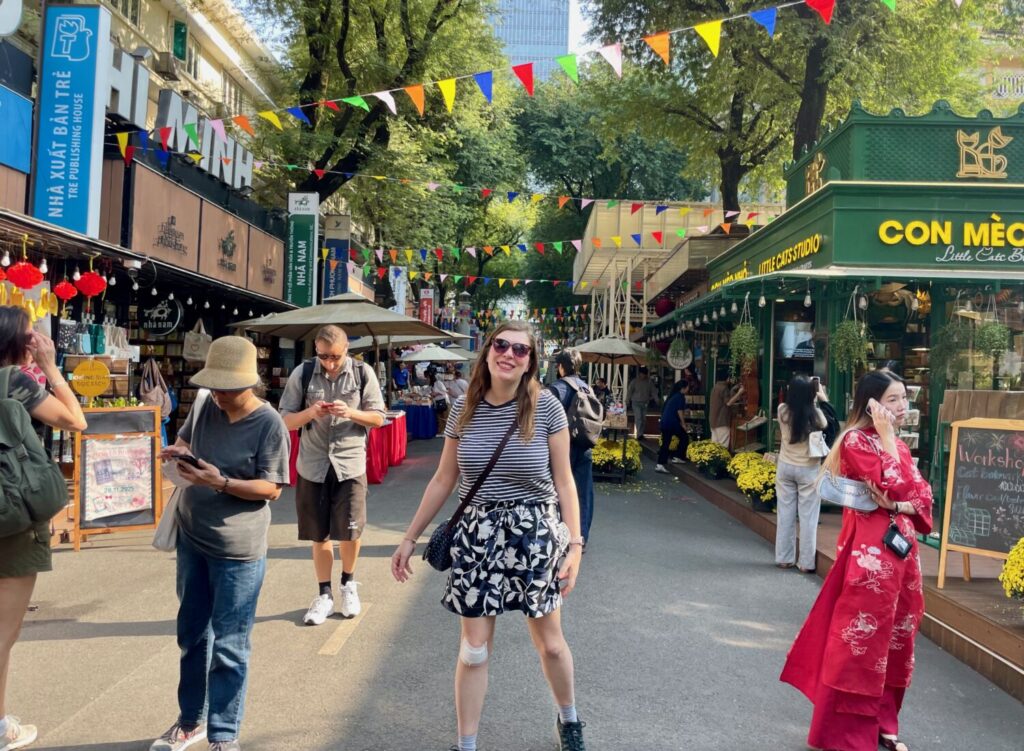
For authentic street food, Ben Thanh Market is one of the main reference points. Built by the French and inspired by European market halls, it is one of the most recognisable landmarks in the city, with its distinctive clock tower at the entrance. It closes relatively early in the evening, so it is best to visit around lunchtime. The market is also a good place to buy souvenirs, although you should bargain, as initial prices are often quite high.
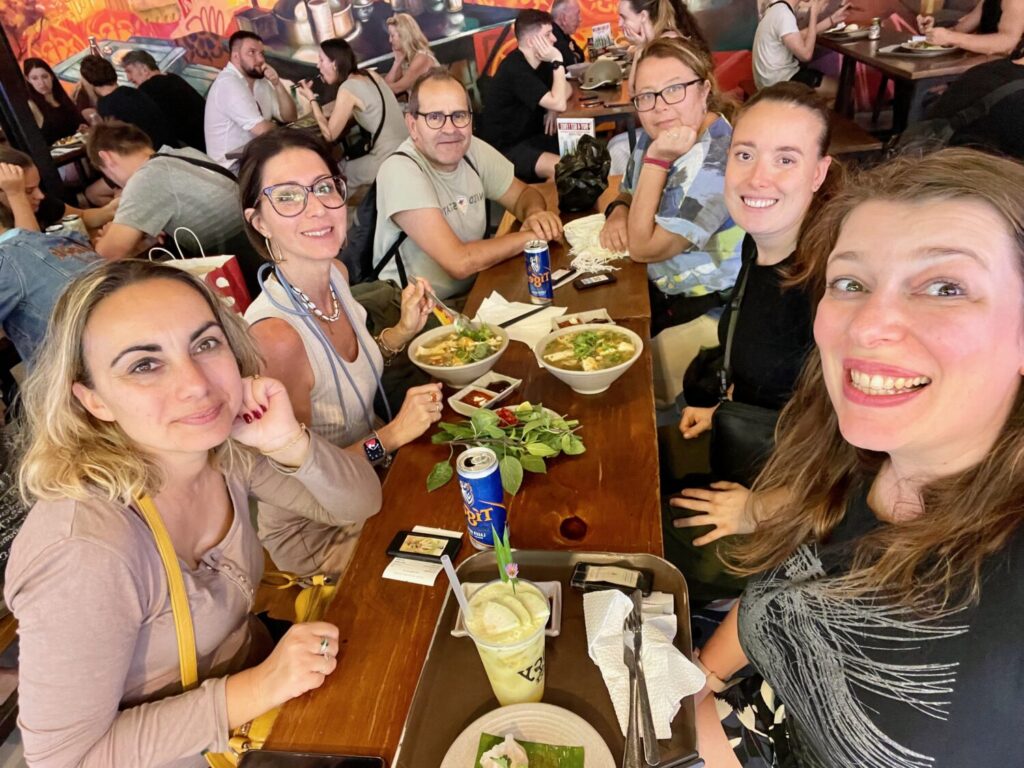
An alternative I found particularly enjoyable is the Ben Nghe Street Food Market. The setting is more organised and cleaner than traditional markets, with shared tables and a wide range of food stalls. You can try Vietnamese dishes as well as international options, along with drinks and smoothies, making it a good place to spend an evening in a more relaxed environment.
In Cholon, the city’s Chinatown, you will find less touristy restaurants where the cuisine reflects the influence of the local Chinese community. Even without a specific place in mind, it is worth stopping at a local restaurant to try dishes such as dim sum, noodles, roast duck and rice-based specialities from Cantonese and Teochew traditions, offering a different culinary perspective within the city.
Where to Stay in Ho Chi Minh City: Best Areas and Hotels
Staying in District 1 is the most convenient option for visiting the main attractions, especially if it is your first time in Ho Chi Minh City. District 3 offers a quieter alternative, with a more local atmosphere and fewer tourists. Some boutique hotels provide elegant and well-located options, often with swimming pools, ideal for relaxing before or after a day of sightseeing.
If you are looking for a stay connected to the city’s history, you can choose the Hotel Continental or the Caravelle Saigon. Both were key meeting points for foreign correspondents during the Vietnam War. Today, they are fully renovated luxury hotels, while still preserving the elegant atmosphere of the past.
During my last trip, I stayed at Winsuites Saigon Hotel, which stood out for its central location, just a short walk from Ben Thanh Market and close to the Ben Nghe Street Food Market. The rooftop pool and sky bar offer a panoramic view of the city, making it a great place to unwind after a day exploring Saigon and experience a different perspective on the skyline.
Why Ho Chi Minh City Is Worth Visiting
Ho Chi Minh City is an intense and fast-paced destination that can feel overwhelming at first. Even if you have visited before, returning and seeing modern skyscrapers rise alongside traditional markets highlights how quickly the city continues to change. Its appeal lies in the contrast between history, rapid development and everyday life.
Compared to Hanoi, it feels more dynamic and less traditional, yet equally interesting. Spending time here and exploring what was once Saigon helps you better understand contemporary Vietnam and its ongoing transformation.
If you have already visited Ho Chi Minh City, sharing your experience in the comments can help other travellers planning their trip.
