
My journey through North India, between Delhi, Rajasthan and Agra, was an intense experience. Magnificent architecture, everyday spirituality guided by gods for every occasion, surreal traffic shared with wandering cows, and impossible-to-ignore contrasts shaped it. From the chaos of Delhi to the haveli of Mandawa, and from the noise of temples to the quiet contemplation of the Taj Mahal, this itinerary was my first true immersion in a complex and fascinating country. Profoundly different from Europe, it left a lasting impression and found its way into my heart.
Table of Contents
Travelling in North India and Rajasthan: What You Need to Know Before You Go
Anyone who has been to India will tell you that it is a country you either love or hate. India is by no means an easy destination. You face constant contrasts, from the luxury of royal palaces to people living on the streets, and from extraordinary beauty to piles of rubbish beside temples.
Yet it is also a journey that never leaves you indifferent. It can change you and stir very strong emotions. I personally loved it and cannot wait to return, even though it forced me to confront my limits and my Western prejudices. At the same time, it opened my mind and offered me a different perspective on life and spirituality.
PLAN YOUR TRIP TO INDIA
When in India, stay connected at the best rates by purchasing a Holafly eSIM online before your trip. With unlimited data and fast and reliable internet, this eSIM eliminates the hassle of purchasing a physical SIM at the airport.
About travel insurance, Heymondo is the way to go. They offer comprehensive coverage against unexpected events like medical emergencies, trip cancellations, lost luggage, and more. Heymondo provides excellent value for money and will give you peace of mind on your travels!
Travelling in India: Is It Better to Go Solo or Join an Organised Tour?
Although many travellers take pride in travelling independently, there are destinations where an organised tour makes a real difference, especially on a first visit. India is one of them. The culture shock of being in a place so different from Europe (or another Western country) is very real. Chaotic traffic, unclear rules and cows wandering across the roads can turn even simple journeys into a challenge.
For this reason, I was very glad to have organised and taken part in this trip to India with my Italian blogging community, Travel Blogger Italiane. Our driver, Makal, and our guide Manoj, who spoke both English and French, were essential to the smooth running of the journey. They also helped us understand much more of what we were seeing.
Many of the experiences we had, such as visiting the ancient capital of Mandore and exploring the stepwells, are realistically possible only with a local guide. This is especially true unless you have plenty of time, local contacts or a good command of the language. For our trip, we relied on the Indian tour operator 3959 Miles, which organises tours throughout India and neighbouring countries.

Rajasthan: Climate, Distances and Travel Costs in North India
Compared to many other destinations, India requires more planning. First of all, it is a vast country, and climates and landscapes vary greatly from one region to another. If you are planning a trip similar to mine, I would strongly advise against travelling in the summer months. Heat can become extreme, especially in Rajasthan’s cities.
Summer also coincides with the monsoon season. Heavy rainfall can make travel more complicated, particularly on secondary roads. The best time to visit North India and Rajasthan is generally from October to March, when temperatures are more manageable and the climate is dry.
Rajasthan is an enormous region. Distances between cities often involve hundreds of kilometres and many hours on the road. On the plus side, accommodation and transport costs in India are generally very affordable compared to European standards.
What to Eat in North India and Rajasthan: Spice, Heat and Street Food
Food is an essential part of travelling in India and it varies greatly from one region to another. Rajasthan has its own distinct cuisine, rich in spices and bold flavours. We discovered this in Jaipur during a cooking class.
Chilli is everywhere, often even in dishes that do not look spicy at first glance. Our guide was brilliant at negotiating with the cooks to make the food mild enough for Western palates. The most satisfying dishes were based on lentils and vegetables, always served with bread such as chapati and naan.
Street food is incredibly popular and offers an authentic glimpse into everyday life. It can also be challenging for Western stomachs used to different hygiene standards. Our guide, genuinely worried that someone in the group might fall ill with the so-called “Delhi Belly”, always checked that vendors cooked the food fresh. He also made sure staff rinsed plates and utensils.
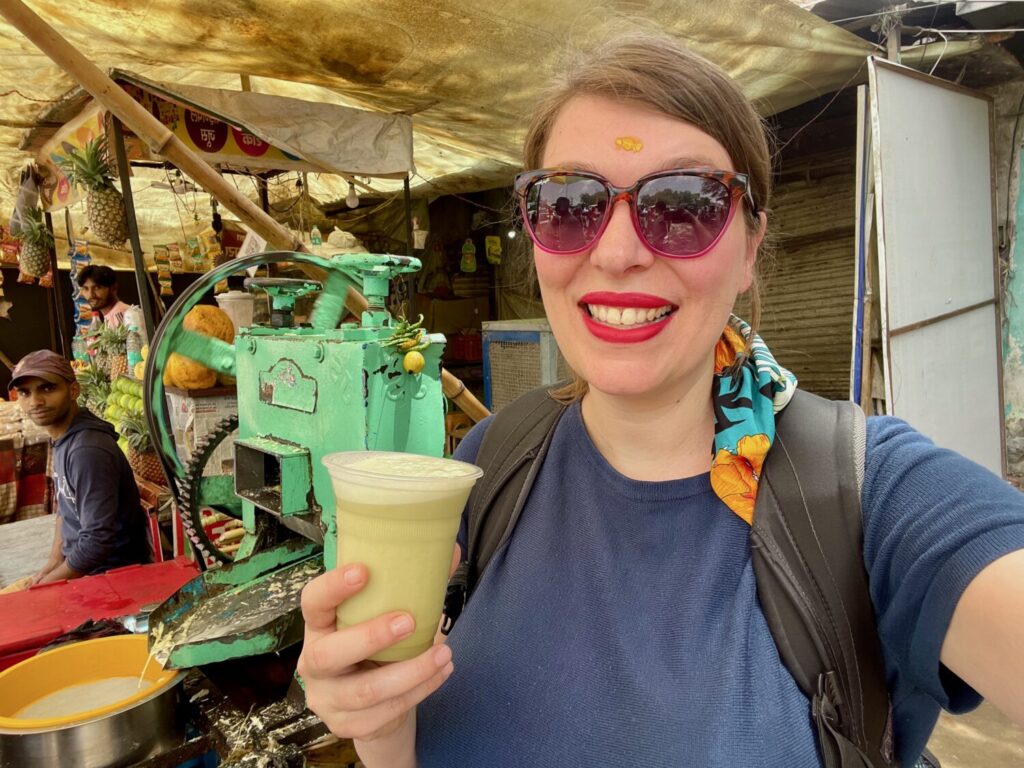
One of my favourite tastings was freshly pressed sugarcane juice from a market stall. It was delicious even without ice, which you should avoid in India, where tap water is not drinkable.
Dirt, Poverty and Contradictions: What to Expect in India
Dirt is one of the first things you have to come to terms with in India, as it is everywhere. Around the most famous monuments there is sometimes a superficial level of cleanliness. A few streets away, however, you will see people living on the pavement and widespread decay. Even inside temples and holy lakes, you can see rubbish floating just a few metres from worshippers. No one seems disturbed by it, as locals consider it normal.
In this context, entering temples always means going barefoot. This is another aspect that many Western travellers struggle with, especially when you see the hygiene conditions across much of India. To avoid unnecessary stress, it helps to accept walking barefoot as part of the experience. My only practical advice is to carry a pair of socks and plenty of hand sanitiser.
Indians also have a very different attitude towards animals, which people often exploit for tourists’ entertainment. In some heavily visited areas, you may encounter women and children asking for money. At times, they even cling to the windows of moving buses. Our guide explained that exploitation and abuse often sit behind this kind of begging. In these situations, if you really want to help, it is better not to give money. Turning to charities or asking local people for advice is a more responsible choice.
North India Itinerary: Nine Days Between Delhi, Rajasthan and Agra
A classic North India itinerary brings together some of the country’s most representative destinations. It offers a first, meaningful overview of India’s cultural, historical and religious diversity. The journey usually starts and ends in Delhi, well connected by international flights and an ideal gateway to understand the chaos and contradictions of modern India.
From Delhi, the route continues into Rajasthan, one of the most fascinating regions of North India. Here you encounter historic cities such as Mandawa, known for its frescoed haveli, Jodhpur, the Blue City dominated by Mehrangarh Fort, and Pushkar, a holy town set around a lake and linked to the worship of Brahma. Jaipur, the Pink City, brings together monumental architecture, royal palaces and remarkable astronomical observatories.
After Rajasthan, the journey moves on to Agra, in Uttar Pradesh, for a visit to the Taj Mahal, India’s most iconic landmark. This itinerary is considered a classic because it includes many famous sites, while also offering space to reflect on the cultural and spiritual complexity of North India. I travelled this route on a nine-day trip with fellow Italian travel bloggers, and sharing landscapes and experiences with other passionate travellers made it even more memorable.
Delhi: What to See in the Indian Capital
Our journey began with a warm welcome at the airport, where our guide Manoj greeted us with a fragrant and beautifully arranged flower garland. As soon as we left the airport, order and cleanliness quickly gave way to the chaos of Delhi, a city that works well as a first introduction to India.
Our first real encounter was with the traffic. It is impossible to explain it in rational terms. Animals and people move through congested roads, accompanied by a constant soundtrack of horns that would follow us throughout the entire journey in Rajasthan.
After leaving our luggage at the hotel, we set off straight away to explore the main sights of Delhi. On this first day, we moved through very different eras and meanings, passing between places of worship, sites of historical memory and symbols of contemporary India.
Qutb Minar
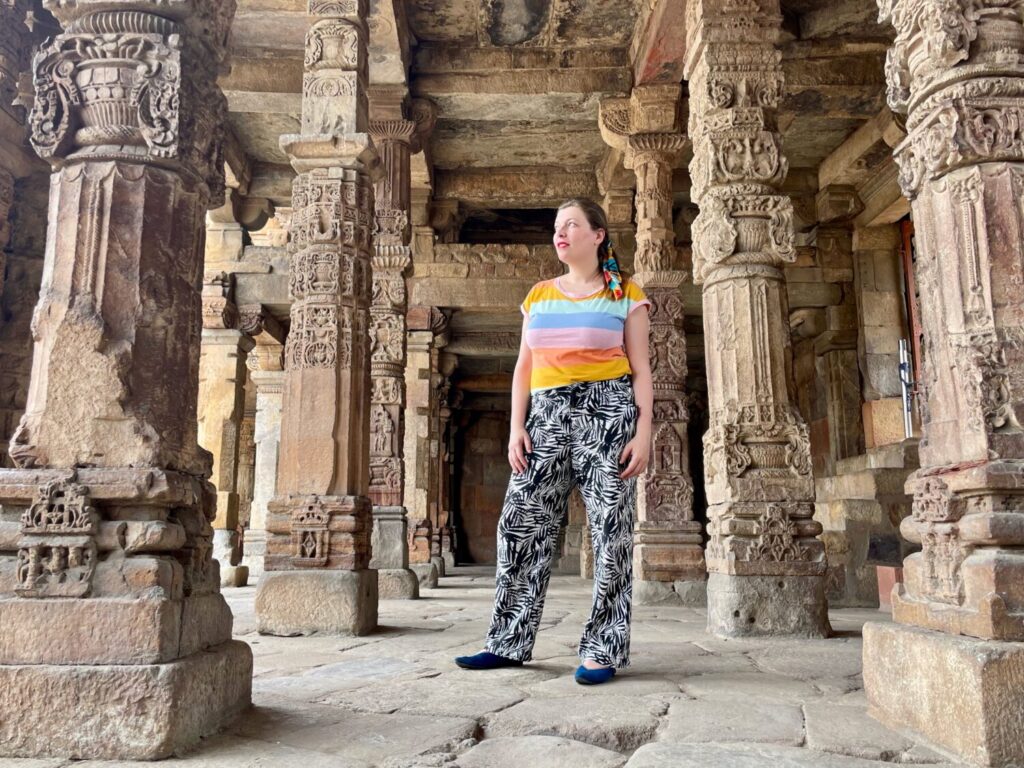
Considered one of the oldest and most important monuments in Delhi, Qutb Minar is a towering minaret built in red sandstone. Visiting it as our first stop immediately introduced us to the history of North India, deeply shaped by Islamic rule. This period left a lasting mark on local art and architecture. Qutb Minar stands within the Mehrauli Archaeological Park, a vast complex of historic buildings.
Jama Masjid, the Great Mosque of Delhi
The Great Mosque of Delhi is the city’s main Muslim place of worship and one of the largest mosques in India. Built in red sandstone and white marble, it dominates the surrounding area with its tall minarets and vast central courtyard. However, we haven’t fully appreciated the experience. Despite wearing modest clothes, we were required to put on robes and head coverings that had already been used by many visitors before us. This took away much of the enjoyment and made it harder to appreciate the visit.
Lotus Temple
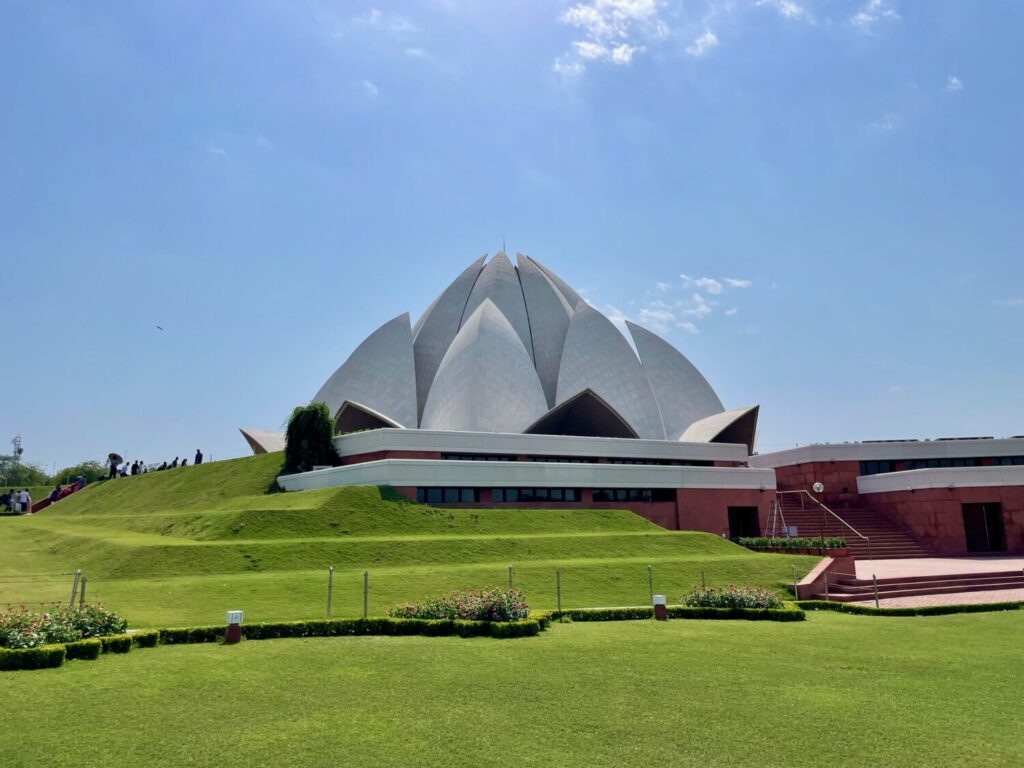
Having previously visited the Bahá’í Gardens in Haifa, Israel, I was very curious to see Delhi’s Lotus Temple, the main Bahá’í temple in India. Shaped like a lotus flower and built entirely in white marble, it symbolises purity and universal openness. The temple welcomes people of all religions and contains no holy images or symbols, as it aims to offer a shared spiritual experience. The fast-paced management of visitor flows, however, leaves little room for quiet contemplation. Even so, the visit remains interesting from an architectural point of view.
Gandhi Memorial
The Gandhi Memorial is one of the most meaningful places for understanding modern Indian history. It commemorates Mahatma Gandhi, the moral and political leader of India’s independence movement, founded on the principle of non-violence. The memorial is deliberately simple and understated, far removed from any sense of grand celebration. Visiting it allows you to connect with a fundamental part of India’s identity and with the values that have profoundly shaped the country’s history.
India Gate
India Gate is one of the symbols of modern Delhi and a memorial dedicated to Indian soldiers who died during the First World War. Standing along a wide ceremonial boulevard and surrounded by open spaces and green areas used by local residents and families, it reflects India’s colonial and post-colonial history and offers a very different perspective compared to the city’s more chaotic neighbourhoods.
Mandawa: Haveli and the Legacy of Rajasthan’s Merchants
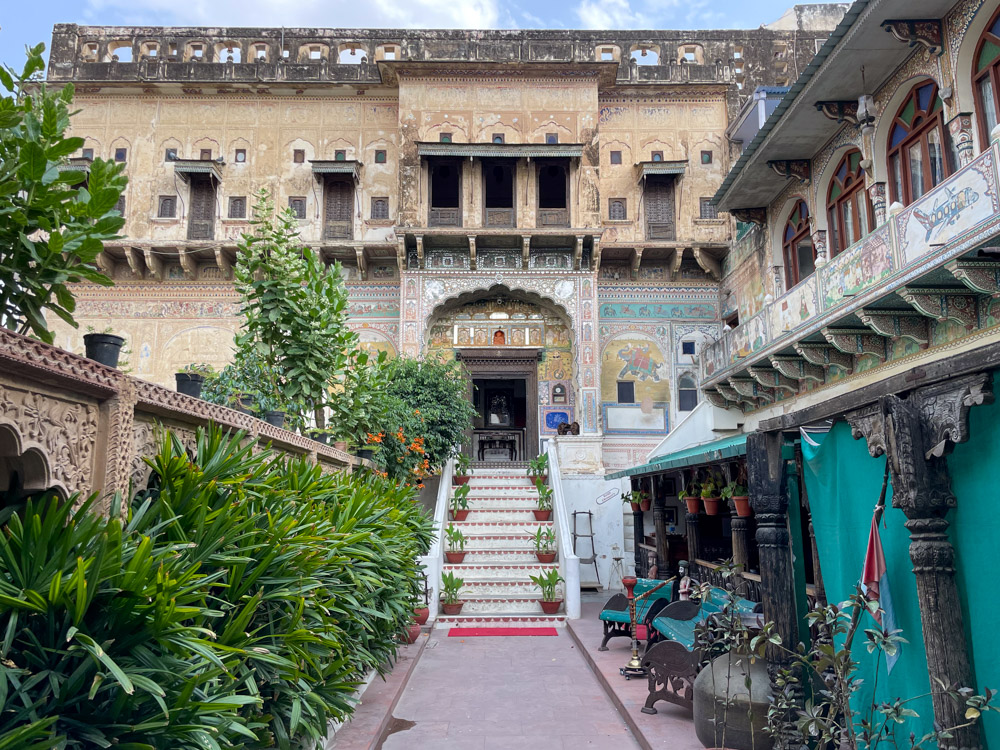
On the second day we travelled about 260 km by car. We left Delhi and headed to Mandawa, a town that feels almost abandoned today but is still known for its haveli, elegant historic mansions. Founded in the mid-17th century, Mandawa prospered thanks to its strategic position along the Silk Road, one of Asia’s most important trade routes.
As international trade passed through Rajasthan, local merchants accumulated enormous wealth. In many cases, they were even richer than the maharajas of Jaipur. They chose to display their status by building lavish homes, decorated with frescoes inside and out, known as haveli.
Today, many haveli are abandoned. Others can still be visited by buying a ticket or leaving a small tip for the caretaker. In a separate article, I have listed the havelis in Mandawa that are still standing and recognisable, even if only from the outside.
In the evening, our guide organised a surprise outing on a camel-drawn cart to an artificial sand dune. While this activity is very popular with Indian tourists, it prompted us to reflect on the different sensitivities between Indian and Western tourism, particularly when it comes to animal exploitation and travel sustainability.
Jodhpur: The Blue City Between Fortresses, Markets and Contrasts
From Mandawa we travelled about 332 km by car to reach Jodhpur, where we stayed for two nights. Along the way, we stopped at the cow shelter in Nagaur. At first glance it looks like a farm, but it is actually a hospital for cows, which are considered holy in India. Here, sick animals receive care or are allowed to die naturally.
Seen through Western eyes, it is easy to wonder whether a humane form of euthanasia would be preferable. This, however, is not part of the Indian mindset. Caring for cows is seen as a positive karmic act. For this reason, many families visit the shelter to cook food for the animals and leave offerings. During our visit, an Indian family invited us to share this moment with them. It gave us the chance to witness a very genuine act of devotion.
Mehrangarh Fort
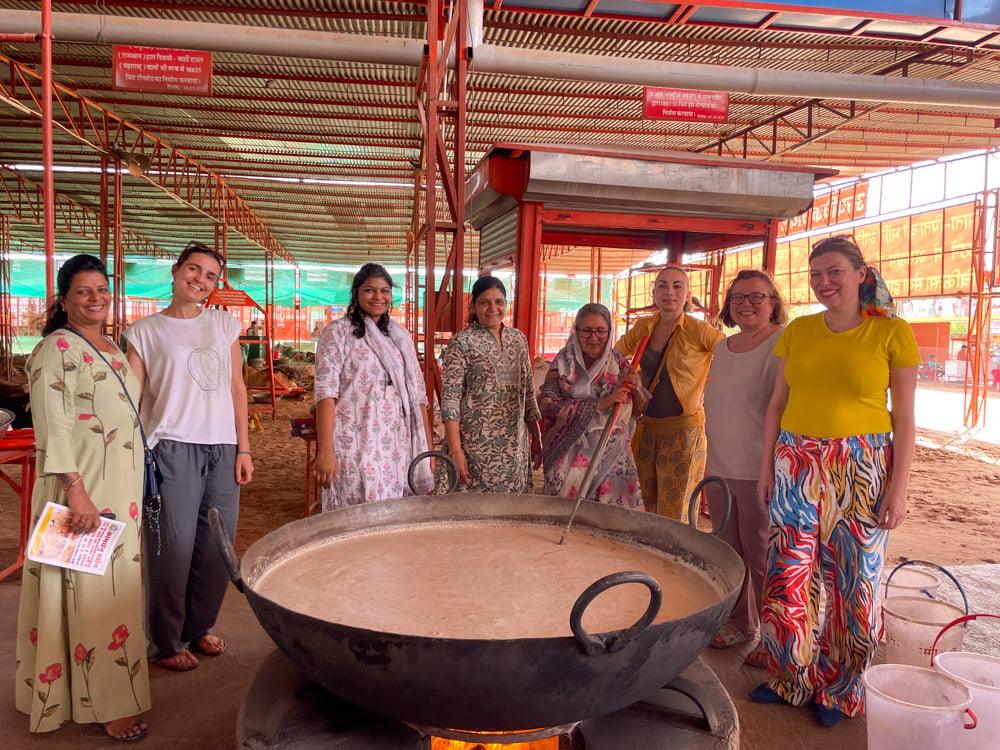
The first attraction we visited in Jodhpur was Mehrangarh Fort, built on a rocky hill that towers over the entire Blue City. Inside, vast courtyards open onto richly decorated palaces. These spaces were once royal residences and now house museums.
The Royal Palace within Mehrangarh Fort is made up of three distinct buildings, each with its own decorative style. Parts of the complex are closed to the public. The areas that can be visited reveal strong Islamic and Mughal influences, clearly showing the cultural mix that has shaped this region over the centuries.
Jodhpur and the Blue City
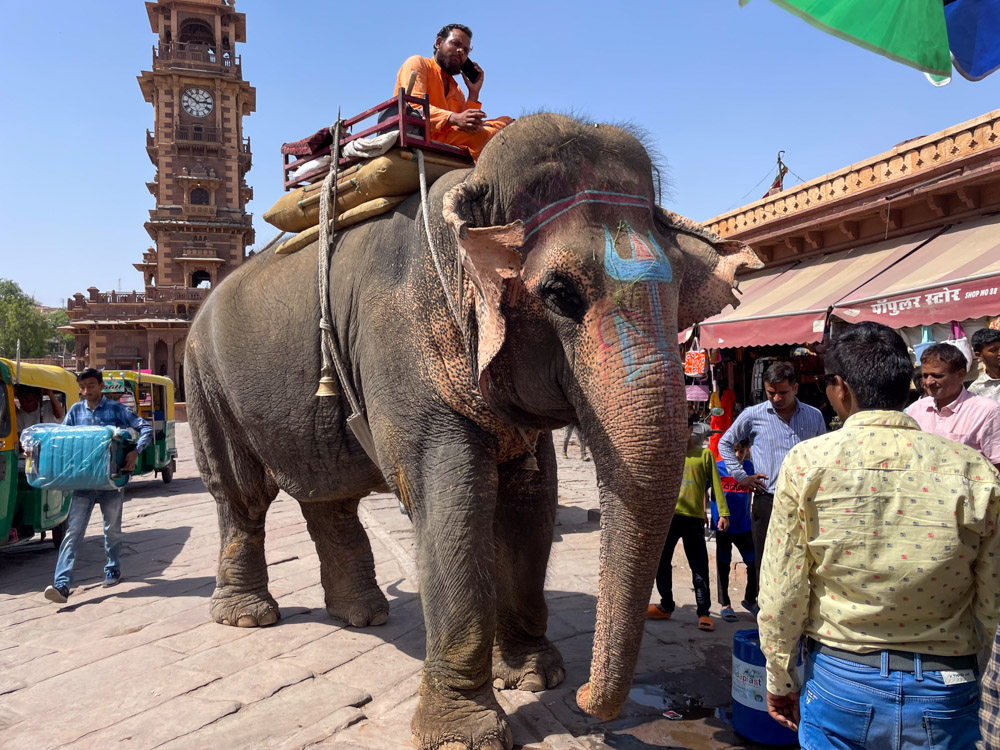
Jodhpur is well known among tourists, but we wanted to see the real Blue City of Rajasthan, not just admire it from above at Mehrangarh Fort. Our guide seemed reluctant and gave the impression she had never actually been inside. After insisting on exploring it by tuk-tuk with a local driver, we understood why many tour operators avoid it. There was rubbish everywhere, open drains and stray dogs.
Yet, in the middle of this decay, we were struck by the people. Locals smiled at us. Children played badminton in the narrow alleys and were delighted to try on our sunglasses. In the evening, from a rooftop, we watched an improvised procession of colourful umbrellas and Bollywood music. Later, we joined the group and danced with them along the street for a while. It was an authentic and amazing experience.
Bishnoi Villages
One of the most popular excursions around Jodhpur is the Bishnoi village safari. This minority group is known for having opposed the cutting down of trees for palace construction, even sacrificing their own lives to protect the forest.
My travel companions from Travel Blogger Italiane and I were genuinely excited to join this jeep excursion through their territory. The idea of meeting a community so deeply connected to nature, and so committed to its protection, was fascinating.
As often happens in India, however, attractions that sound particularly meaningful on paper can turn out to be carefully staged for tourists. The safaris follow paved routes and present a version of daily life that feels more like a performance than reality. There is very little space for authenticity. For us, this experience sparked a reflection on the fine line between cultural storytelling and over-spectacularised tourism.
Mandore
Mandore is a stop not to be missed, located just 9 km from Jodhpur and still largely unknown to most tourists. This was once the ancient capital of Mandore, and its architecture is often compared to Angkor Wat, though without the overwhelming presence of jungle vegetation.
The site is also tied to legend. According to local tradition, Mandore was part of the dowry brought by Princess Mandora when she married the demon king Ravana of Sri Lanka. Walking through the complex, the atmosphere feels calm and almost forgotten, a striking contrast to the crowds found at many other destinations in Rajasthan.
Pushkar: the holy city of Brahma and its pilgrimage lake
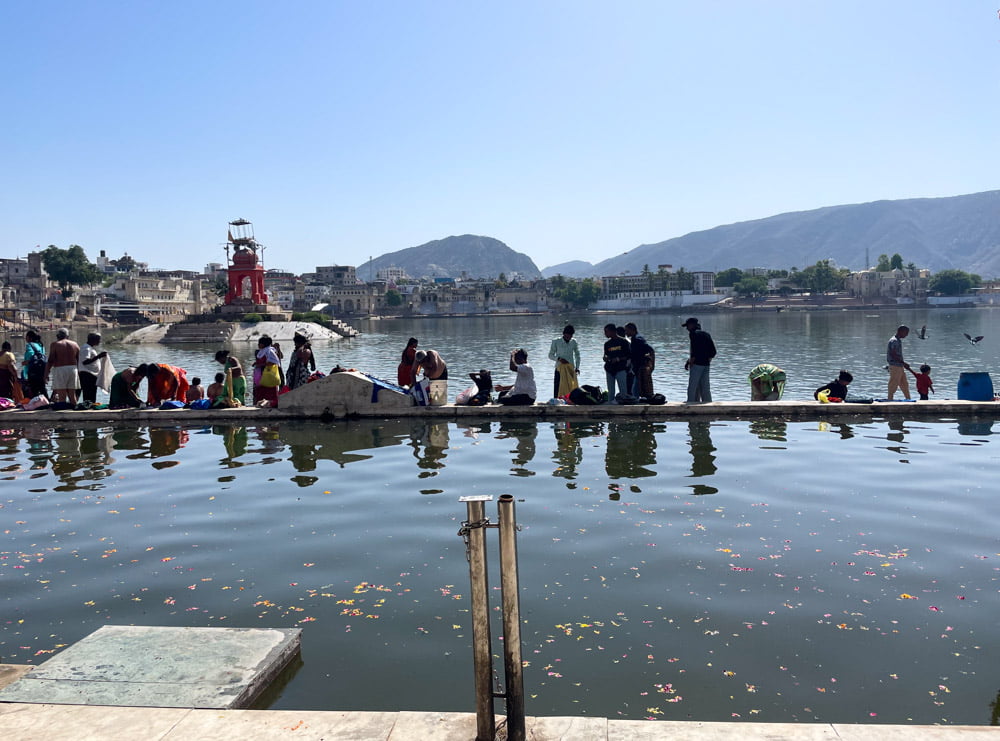
After Jodhpur, we continued our journey towards Pushkar, one of the holiest towns in Rajasthan, located about 211 km away. This small town is home to the most important temple dedicated to Brahma, the creator god of the universe. The temple overlooks Pushkar Lake and is a constant destination for pilgrims from all over India. For this reason, the entire town is considered holy. Alcohol is not served anywhere, and the atmosphere feels noticeably different from that of Rajasthan’s larger cities.
With our guide, we took part in the Aarti ritual on the shores of the lake. During the ceremony, a Brahmin priest lifts flaming oil lamps into the air, circling them repeatedly in front of the statues of Brahma and his wife. Bells ring continuously while devotees clap their hands in rhythm. The experience felt intense and almost surreal, yet we let ourselves be carried by its hypnotic pace.
Beyond the Brahma Temple, Pushkar Lake is surrounded by more than 300 temples. Among them, we visited the temple dedicated to Savitri, Brahma’s wife. The shrine sits on top of a hill and can be reached by climbing 923 steps or by taking a cable car, as we did. In the centre of Pushkar, countless small shops sell souvenirs, food and clothes. Outside the temple area, however, the town truly comes alive only during the annual Pushkar Camel Fair, dedicated to livestock trading.
Jaipur: the Pink City and the palaces of the maharajas
From Pushkar, we travelled another 150 km towards Jaipur, the famous Pink City of Rajasthan. The city’s most iconic landmark is without doubt the Hawa Mahal, also known as the Palace of the Winds. Its stone windows, carved so densely they resemble lace, allowed the women of the royal court to watch street life and processions without being seen.
The City Palace is Jaipur’s Royal Palace and is still the residence of the maharaja’s family today. Its architecture blends Rajput, Mughal and European influences. Part of the complex is open to visitors and houses several museums. Among the most unusual objects are two enormous silver vessels, once used to carry drinking water from the Ganges during a royal trip to England. Another room displays portraits of past rulers, while the entrance to the armoury greets visitors with an ironic “welcome” spelled out using blades and knives.
Jaipur is also home to one of the most unusual architectural complexes in Rajasthan: the Jantar Mantar, the city’s astronomical observatory and a UNESCO World Heritage Site. Here, huge stone instruments were built to observe the movement of celestial bodies, including the world’s largest stone sundial. What fascinated me most was discovering how closely astronomy and astrology are linked in India, and how astrology still plays a role in decisions such as marriage and career choices.
Around Jaipur: forts, palaces and holy sites
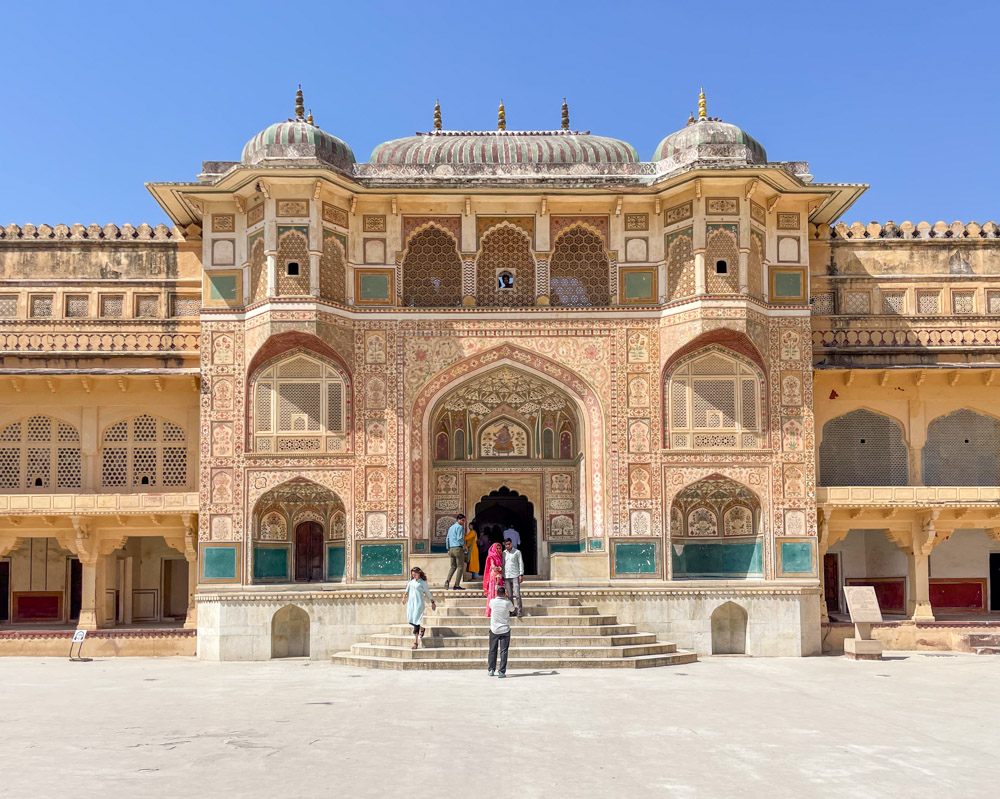
In the surroundings of Jaipur, we first stopped to see Jal Mahal, the Water Palace, which appears to float on the surface of Man Sagar Lake. Unfortunately, it cannot be visited from the inside. We then spent half a day exploring Amber Fort, the former fortified residence of the Rajput rulers and today one of the most photographed sites in Rajasthan, especially for wedding shoots. Along the way, we also visited Gatore Ki Chhatriyan, a complex of royal cenotaphs, and Panna Meena Ka Kund, one of the many stepwells of Rajasthan once used as a vital water reserve for the local population.
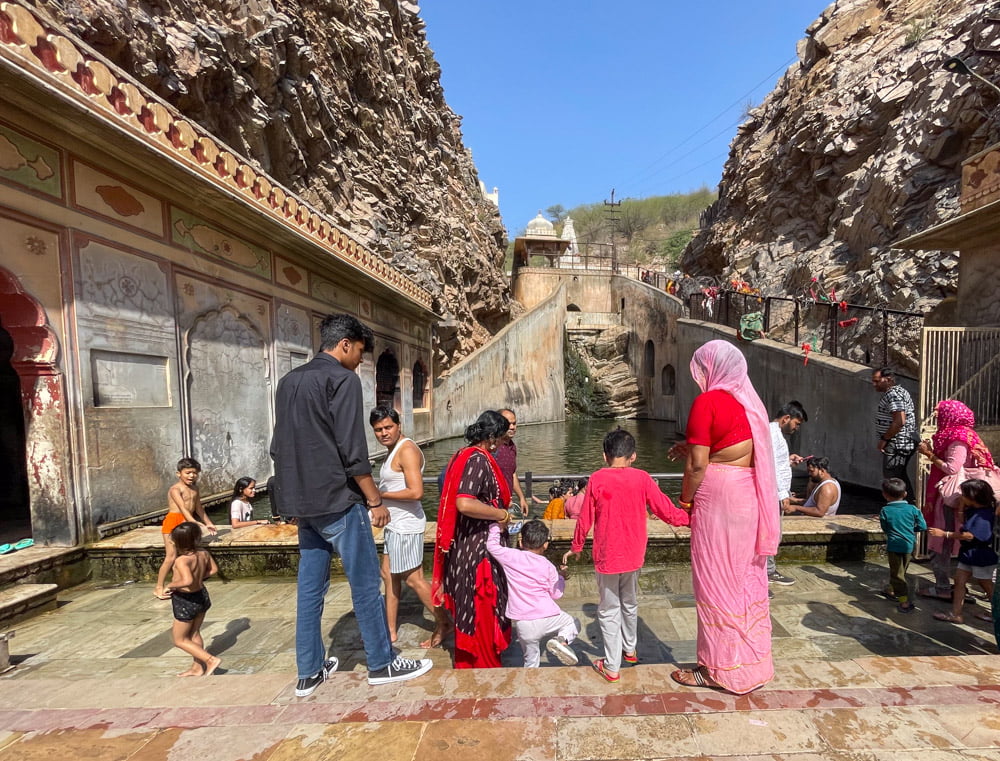
Leaving Jaipur behind, we stopped at Galta Ji Temple, also known as the Monkey Temple, because of the large number of monkeys living freely within the complex. From an architectural point of view, the site is striking, set among rocky hills and organised around a series of holy pools used by pilgrims for ritual bathing and purification. What struck us most, however, was the widespread dirt and the piles of rubbish scattered around the area, which did not seem to disturb the worshippers in the slightest.
Agra: the Taj Mahal and the great Mughal monuments
We continued our journey for over 245 km towards Agra. Along the way, we stopped at Fatehpur Sikri, the lost city. Its architecture blends Indo-Islamic styles and offers a clear example of a Mughal walled city, with distinct public and private areas and imposing gateways.
After leaving Rajasthan, we entered Uttar Pradesh, where Agra lies. Travellers come here almost exclusively to see the Taj Mahal, which truly needs no introduction. The monument is breathtaking and lives up to every expectation.
Before leaving Agra, we visited the Red Fort, once the main residence of the Mughal emperors when the city served as the capital of North India. From here, we returned to Delhi to catch our flight back to Italy.

The India I did not expect: what this journey gave me
Despite its challenges, India turned into an inner journey even before a geographical one. Each day pushed me to question my beliefs, habits and assumptions, while confronting a lifestyle shaped by religion and spirituality, so different from a Western perspective.
Hinduism is not only a religion but a philosophy applied to everyday life. Its principles emphasise respect for all living beings, animals included, which explains why many Indians follow a vegetarian diet. Each deity has a specific role, and the relationship with the divine often feels deeply personal. People choose which god to turn to based on their needs, life experiences or spiritual inclinations at that moment.
In India, you can bless a scooter before riding it for the first time, just as you can ask an astrologer for help in choosing the right partner. Stars form part of nature too and point towards a possible path. During this trip, I allowed myself to be carried along by this mindset. Even if the future husband predicted by an Agra fortune teller has yet to appear, letting go of logic for a while felt surprisingly freeing, before returning to my rational Western self.
India also wins you over with the beauty of Rajasthan’s palaces, secret gardens hidden behind walls, cenotaphs that resemble entire cities and the ingenious engineering of stepwells. If you have already visited India, or if you are considering it as your next destination, share your experience in the comments. I’d like to read what you would like to see in Rajasthan and North India.
