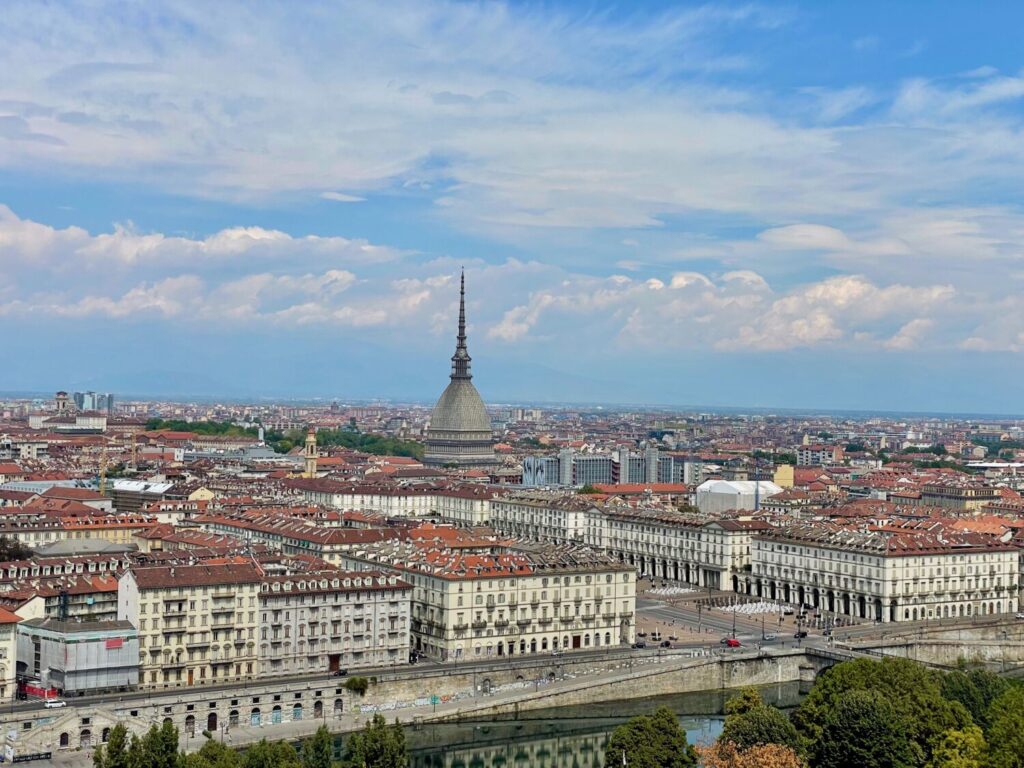
The Mole Antonelliana dominates Turin’s skyline and has become the unmistakable symbol of the city. Originally designed as a synagogue in the nineteenth century, it now houses the National Museum of Cinema, one of the most remarkable film museums in Europe. Visiting the Mole offers one of the most memorable experiences for anyone interested in architecture, cinema or panoramic views.
Table of Contents
Why the Mole Antonelliana Is Turin’s Most Iconic Landmark
Rising dramatically above Turin’s historic centre, the Mole Antonelliana is far more than an architectural landmark. Its distinctive silhouette dominates the skyline and appears on Italian two-cent coins, making it one of the most recognisable symbols of the city. Originally conceived in the nineteenth century, the building gradually transformed into an emblem of Turin’s ambition, creativity and identity, and today it houses the National Museum of Cinema.
PLAN YOUR TRIP TO TURIN
Purchase the Torino + Piemonte Card online to enjoy free public transportation in Turin, as well as access to museums, castles, fortresses, and royal residences in Turin and the Piedmont region.
While travelling in Italy, you can stay connected with family and friends using the Holafly eSIM, which offers unlimited data at 3G, 4G, and LTE speeds. Additionally, be sure to get Heymondo travel insurance for a worry-free adventure.
Curious Facts About the Mole Antonelliana
The Mole’s construction was anything but easy. Architect Alessandro Antonelli repeatedly revised the original plans, raising the height well beyond what had initially been approved. What began as a contained project evolved into an audacious vertical experiment, one that both fascinated and unsettled observers at the time.
Unforeseen events marked its history. In 1904, the winged statue that crowned the spire was struck by lightning and later replaced with a star. In 1953 a violent storm caused the upper section of the spire to collapse. It was rebuilt in 1961 with an internal metal structure to improve stability.
Over the years, the Mole has also become a canvas for light installations. It is regularly illuminated in different colours to mark national celebrations, cultural festivals and international events. These light displays reinforce its role as a living symbol rather than a static monument.
Architecture and Design of the Mole Antonelliana
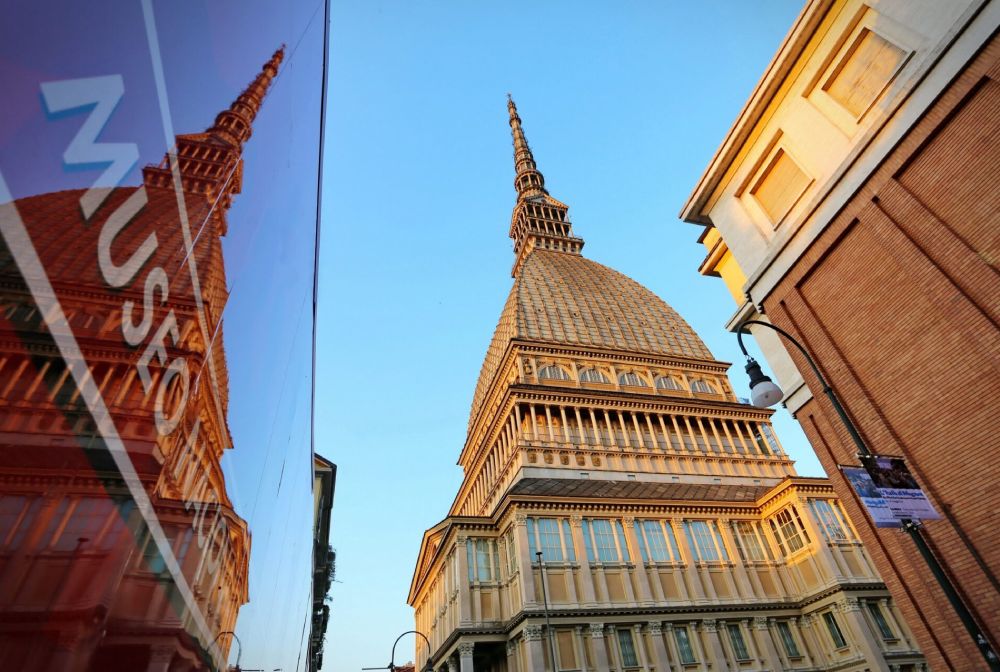
The Mole Antonelliana stands on a square masonry base approximately fifty metres wide. Above it rise progressively smaller architectural sections, combining neoclassical and neo-Gothic elements with nineteenth-century engineering innovation. Decorative cornices, columns, curved roofs and large windows create a layered rhythm that draws the eye upwards towards the soaring dome.
Antonelli’s ambition pushed the structure far beyond its original scale. His increasingly bold redesigns transformed the building into a daring architectural statement that still defines Turin’s skyline, shaping the visual identity of the city and framing the experience of visiting the National Museum of Cinema inside.
The Height and Records of the Mole Antonelliana
At 167.5 metres, the Mole Antonelliana is the tallest building in Turin. This is not accidental. The municipality has deliberately avoided authorising taller constructions in order to preserve its visual primacy, and even the city’s two modern skyscrapers do not exceed its height.
For many years it was the tallest masonry structure in Europe. Later structural reinforcements mean it no longer holds that specific record, which now belongs to Ulm Minster in Germany, standing at 161.53 metres. For comparison, London’s Elizabeth Tower, often referred to as Big Ben, reaches just 96 metres.
You can spot the Mole’s silhouette from several streets across Turin, even from considerable distances. Its tapered profile acts as a constant visual reference point within the urban landscape, guiding you through the city long before you step inside the National Museum of Cinema.
History of the Mole Antonelliana: From Synagogue to City Icon
The Mole Antonelliana stands in Turin’s historic centre, just a short walk from the Royal Museums. Although it is now inseparable from the National Museum of Cinema, the building was not originally intended as a cultural landmark. Its story began as a religious project linked to a pivotal moment in Italian history.
In 1848 the Albertine Statute granted freedom of worship to non-Catholic communities within the Kingdom of Sardinia. For the first time in Italy, religious minorities could openly plan the construction of places of worship and schools. The Jewish community purchased a plot of land and commissioned architect Alessandro Antonelli to design the building.
Construction began in 1863, but the project soon expanded beyond its original scope. Antonelli repeatedly revised the plans, increasing the height from an initial 47 metres to the extraordinary 167.5 metres seen today. His increasingly ambitious vision transformed the project from a synagogue to a daring vertical structure that would dominate the skyline.
After decades of modifications and rising costs, the Jewish community decided to transfer the unfinished building to the City of Turin. In exchange, they received another plot of land. A new synagogue was later built there near Porta Nuova railway station, designed in a Moorish style.
The Mole Antonelliana was finally completed in 1900. Over time, it gradually evolved into a civic symbol. Today it houses the National Museum of Cinema, where architecture and storytelling merge in one of the most distinctive museum experiences in Europe.
Why Turin Is Home to the National Museum of Cinema
Turin may not be the first city that comes to mind when thinking about cinema. Unlike Rome, it does not have a vast studio complex like Cinecittà. Yet the city played a crucial role in the early history of Italian film.
In 1914, Giovanni Pastrone directed the epic silent film Cabiria in Turin. Considered the first great Italian blockbuster, it marked an important moment in international cinema. Decades later, directors such as Dario Argento chose Turin as a setting for atmospheric films like Deep Red, strengthening the city’s cinematic identity.
The National Museum of Cinema was founded thanks to the vision of historian and collector Maria Adriana Prolo. In the 1940s, she began assembling a significant film collection to highlight Turin’s cinematic heritage. The museum first opened in 1958 at Palazzo Chiablese before relocating in the 1990s to the Mole Antonelliana. This move gave the museum a dramatic architectural setting and cemented the link between the city’s most iconic landmark and its cinematic heritage.
Inside the Mole Antonelliana: The National Museum of Cinema
The National Museum of Cinema is one of the most important film museums in the world, due to the richness and diversity of its collections. What makes it truly memorable, however, is its immersive design. Conceived by set designer François Confino, the exhibition unfolds in a spectacular vertical layout that spirals upwards beneath the dome of the Mole Antonelliana.
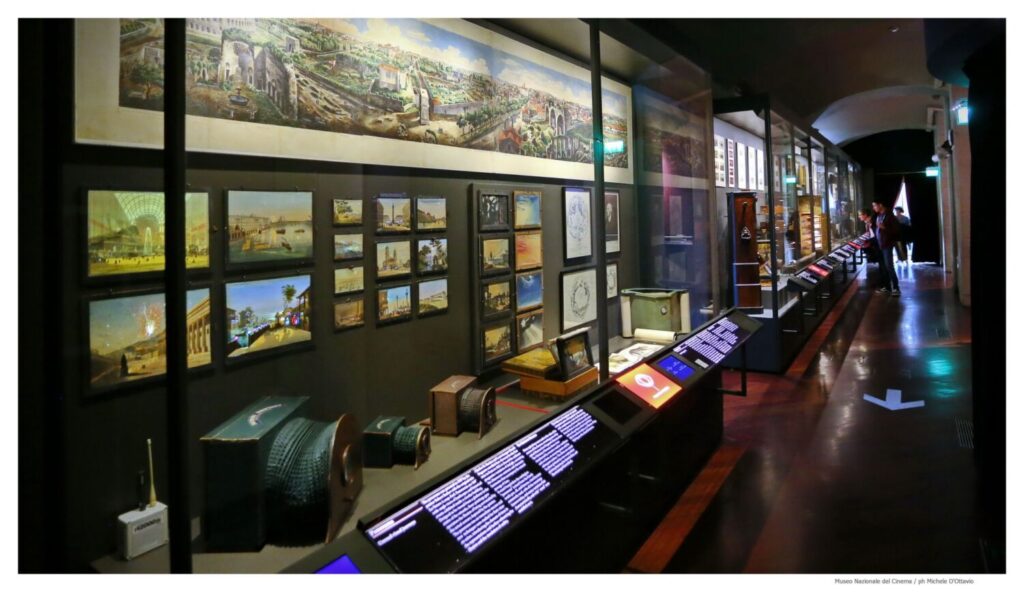
The museum traces the history of cinema from early optical devices and camera obscura experiments to the rise of the modern film industry. The permanent exhibition includes original props, film posters, costumes, interactive installations and rare objects linked to the early development of moving images.
As you move through the building, the different levels follow distinct thematic sections, each with its own atmosphere and exhibition style:
- Archaeology of Cinema
- The Temple Hall
- Temporary Exhibitions
- The Film Production Section
- Posters and Advertising Gallery
Together, these areas create a journey that is both chronological and experiential, allowing you to explore cinema not only as entertainment but also as technology, art and cultural history.
Archaeology of Cinema: The Origins of Film
The Archaeology of Cinema is my favourite section inside the National Museum of Cinema because it allows you to experience early visual technologies first-hand. Many of the optical devices on display are the very instruments that paved the way for the birth of cinema. Rather than simply observing objects in glass cases, you are encouraged to understand how light, lenses and illusion shaped the origins of moving images.
One section is dedicated to eighteenth-century optical boxes, which were once extremely popular across Europe. Through cleverly arranged lenses and lighting effects, these devices transformed static scenes into immersive spectacles. Day could turn into night, and distant landscapes appeared almost alive. Writers such as Rousseau and Goethe described these experiences, while painters depicted them as part of everyday cultural life.
The section also features stereoscopes, nineteenth-century devices designed to create the illusion of depth by combining two flat images into a single three-dimensional view. The model developed by David Brewster and presented at the Great Exhibition in London in 1851 became a sensation, with hundreds of thousands sold in just a few months. Soon, stereoscopy evolved into a widespread social phenomenon that blurred the line between science and entertainment.
You will also encounter dioramas, large-scale panoramic scenes designed to surround the viewer, and the magic lantern, often considered the true precursor of cinema. Invented in 1659 by the Dutch scientist Christiaan Huygens, the magic lantern projected painted glass slides onto walls or screens, laying the groundwork for centuries of experimentation in visual storytelling.
Another highlight is the photography section, which traces the evolution of portraiture from simple personal keepsake to expressive artistic medium. A dedicated room explores chronophotography, a technique that captured sequences of images to analyse movement. By breaking motion into separate frames, it revealed details that the human eye alone could not perceive, anticipating the mechanics of film itself.
The Temple Hall and the Moloch Statue
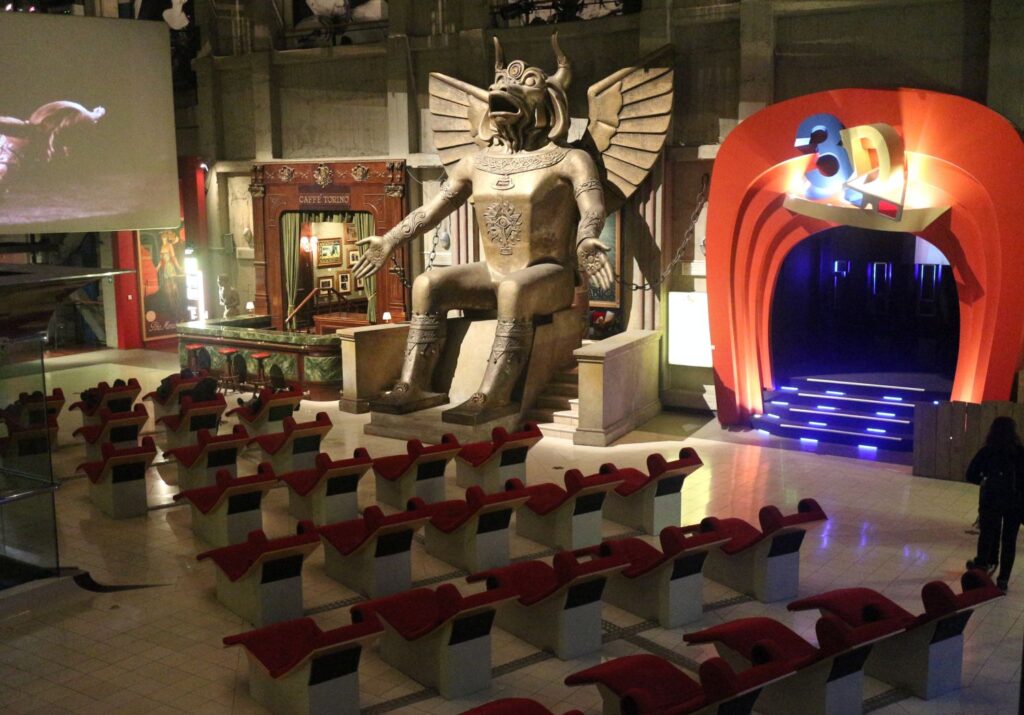
The Temple Hall is the dramatic heart of the National Museum of Cinema. It occupies the vast open space beneath the dome of the Mole Antonelliana. The scale of the room is immediately striking.
At the centre, bright red chaise longues invite you to sit back and watch film clips projected on surrounding screens. Nearby stands the imposing statue of the god Moloch, originally created for the 1914 silent epic Cabiria. The contrast between cinema history and monumental architecture is powerful.
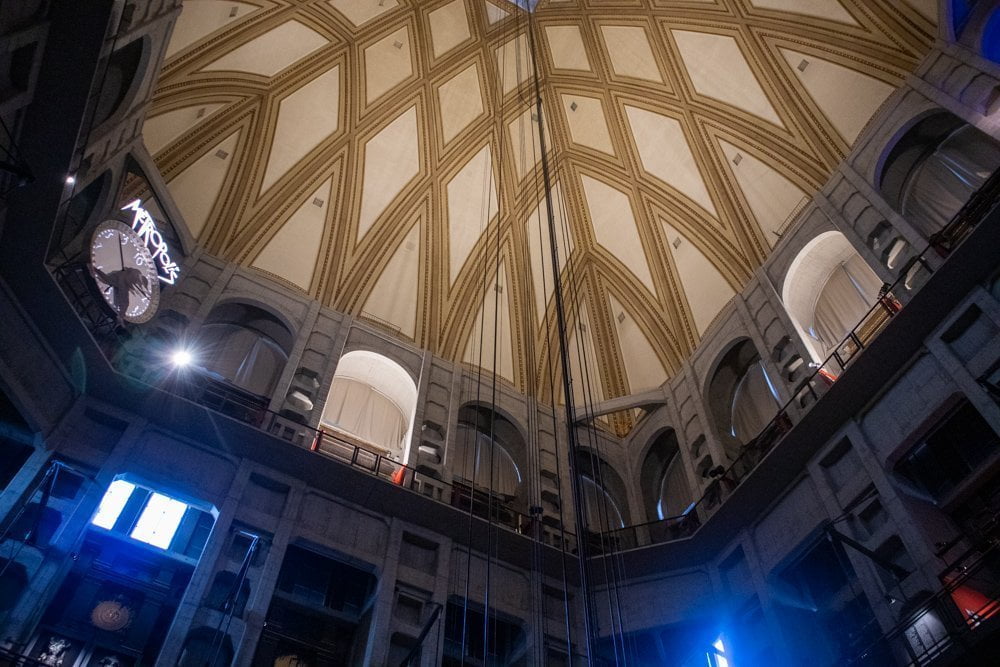
The ceiling rises 85 metres above the ground floor. There is nothing between you and the top of the dome. When you look up, you can see the panoramic glass lift moving slowly through the open void. It glides vertically inside the space, adding a sense of movement to the vast interior.
Around the perimeter of the hall, themed film sets recreate different genres. You can sit on circular beds, step into a Wild West saloon, walk through a refrigerator door, or watch classic cartoons from inside a playful television frame. The experience feels immersive and theatrical rather than traditional or static.
Temporary Exhibitions at the National Museum of Cinema
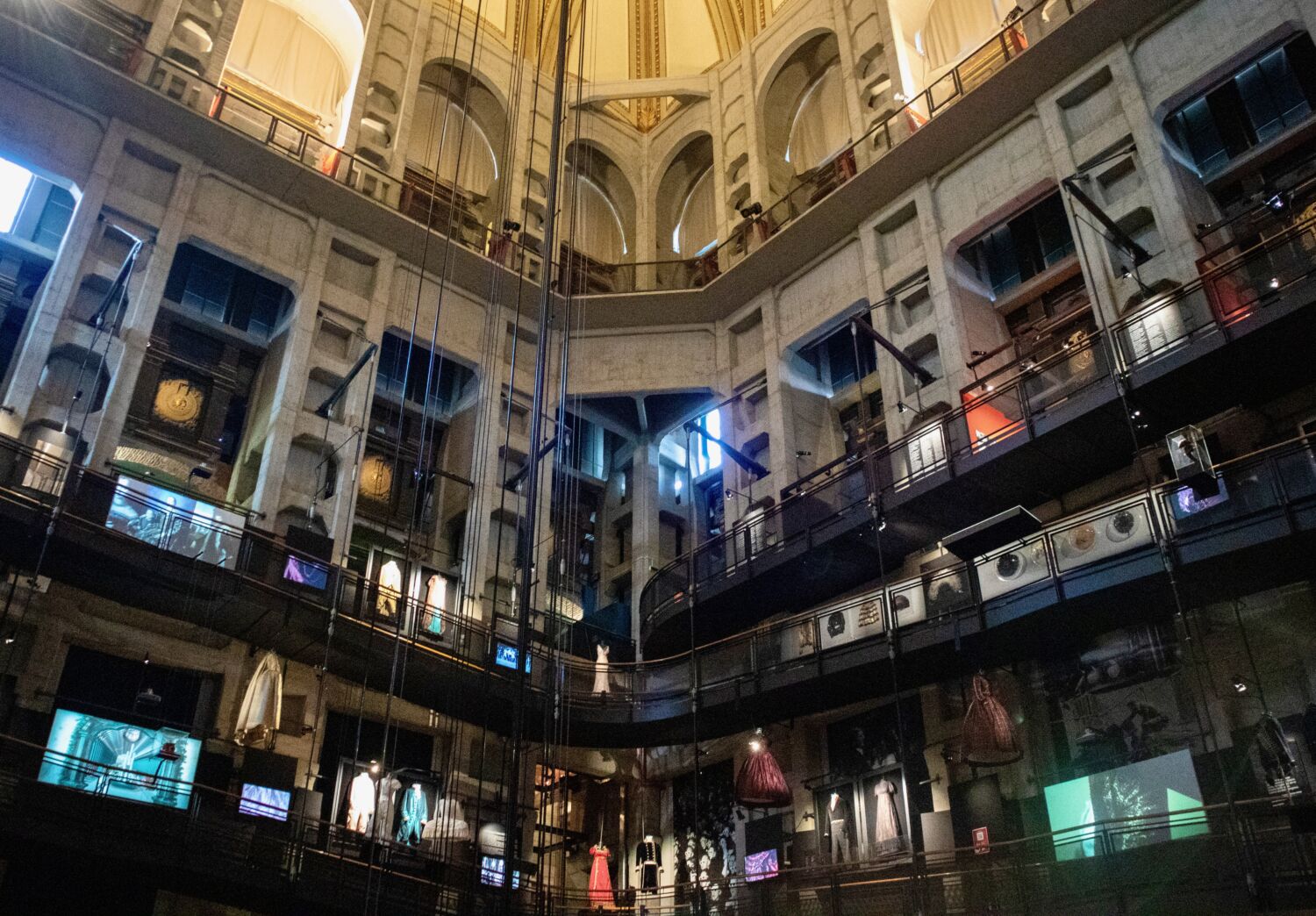
A spiral ramp runs along the inner walls of the dome of the Mole Antonelliana. This space hosts the temporary exhibitions of the National Museum of Cinema. As you walk upwards, the setting itself becomes part of the experience.
During my many visits to the museum , I have seen exhibitions dedicated to a wide range of themes. Some focused on renowned film directors such as Tim Burton or Dario Argento, while others explored costume design, tracing sartorial creations from Cinecittà to Hollywood.
Temporary exhibitions change throughout the year, offering fresh reasons to return even if you have already visited the museum before.
The Film Production Section
The Film Production Section explores the different stages involved in making a film. It covers scriptwriting, directing, set design, costume creation and post-production. Each step is presented in a clear and accessible way.
As you move through this area, you gain insight into what happens behind the scenes. Short videos explain key production processes and introduce the language of cinema in practical terms. The experience feels immersive rather than purely informative.
Along the route, you will see original costumes, archival material and objects linked to Italian cinema, particularly from the 1970s. Together, these displays reveal how creative ideas become the films we eventually watch on screen.
Posters and Advertising Gallery
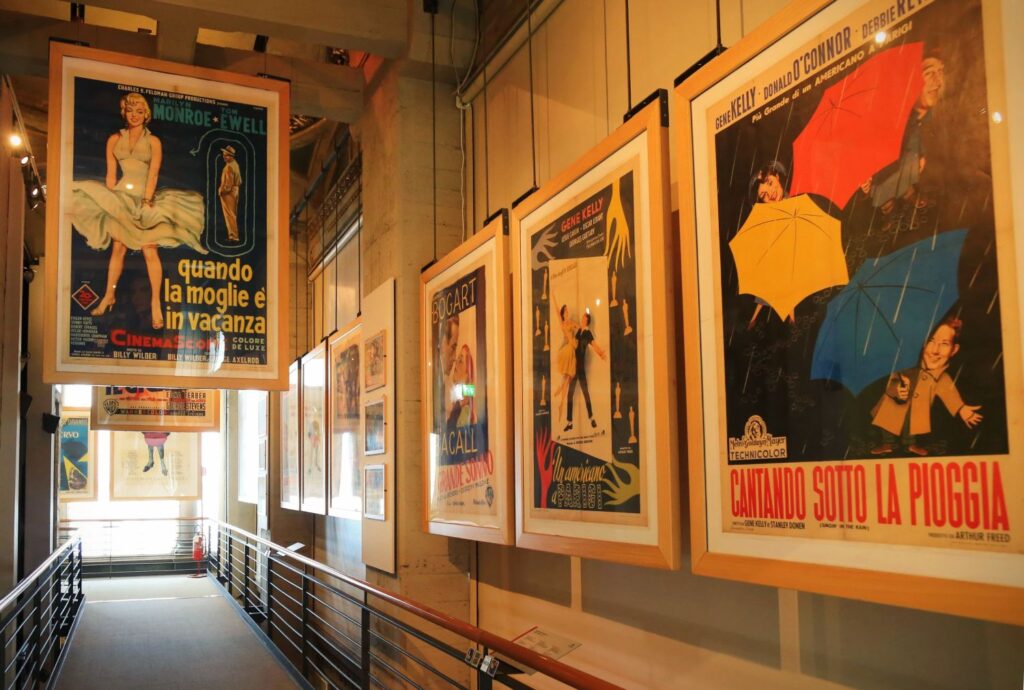
The Posters and Advertising Gallery showcases one of the richest collections within the National Museum of Cinema. The archive includes hundreds of thousands of posters, playbills and promotional materials created for film releases across different eras.
This section is a striking visual walkway. Posters hang above you and line the walls, creating an immersive corridor of colour, typography and graphic design. As you move through the space, you trace the evolution of cinema not only through films themselves, but through the changing styles of visual communication.
The collection spans Italian, American and German cinema, as well as French New Wave classics and selected works from Asian film industries. It is a reminder that film history is also a history of images, marketing and cultural taste.
Turin from Above: The Panoramic Lift and Cupola Ascend
You can ascend the cupola of the Mole Antonelliana for a panoramic view over Turin. There is a viewing terrace 85 metres above ground. From here, you can see the city’s rooftops stretching towards the Alps, particularly on clear days.
There are two ways to reach the top: on foot or by lift.
The staircase is accessible only as part of a guided tour. Tours usually run at fixed times on weekends and public holidays at 10:20, 14:00 and 16:40. On Mondays, Wednesdays, Thursdays and Fridays, access is typically available at 14:00. Children under six years old cannot take the stairs. The Cupola Ascend is also suspended during the summer months and may be affected by weather conditions.
Most visitors choose the panoramic glass lift. The transparent cabin rises through the vast open space of the dome, passing directly through the Temple Hall of the National Museum of Cinema. The ascent takes less than a minute, yet the sensation of moving vertically inside such a monumental interior is striking.
Access to the panoramic lift requires a separate ticket from standard museum admission. A combined ticket is available, but entry to the National Museum of Cinema does not automatically include access to the lift.
Practical Information for Visiting the National Museum of Cinema
The National Museum of Cinema is one of the most visited museums in Turin, alongside the Egyptian Museum. Long queues are not uncommon. At weekends, on public holidays or during particularly popular temporary exhibitions, lines can stretch along the entire street outside the entrance. Queues can also form for the panoramic lift.
I strongly recommend booking your ticket in advance, for both museum and lift. Pre-booking allows you to skip the queue and manage your time more efficiently. Alternatively, you may consider a guided tour that includes the National Museum of Cinema and the panoramic lift, which can help streamline your visit. Planning ahead makes a significant difference, particularly during peak travel periods.
Where to Buy Tickets for the National Museum of Cinema and Skip the Line
I recommend purchasing your tickets online to avoid long queues at the ticket office. If you only want to buy admission tickets, with or without access to the panoramic lift, you can book directly through the official website of the National Museum of Cinema. Right now, guided tours booked via the museum’s website are available only in Italian.
If you only have one day in the city, a combined ticket such as the National Museum of Cinema Skip-the-Line Ticket + Hop-on Hop-off Bus Tour can be a practical solution. It allows you to maximise your time while covering two of Turin’s most popular experiences.
Save Money on Tickets with the Turin & Piedmont Card
If you are planning to visit several attractions during your stay, the Turin & Piedmont Card is the most cost-effective option. It offers free entry to numerous museums, castles and royal residences across Turin and the wider Piedmont region. Included attractions range from the Reggia di Venaria Reale and the Egyptian Museum to the MAUTO National Automobile Museum, and the Royal Museums of Turin. The three-day card generally provides the best value for money.
Guided Tours of the National Museum of Cinema in English
At the time of writing, the official website of the National Museum of Cinema allows you to book guided tours in Italian only. If you would like a tour in English, it is worth considering the National Museum of Cinema & Mole Antonelliana Guided Experience, which also includes access to the panoramic lift.
Visiting the National Museum of Cinema with Children and Teens
If you are visiting with children, planning ahead is important. Italian museums are often less interactive than many international institutions. Some areas of the National Museum of Cinema allow hands-on exploration, but others are more detailed and require patience.
For families with younger children, a tailored option such as the Private Tour for Kids & Families at the Turin Cinema Museum can make the visit much easier. A specialised guide presents the content in a simple and engaging way. This helps children stay focused and understand what they are seeing throughout the museum.
Teenagers with an interest in science, photography or film history are likely to appreciate the museum’s more technical sections. They often enjoy exploring the early technologies behind cinema. For this age group, the experience can be both educational and rewarding.
How to Get to the National Museum of Cinema
The National Museum of Cinema is located inside the Mole Antonelliana, just a short walk from Piazza Castello, the historic heart of Turin. It is also only a few minutes from Piazza Vittorio Veneto. You can easily combine your visit with the Royal Museums of Turin or the Teatro Regio nearby.
From the city centre, you can reach the museum on foot. Public transport connections are also convenient. Bus lines 55, 56 and 61, as well as tram lines 13 and 15, stop at Rossini on Via Po. Bus 68 stops at Verdi on Via Rossini. Tram 16 stops at Palazzo Nuovo on Corso San Maurizio. For the easiest route from your hotel, check Google Maps before you set out.
I don’t recommend getting to the National Museum of Cinema, and in the centre of Turin in general, by car because of the shortage of parking and the limited traffic zone. If you’re driving, remember that only in Turin does the traffic system differ slightly, requiring you to turn right onto the main road to turn left, and vice versa.
You can buy public transport tickets at tobacconists and newsstands, or through the official transport app TO Move (TO Move app for iOS and TO Move app for Android). If you travel with a small group I recommend the Daily x4 ticket, for four people travelling together.
Museo Nazionale del Cinema (National Museum of Cinema)
Via Montebello, 20/A
10124 Torino
Where to Stay in Turin
In Turin, as in all major cities, location greatly influences your experience, because staying in the city centre means having museums and historic cafés just a short walk away. Among the finest hotels are the NH Collection Torino Piazza Carlina, modern and functional, and the elegant Principi di Piemonte | UNA Esperienze, right in the heart of the city.
Alternatively, more affordable and equally interesting options include the contemporary hostels with co-working spaces and private rooms at Combo Torino, set inside a former fire station, and the residence CX Turin Belfiore, located in Aurora and San Salvario respectively, two lively neighbourhoods filled with restaurants and bars.
Why the Mole Antonelliana Is Worth Visiting
Visiting the Mole Antonelliana and the National Museum of Cinema is not simply about ticking off one of Turin’s landmarks. It is about stepping inside a building that tells two parallel stories: the architectural ambition of nineteenth-century Turin and the evolution of cinema from optical illusion to global industry.
Feel free to share your experience in the comments. From the soaring Temple Hall to the panoramic lift rising through the dome, I would love to hear what impressed you most. I would love to hear your impressions, whether you are passionate about film or you were simply looking for the best view over the city.
