
Trekking in Hoang Su Phi is one of the most interesting experiences you can have in northern Vietnam. In the Ha Giang region, you still see terraced rice fields far from mass tourism. You also meet ethnic minorities who farm in remote mountain villages. The trek is physically demanding, yet it lets you observe mountain crops up close. You also experience local hospitality in simple, authentic homestays surrounded by tea trees and medicinal plants.
Table of Contents
Hoang Su Phi or Sapa: Comparing Two Rice Terrace Treks in Northern Vietnam
One of the most incredible experiences you can have in Vietnam is trekking through the northern mountains. There you can see the famous terraced rice fields. They turn an intense green between May and September, during the growing season. Even out of season, such as in January during my trip to Hoang Su Phi, the landscapes remain beautiful.
PLAN YOUR TRIP TO VIETNAM – 5% discount on your eSIM and travel insurance
For getting around Vietnam with ease, choose a Holafly eSIM: you get unlimited internet, perfect for using Google Maps, Grab or other navigation apps, booking transport on the go, and sharing photos and videos in real time on WhatsApp without worrying about local SIM cards or extra charges.
For extra peace of mind, pair connectivity with Heymondo travel insurance, which covers you in case of medical emergencies, delays or cancellations. A practical solution that lets you focus on exploring Vietnam, rather than dealing with unexpected setbacks.
The best-known and most visited mountain destination for trekking among the rice terraces is Sapa. This town is more accessible and organised for international tourism. In Sapa you will find panoramic hotels, restaurants and trekking agencies accustomed to welcoming travellers from all over the world. English speakers are easy to find, and local businesses design their services for travellers who stay only a short time.
If you prefer to visit lesser-known areas far from mass tourism, Hoang Su Phi is a rural district in Ha Giang province. It lies in the far north of Vietnam, close to the Chinese border. The experience feels less structured and brings you closer to local life. These communities still see very few tourists.
To reach Hoang Su Phi from Hanoi, you travel for more than six hours. The road winds through mountains and small isolated villages. Local people do not speak English, so you need to arrange the trip with a guide from Hanoi alongside the local trekking guide in order to communicate.
There are few hotels in the area. However, you can stay in deliberately isolated luxury properties such as the eco-resort Panhou Retreat. Alternatively, you can stay in the homes of local families in the villages, in very simple homestays. This very distance from mass tourism makes Hoang Su Phi more authentic and more intense to experience.
Hoang Su Phi Trekking Guide: Elevation, Distance and Mountain Landscapes
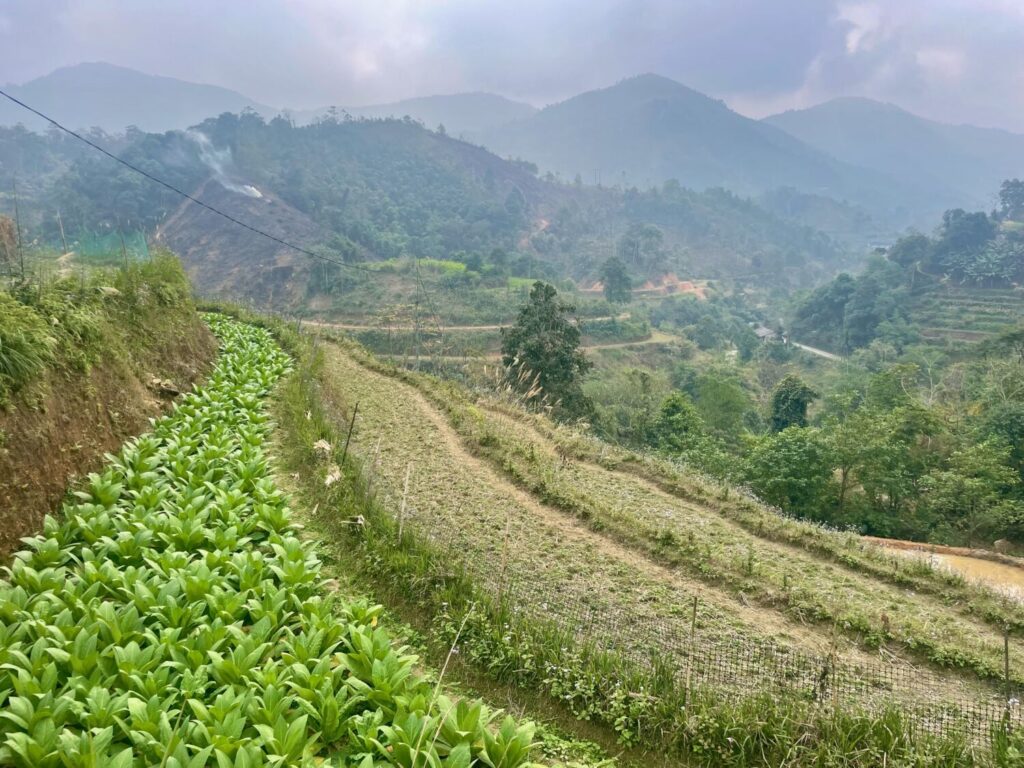
Trekking in Hoang Su Phi is not a simple scenic walk. It takes place in a mid-altitude tropical mountain area, between 900 and 1,600 metres. Terraced rice fields shape the landscape, and heat and humidity vary by season.
The route I followed with a local guide was about nine kilometres long, with 600 metres of elevation gain spread between steady climbs and steep descents. The duration alone does not fully convey the effort required, as the terrain can be slippery and uneven.
Visiting northern Vietnam in January meant we avoided the intense summer heat. Reaching the ethnic minority villages on foot remained demanding because of the elevation changes and physical effort involved. The landscape of Hoang Su Phi’s terraced rice fields, however, is spectacular and rewards the effort in any season.
Local communities shape the hills into terraces so the rice can retain the water it needs to grow. Small earthen embankments support each level and turn the mountain into a sequence of steps that appear vividly green during the harvest season. At the top of the hills you can see small isolated houses, where families from the mountain ethnic minorities live.
Mountain Farming in Hoang Su Phi: Rice, Tobacco, Cinnamon and Traditional Crops
Trekking in the mountains of Vietnam is fascinating. It reveals how ethnic minority families have built a self-sufficient agricultural ecosystem over time.
As you walk along the paths, the guide shows you that, alongside the rice fields, mountain farmers also grow tobacco. This plant has large leaves that resemble oversized heads of lettuce. Families harvest the leaves, dry them and then roll them to produce handmade cigarettes. They make them for local consumption, not for tourists, and they rarely sell them.
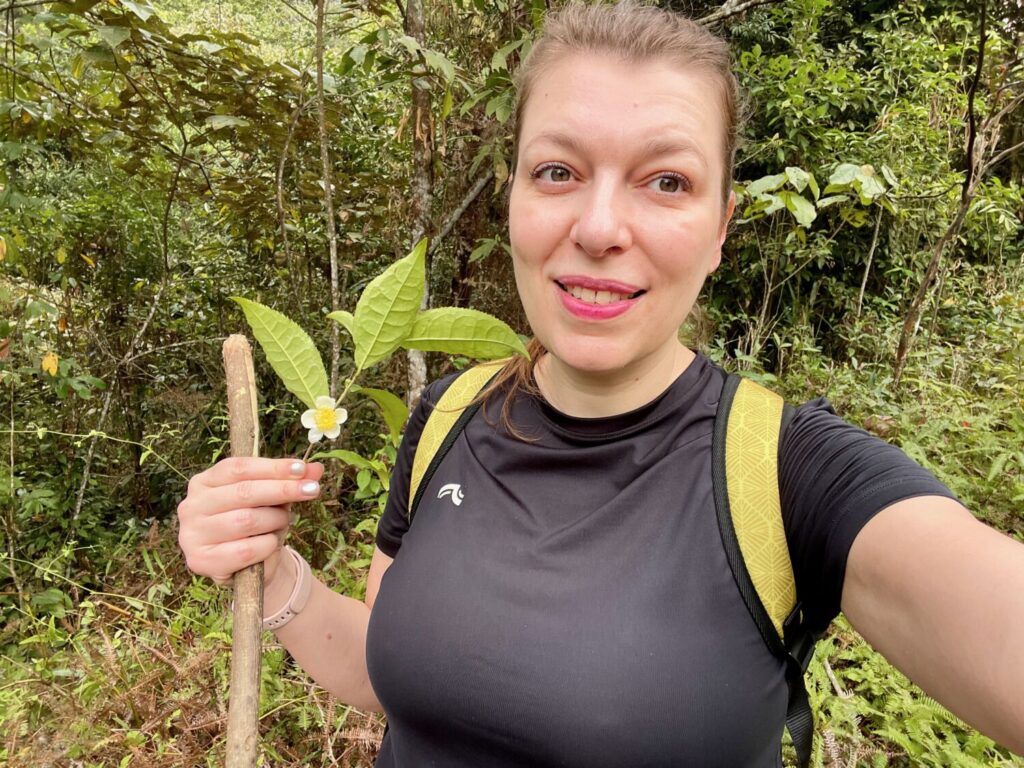
Along the way you can also see cinnamon trees, whose inner bark is edible. Many people chew fresh cinnamon. Locals also use wild tea plants, which are not suitable for trade, as traditional remedies, for example after childbirth. Farmers keep cultivated tea plants low, at around fifty centimetres, because pruning encourages new shoots.
Bamboo is another constant presence in the mountain landscape around Hoang Su Phi. People use it both as timber and to prepare a local delicacy. The guide explained that when the bamboo stem matures, they drill holes into it and insert larvae, which grow inside. After a certain period, they cut the bamboo and eat the larvae as a local speciality, which I did not have the chance to taste.
Farmers mainly grow tapioca as animal feed because they consider it a food that “warms” the body. They often grow ginger in sacks, in a way that resembles how we grow potatoes in balcony gardens. The difference is that here it is not just a hobby, but a matter of subsistence.
High-Altitude Tea in Hoang Su Phi: Ancient Tree-Grown Plantations and Tasting Experience
During our trek in Hoang Su Phi, my group made a detour to visit the Fin Ho Tea cooperative. There, we joined a tea tasting to learn about the different varieties produced in the area. Among the most unusual types, we sampled pressed black tea. This preservation method originated in these mountains to make transport easier.
Tea from high-altitude plantations is considered more valuable because growers follow a method passed down through generations that allows the plant to grow tall. Tea plants can become real trees when farmers do not prune them, unlike in commercial plantations. High-mountain tea also has only one harvest season, in December. This limits its quantity and further increases its value.
Trekking in Hoang Su Phi: Meeting Ethnic Minorities in Northern Vietnam
A trek in northern Vietnam is particularly interesting. It allows you to closely observe how ethnic minorities in rural villages live, according to a lifestyle very different from our Western one. The idea of living in harmony with nature is appealing in theory. In practice it involves sacrifices, hard work and responsibilities that, personally, I would not choose at all.
While observing daily life in such an isolated place, I found myself wondering whether the way families live in northern Vietnam is truly stranger than ours, or if the opposite might be true. In the end, it comes down to perspective, shaped by where you are born and raised. This comparison is the real richness of trekking in remote areas of Vietnam.
Daily Life in Hoang Su Phi’s Mountain Villages: School, Work and Local Economy
In mountain areas, in Vietnam as anywhere else, every aspect of daily life requires adaptation and personal organisation. For example, going to school is something we take for granted, but for those living in the most isolated areas it is a demanding choice. As we walked through the rice fields, the guide pointed out the only local school. It was a large yellow multi-storey building on the opposite side of the valley. Children from the villages walk there every day, often for hours. Only those who live near the main road can sometimes get a lift on a motorbike from their parents.
In the mountains of Vietnam there is no waste collection service. Our group was shocked to discover that people burn plastic in brick containers beside their houses. The truth is that without a public disposal system, separating waste does not make sense for locals. Those who live in such isolation know they must handle everything themselves in the most efficient way possible.
Electricity at home is another aspect we take for granted. In Hoang Su Phi, only families who live near the road are connected to the grid and pay for electricity based on consumption, as in urban areas. Families living in more remote locations use a generator instead.
Work as we understand it, with factories or offices, does not exist. Mountain community families earn their income from agriculture and livestock farming. Shops are far away, so hunting wild animals is also common. During the trek we saw people repairing a stretch of road and holding a large rat-like animal. The guide explained that they would eat it that evening.
Ethnic Minorities in Hoang Su Phi: Red Dao, Black Hmong and Tay Explained
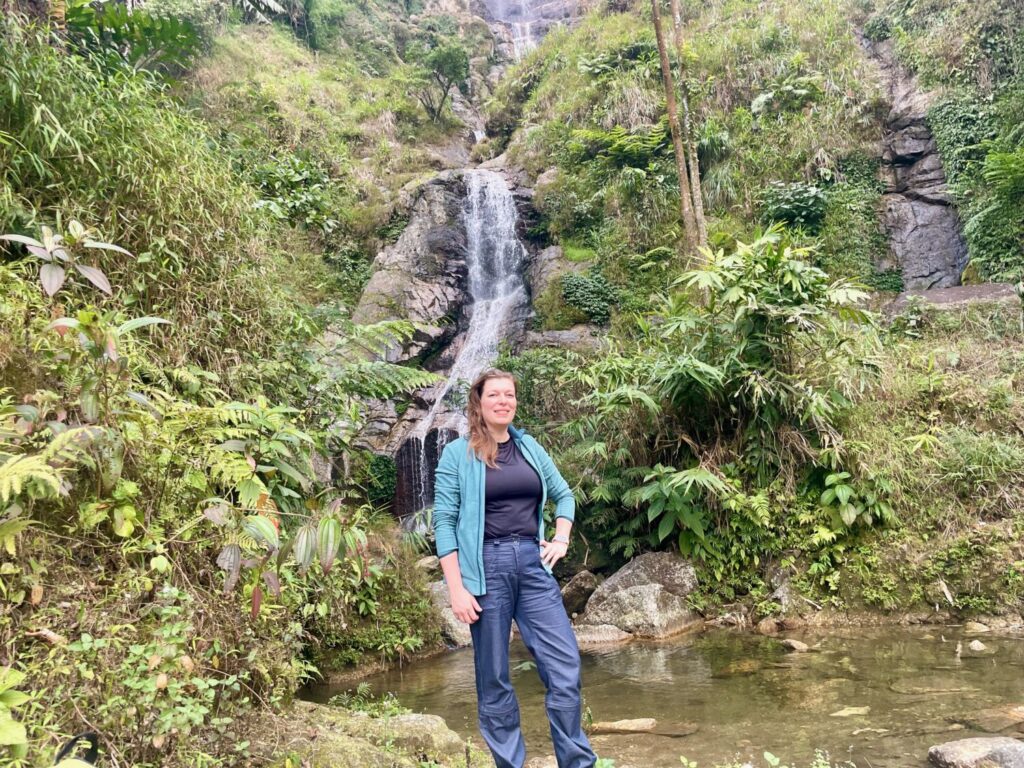
During a trek in Hoang Su Phi you meet different communities, each with distinct clothing, traditions and house architecture, even though many people describe them simply as “ethnic minorities of northern Vietnam”. The colours of their garments, the structure of their homes and their daily habits are not folklore for tourists. They reflect the real life of families who live in such isolation that they preserve traditions passed down through generations.
Red Dao in Hoang Su Phi: Hand-Embroidered Clothing and Mountain Traditions
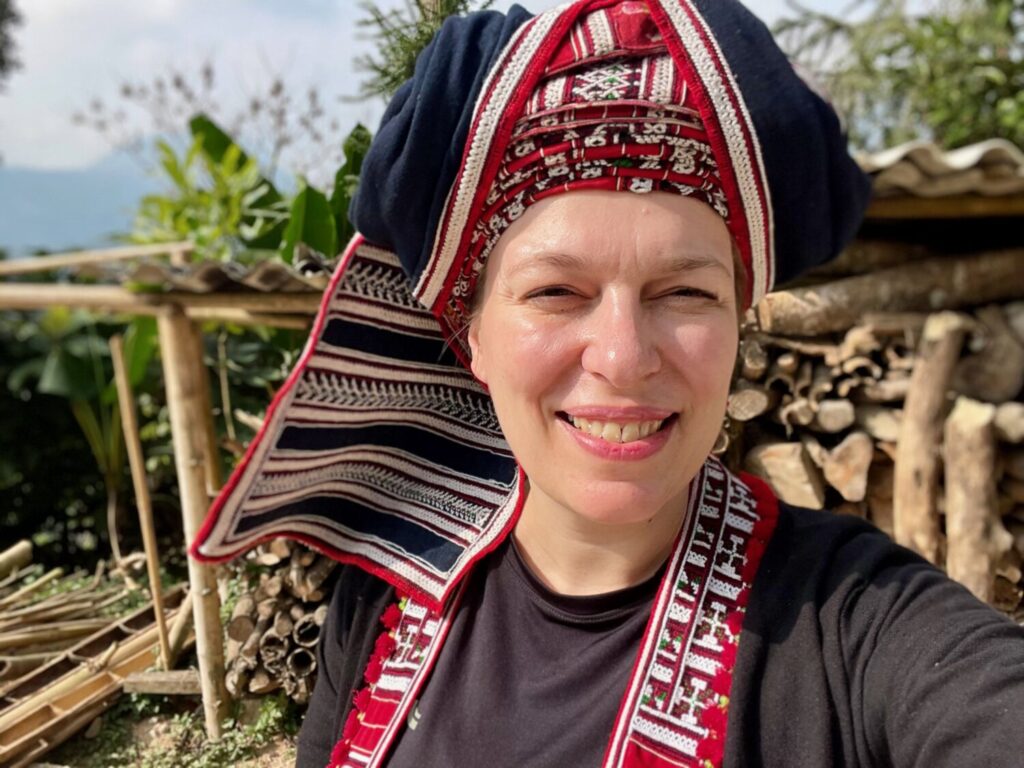
My first encounter with Vietnam’s ethnic minorities took place in the village of Nam Nghi. We stopped for lunch at the home of a Red Dao family, a subgroup of the Dao ethnic group recognised for the complexity of their traditional clothing. The Red Dao mainly live in the northern mountain provinces of Vietnam, including Ha Giang district, and maintain a strong cultural identity linked to family rituals and ancestor worship.
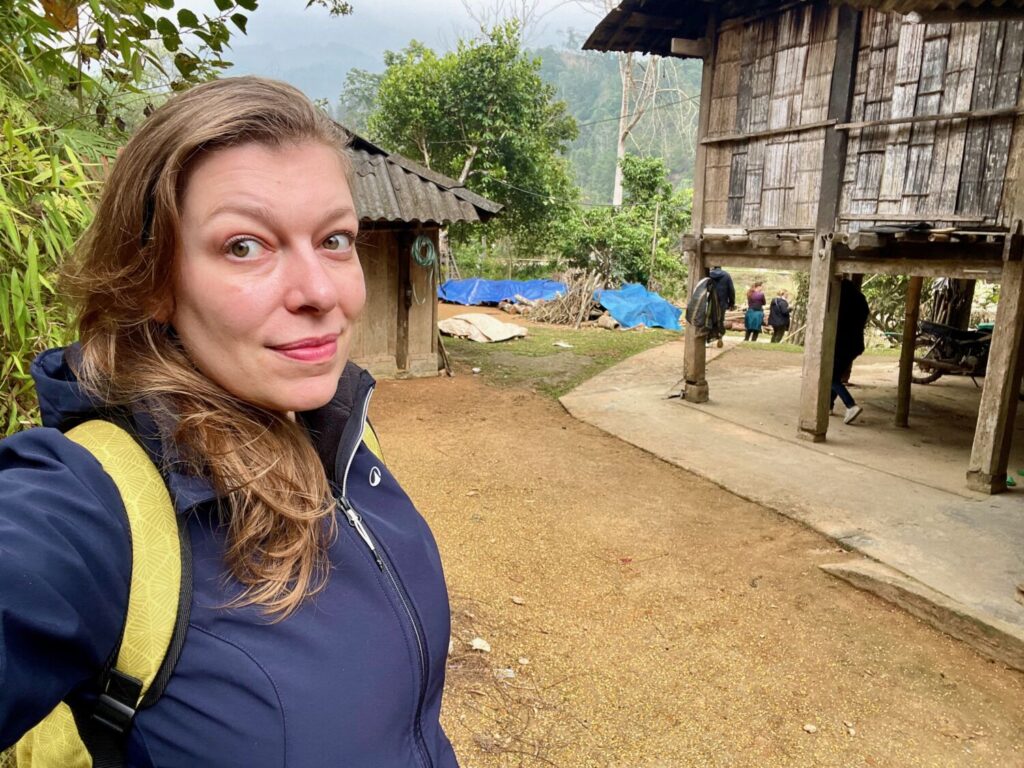
The house of the family who hosted us was made of concrete, painted in colours that imitated wood. It consisted of a single large room with a tiled floor and a few pieces of furniture arranged along the walls. As in many traditional mountain homes in Vietnam, all daily activities take place in the main communal room. Next to the house there was an outdoor kitchen, with a simple cement surface instead of proper flooring.
The lady of the house was a skilled embroiderer. She showed us the traditional clothes and taught us how to wear them for photos. One outfit can require up to a year of work because it is entirely sewn and embroidered by hand. Red Dao families wear these clothes in everyday life and make new ones to celebrate the Lunar New Year.
The guide explained that if you want to buy one, there are no shops. At most, tourists can purchase traditional garments as they are, on a “what you see is what you get” basis, directly from the families. The cost is around 1,000,000 VND, about €30, which is almost nothing considering the time required to embroider them.
Black Hmong Culture: Indigo Textiles, Hearth Traditions and Two-Storey Homes
The Black Hmong are a subgroup of the Hmong ethnic minority in northern Vietnam. They stand out from other ethnic groups for their dark indigo clothing, almost black, dyed with natural pigments obtained from plants grown in their gardens. Traditionally, Black Hmong women not only dye the fabrics but also weave them at home. As someone who enjoys spotting unexpected connections, discovering this reminded me of the traditional indigo dyeing of Hungary, thousands of kilometres away.
Their houses accommodate several generations under the same roof. They have two storeys, as women usually sleep on the ground floor and men on the first floor. Black Hmong homes have two kitchens, always without proper flooring, just cement. Families use one kitchen to prepare food for themselves and the other to prepare food for the animals. The hearth holds strong symbolic value, and people consider placing your feet near the fire a sign of bad luck.
Tay Ethnic Minority: Stilt Houses and Authentic Hospitality in Northern Vietnam
The Tay are the largest ethnic minority in Vietnam. They live in stilt houses that closely resemble traditional Thai dwellings, from which they likely derive. Unlike the Red Dao and Hmong, Tay families often live in wider valleys and also cultivate rice in the lowlands.
The Tay raise their houses above the ground to protect them from humidity and animals, and above all to keep the interiors cooler during the hot summers. In Tay families there is no concept of privacy as we understand it in Europe. People live and sleep together in one large communal room.
During our trek in Hoang Su Phi, the guide asked the owner if he could show us his home. The owner invited us in for tea. We entered the main room, walked across the bamboo floor and sat down with our host. It was a moment of genuine hospitality. It made me reflect on how unlikely it would be in Europe for someone to open their home like this, simply because you are a curious traveller.
What to Eat on a Hoang Su Phi Trek: Traditional Meals in Local Family Homes
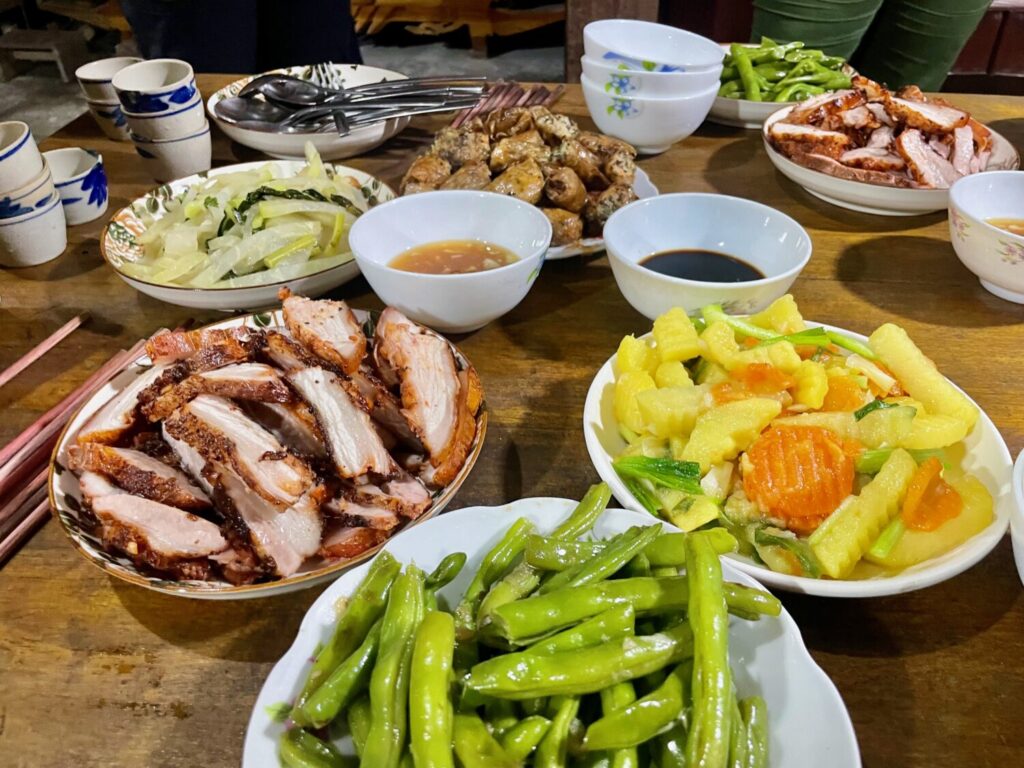
During a trek in the mountain villages of northern Vietnam, you always eat in local family homes because there are no restaurants in the villages. Families prepare the meals with ingredients they grow in the fields or raise in the yard, and the dishes are delicious in their simplicity.
There is no menu to choose from and you eat what the host family prepares. For lunch, for example, we had meat, eggs and vegetables, accompanied by white rice.
Dinner included several dishes. I especially loved the fried rolls wrapped in taro leaves, similar to rice paper, filled with pork, eggs, onion, mushrooms and chilli. Our host family also grilled pork over charcoal and served it with stir-fried vegetables and rice. The real surprise, however, was toasting with “happy water”, a homemade spirit, together with the host family.
Homestay in Hoang Su Phi: What to Expect in a Real Ethnic Minority Home
Families who open their homes as homestays host visitors on average once or twice a month, at most three times. Guests mainly come from European countries such as France, the Netherlands, Germany and Italy. There is no specific type of group: families, couples or small organised groups all take part. The guide explained that Vietnamese travellers rarely choose the homestay experience because they do not enjoy walking in the mountains.
The impact of the homestay was strong for my entire group. The accommodation was cold and basic, with thin mattresses placed on the floor on a wooden mezzanine covered with mats. The house had no heating and you could feel the humidity. The bathroom was outside and I was the only one in my group who took a shower that evening.
Yet, despite the simplicity of the conditions, we were all surprised by the hospitality. Experiencing first-hand the contrast between material simplicity and human warmth is unique. The Red Dao family who hosted us welcomed us naturally, sharing their home and food without formality. On the other side of the world, in a house without the comforts we know in Europe, I began to reflect. Perhaps we have lost something along the way in how we practise hospitality and human connection.
How to Plan a Trek in Hoang Su Phi: Practical Tips and Local Guides
An experience as authentic as trekking in the mountains of Hoang Su Phi is only possible with the support of a local tour operator. Unlike Sapa, which is far more touristic, local guides here do not speak English. For this reason, our guide from Hanoi accompanied us as well.
On your own, it is practically impossible to move independently between the villages and meet local families from the Red Dao, Hmong and Tay ethnic minorities. For this reason, I am very grateful to Travel Sense Asia, which arranged this unique experience. I particularly appreciated that this trek is part of a project created to support a sustainable local economy, backed by the Panhou Retreat in Hoang Su Phi.
From a practical point of view, it is important to have realistic expectations. We imagined a simple mountain walk, but the route proved far more demanding than expected. If you want to have this experience, I recommend asking in advance not only about the duration of the trek, but also about the distance and elevation gain. You may also want to compare it with someone used to mountain walking. Duration alone is not enough to understand the level of difficulty.
You must also be aware that a real homestay is not a B&B, but a house in an isolated mountain village. The accommodation is very basic by Western standards. You sleep on the floor on a thin mattress, you hear roosters crowing at unlikely hours, the bathroom is outside, there is no hairdryer and in the morning your clothes may still be damp, with no privacy at all.
Trekking in Hoang Su Phi: Costs, Prices and Practical Budget Guide
As for costs, the trek and the homestay were included in our 12-day itinerary from Hanoi to Ho Chi Minh City, so I cannot separate them. If you are interested only in this experience, you can contact the Travel Sense Asia team directly.
Online I found that a two-day, one-night tour from Ha Giang costs around €200. However, this option follows a different itinerary and includes fewer encounters with local families than the one I experienced. Personally, before booking such a demanding experience, I would ask for a quote from a company already tested by other travellers, such as Travel Sense Asia.
Trekking in the mountains of northern Vietnam does not require mandatory tips. Still, our guide suggested leaving a tip around 200,000 VND for lunch. That is approximately €6 for a group of seven people plus two guides. As a result, we left a little more at the homestay where they prepared dinner and breakfast for us. I realised that local families in the mountains of Hoang Su Phi are not truly accustomed to tourism when we handed over the tip. They had not expected the gesture at all.
What to Wear for Trekking in Hoang Su Phi: Essential Clothing and Footwear
A trek in Hoang Su Phi is not a simple scenic walk and the right clothing truly makes a difference. The climate is humid all year round, yet it can also become very hot. In January, during my trip, we set off in the morning wearing jackets and shortly afterwards we were in short-sleeved T-shirts.
The most important thing is to dress in layers and wear breathable technical clothing that dries quickly. Especially if you stay overnight in a homestay, keep in mind that humidity lingers on your skin and cotton clothes do not dry well during the night.
The route to see the terraced rice fields follows uneven paths. Steep sections and dirt tracks can be slippery. Trekking shoes are essential. I recommend soles with good grip and a stable structure, as the elevation gain and descents can be demanding.
Trekking in Hoang Su Phi: An Honest Experience Review
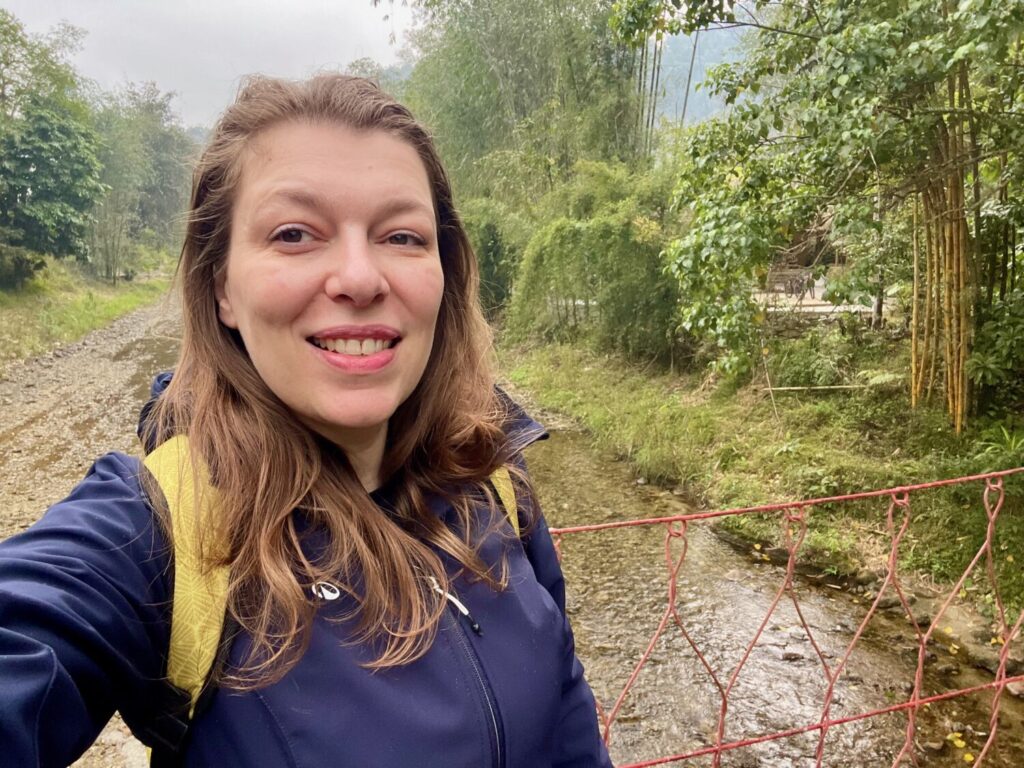
A trek among the terraced rice fields of Hoang Su Phi is not just an intense mountain walk. It takes you into a remote and fascinating setting, offering direct contact with a way of life that is essential and far beyond your comfort zone.
The route is physically demanding, the homestay is basic and communication is not immediate. Yet precisely for this reason, the experience becomes intense and memorable. Through trekking, you can closely observe communities that live in close contact with nature and still rely solely on their own resources.
Hoang Su Phi is not a convenient destination, but a place that invites you to observe, adapt and reflect. Feel free to share in the comments what you think of this experience. Let me know whether the idea of this kind of trek in northern Vietnam has sparked your curiosity.
