
In northern Vietnam, tea is not just a drink but a daily gesture that reflects landscape, tradition and community. Among the mountains of Hoang Su Phi, I realised that tasting tea means understanding where it comes from, its cultivation and the people who produce it. From wild tea plants to centuries-old trees, this experience allowed me to see tea in a completely different way. In these remote mountain areas, tea is deeply connected to local life. Families cultivate it on small plots, harvest it by hand and share it as a gesture of welcome. Spending time in the region helped me recognise that tea here is not a commodity first, but part of a living cultural system rooted in place.
Table of Contents
Tea in Northern Vietnam: Culture, Community and Everyday Tradition
In Vietnam, a cup of tea offered when you arrive at someone’s home is a gesture of welcome. I experienced this at the Travel Sense Asia office in Hanoi, yet no ceremony is required. From rural shopkeepers to farmers in the mountains, everyone keeps a small table ready with a teapot and tiny cups.
It does not need to be a refined tea set. It can simply be a plastic thermos, like the ones served in the homes of Dao, Hmong or Tay families in the northern mountains. A cup of tea is the quiet way Vietnamese people say welcome, without the need for words.
PLAN YOUR TRIP TO VIETNAM – 5% discount on your eSIM and travel insurance
For getting around Vietnam with ease, choose a Holafly eSIM: you get unlimited internet, perfect for using Google Maps, Grab or other navigation apps, booking transport on the go, and sharing photos and videos in real time on WhatsApp without worrying about local SIM cards or extra charges.
For extra peace of mind, pair connectivity with Heymondo travel insurance, which covers you in case of medical emergencies, delays or cancellations. A practical solution that lets you focus on exploring Vietnam, rather than dealing with unexpected setbacks.
Camellia sinensis Explained: The Plant Behind White, Green and Black Tea
The tea plant is the botanical species Camellia sinensis, and it is always the same plant for the different types of tea you find on the market. Whether growers keep it as a low bush in lower areas or allow it to grow into a tree at higher altitude, the species remains the same.
What distinguishes white, green and black tea is the way producers process the leaves after harvesting. In practice, it is not the plant itself that determines colour, aroma and intensity, but the processing stage known as oxidation.
Producers handle white tea with minimal intervention, simply drying the buds and young leaves to preserve a delicate, floral profile. Green tea undergoes rapid heating after harvesting, which stops oxidation and retains fresh, vegetal notes. For black tea, they allow the leaves to oxidise for longer before drying, which develops more structured flavours and an amber colour in the cup.
Although I had appreciated tea since my time as an expat in England, I had never explored the stages of its production in depth. Understanding how white, green and black tea are made changes the way you approach tasting. In your cup you are not tasting different plants, but different transformations of the same leaf.
How Tea Grows in Northern Vietnam’s Mountain Regions
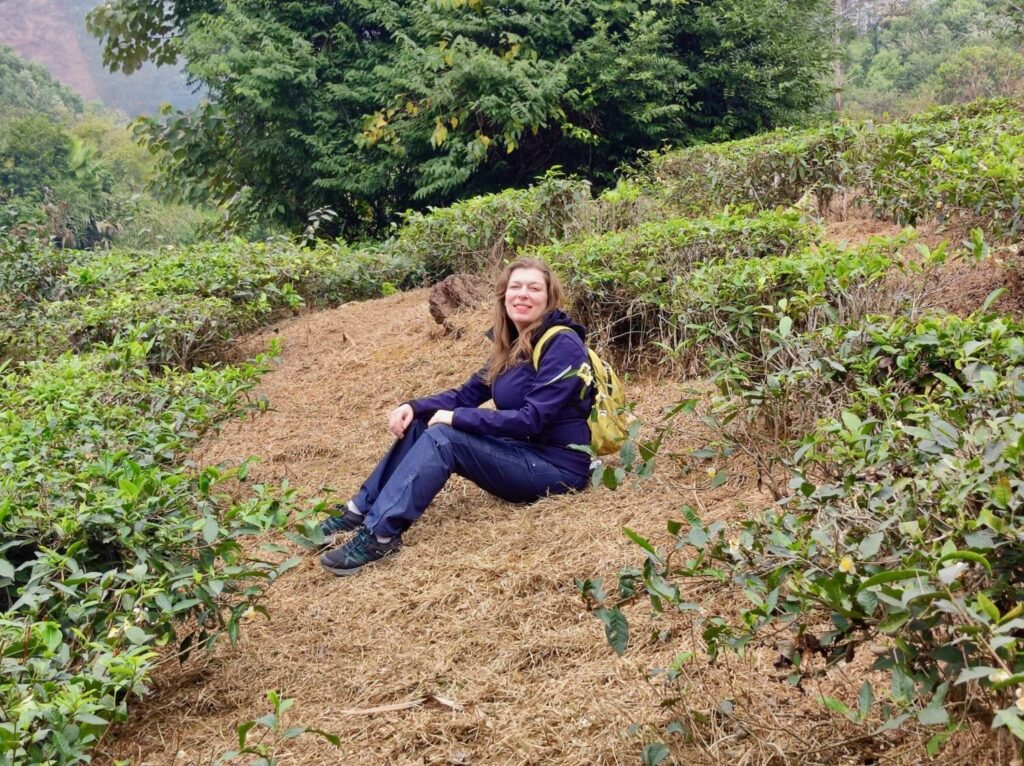
When I thought about tea plantations, I imagined vast, orderly monocultures ready for industrial harvesting and processing. In the mountains of Vietnam, especially around Hoang Su Phi, the reality is very different. Cultivations are small, often family-run and sometimes even spontaneous, far removed from the idea of large-scale production.
Northern Vietnam is a mountainous landscape of steep slopes, tall bamboo and banana trees. Tea plants blend into their surroundings, whether they are part of a family plot or grown for resale. These are not artificial expanses of uniform crops, but living presences integrated naturally into the territory.
Wild Tea Plants in Hoang Su Phi: Tea as Part of Mountain Life
During our trek in the mountains of Hoang Su Phi, our guide pointed out wild tea plants growing alongside the paths. Some families own one or more tea trees near their homes and gather the leaves for daily use, without any commercial exchange.
In the homestays, families always served us tea picked directly from these plants. They did not offer a packaged product prepared for visitors, but the tea they drink every day. A tea grown for the household, not for the market, and part of ordinary mountain life.
Tea Bush Cultivation in Northern Vietnam’s Lower Slopes
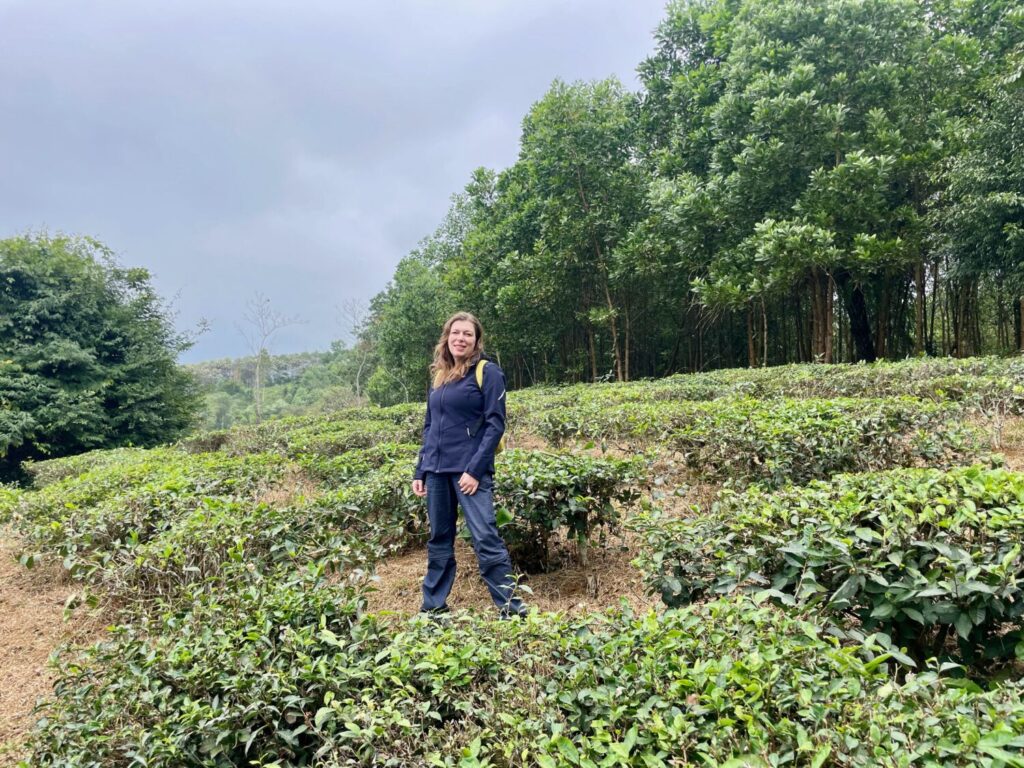
In lower areas, farmers grow tea as low bushes. They prune the plants to the same height and arrange them in rows that follow the slope of the land. We observed this type of cultivation along the road as we made our way towards Hoang Su Phi.
Farmers often sell the harvested leaves to producers or cooperatives for processing, as the owner of the plantation we visited in Bac Quang explained to us. Although these plots are more structured, they remain far from large-scale industrial production, with fields that are still small or medium in size.
High-Altitude Tea Trees in Northern Vietnam and Traditional Hand Harvesting
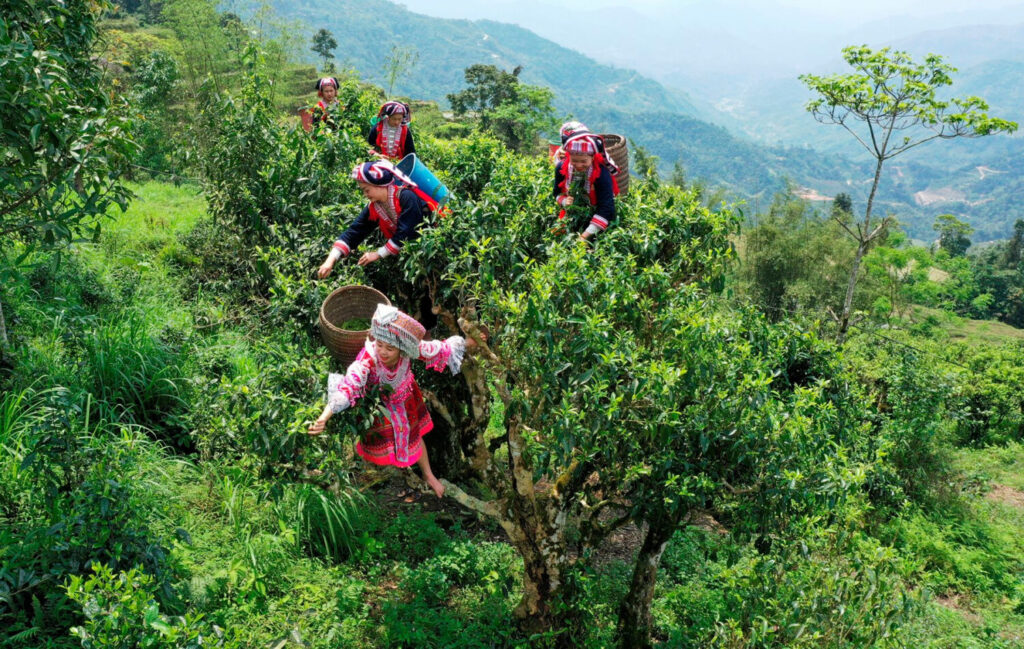
In Vietnam, growers cultivate tea in its most unusual form at high altitude, above Hoang Su Phi. This tea is not only a drink, but also a symbol for the communities of Ha Giang who have cultivated it for centuries.
In the mountains, tea plants do not grow as low bushes but as real trees that can reach several metres in height. Growers harvest them by hand, sometimes climbing onto the higher branches to reach the tender leaves. People consider tea gathered from these ancient trees the most prized, partly because production remains limited.
Visiting Fin Ho Tea Cooperative: How Mountain Tea Is Produced
After seeing wild tea plants in the mountains, learning about production within a local cooperative allowed us to deepen our understanding of the link between tea and territory in northern Vietnam. Visiting the Fin Ho Tea cooperative was not originally part of our trekking plan in Hoang Su Phi.
We were initially meant to continue on foot along mountain paths towards another village. However, as the route proved more demanding than expected, we changed our plans and called our driver to meet us. By coincidence, the Fin Ho Tea tasting room in Ha Giang was close to our agreed meeting point, and curiosity quickly won over fatigue.
Fin Ho Tra (Fin Ho Tea)
Lang Giang Village, Thong Nguyen Commune, Tuyen Quang Province
Fin Ho Tea in Ha Giang: Local Production and Community Impact
The Lý family runs Fin Ho Tea as a producers’ cooperative, now in its fifth generation. They directly manage 140 hectares of cultivation under European organic standards and reinvest in local development. A photograph of the family’s ninety-five-year-old grandmother, who passed away a few years ago, shows her wearing traditional Red Dao dress while sipping a cup of tea and reflects the strong link between production and community pride.
Local communities regard tea trees as culturally significant because they represent a centuries-old tradition. Growers still harvest the leaves by hand, especially the most prized mountain tea buds, and sell their fresh leaves to the cooperative, which oversees drying, oxidation and selection.
For farmers working in these remote areas, tea represents their main source of income. Processing combines traditional craftsmanship with modern techniques, ensuring consistent quality and greater economic stability for families. Personally, I appreciated seeing tea as a concrete driver of mountain economy rather than simply a souvenir for visitors.
Tea Tasting at Fin Ho Tea: What You Learn and What You Taste
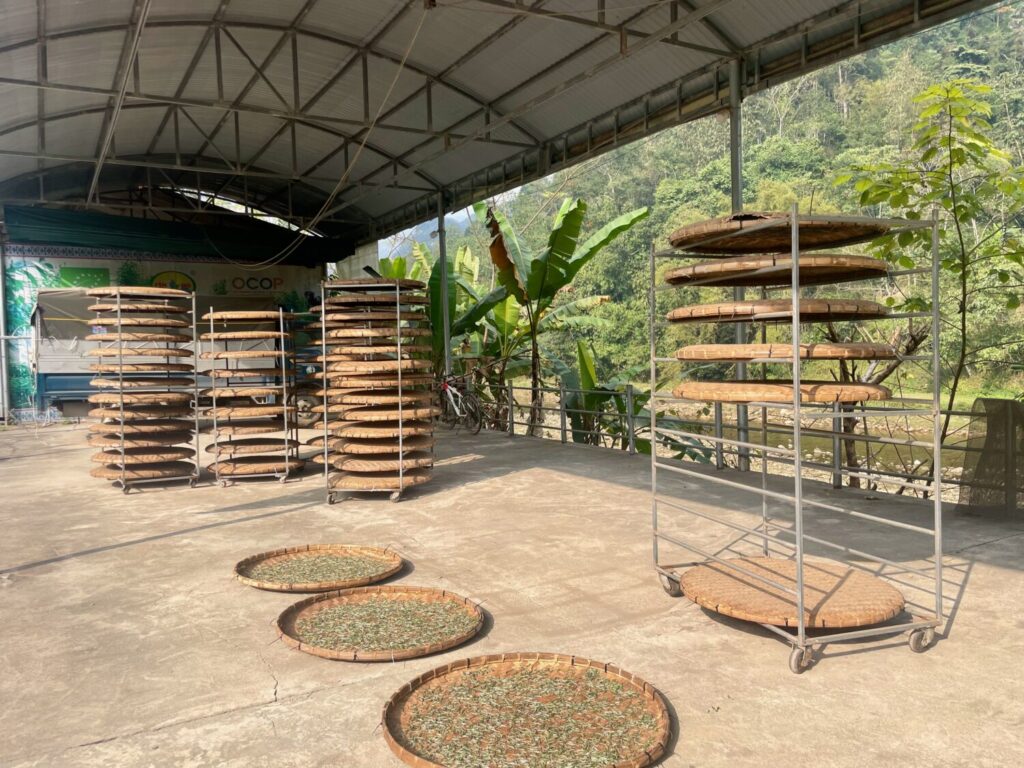
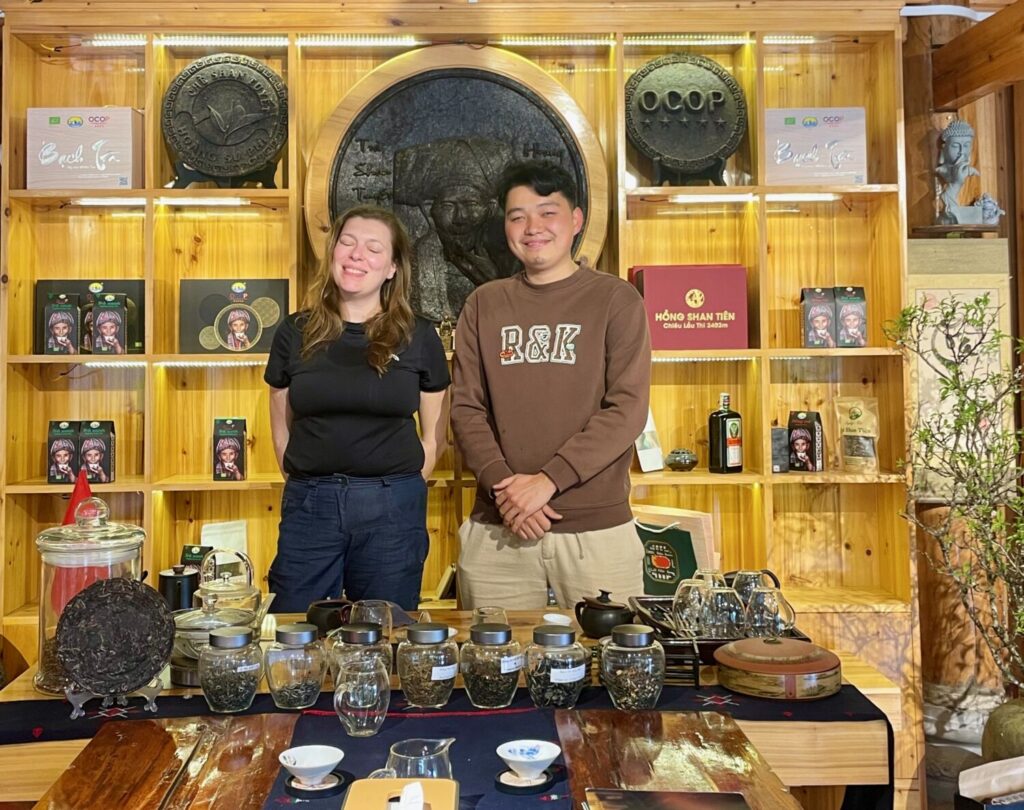
The Fin Ho Tea tasting room is located next to the area where freshly picked tea leaves are left to dry, and it offers tastings of the different varieties produced by the cooperative. I am not an expert, yet the explanation was clear and accessible.
The tasting follows a precise order, starting with the most delicate teas and moving towards the more structured ones. We began with a white Shan Tuyết tea, light and floral, then moved on to a greener, more vegetal variety, and finally to a more oxidised version. On my own, I would not have been able to distinguish the different aromas and flavours, but with guided tasting the differences became much clearer.
Depending on the type of tea, the same leaves can be infused several times, adjusting the steeping time. Each infusion changes in colour and intensity. For some white teas, the second infusion can even be more aromatic than the first.
The most unusual tea I tasted, not so much for its flavour as for its shape, was pressed tea cake. This version consists of fermented tea leaves compressed into solid round forms. Originally developed as a method of preservation and transport in mountain areas, it was used when trade routes were long and difficult.
Its compact form allows the tea to mature over time, and some cakes are stored for years, developing deeper aromas. To prepare it, you simply break off a small piece and steep it. Some of the tea cakes produced by Fin Ho Tea feature an embossed image of Ho Chi Minh, while others show the grandmother in traditional dress who has become the symbol of the cooperative.
Tea Prices in Northern Vietnam and What Influences Them
At Fin Ho Tea you can purchase tea produced locally by the cooperative. It is a rare opportunity to buy genuine mountain tea that you will not find in city shops, but only here or online. It is a purchase that makes sense because it is rooted in place, not in a standardised tourist distribution chain.
Prices for teas grown in the mountains around Hoang Su Phi vary significantly. The most prized qualities, harvested from the oldest trees and in limited quantities, can reach €500–600 per kilo. More accessible versions start at around 1,000,000 VND per kilo, approximately €30, still artisan-produced and of very good quality.
Price differences depend on altitude, the age of the plant and the selection of buds. Understanding this, and seeing real tea rather than supermarket tea bags from multinational brands, allowed me to appreciate its value in a far more informed way.
Visiting Tea Plantations in Northern Vietnam: Practical Tips for an Authentic Experience
Tea plantations in northern Vietnam are located in very remote mountain areas. To understand how tea is grown, it is essential to rely on a local guide who can not only lead the way but also help you recognise wild tea plants. Our guide was crucial in asking permission from the owner before entering his family plantation in Bac Quang.
When it comes to discovering mountain tea, the tasting experience makes a real difference. If this activity interests you, I recommend choosing a local cooperative such as Fin Ho Tea. The manager of the tasting room spoke excellent English and helped us understand the differences between their tea varieties, as well as observe the leaves drying in the open air.
Drinking tea after seeing where it grows changes your perception completely. The experience makes even more sense when connected to the territory, perhaps combined with a homestay rather than treated as an isolated visit. Feel free to share your questions or experiences about tea tasting and tea plantations in northern Vietnam in the comments.
