
The War Remnants Museum is one of the most visited museums in Saigon, Ho Chi Minh City. It is not an easy place to visit. The exhibitions tell the story of the Vietnam War through a distinctly Vietnamese perspective. I found it raw, confronting and, at times, overwhelming. It is also one of the very few museums I have left without seeing everything. It is an important stop if you want to understand how Vietnam remembers this part of its history. Yet, I would strongly not recommend it for children or for sensitive visitors.
Table of Contents
What to Expect from the War Remnants Museum: Info for First Time Visitors
The War Remnants Museum is one of the most visited museums in Ho Chi Minh City, and likely one of the most visited in Asia. Originally housed in a colonial-era villa, it was once known as the Museum of American War Crimes. The name later changed after relations between Vietnam and the United States normalised. The tone, however, remains just as direct and uncompromising.
PLAN YOUR TRIP TO VIETNAM – 5% discount on your eSIM and travel insurance
For getting around Vietnam with ease, choose a Holafly eSIM: you get unlimited internet, perfect for using Google Maps, Grab or other navigation apps, booking transport on the go, and sharing photos and videos in real time on WhatsApp without worrying about local SIM cards or extra charges.
For extra peace of mind, pair connectivity with Heymondo travel insurance, which covers you in case of medical emergencies, delays or cancellations. A practical solution that lets you focus on exploring Vietnam, rather than dealing with unexpected setbacks.
The museum presents the war from a distinctly Vietnamese perspective and does not aim to offer a balanced geopolitical overview. Instead, it focuses heavily on the human cost and on violence against civilians, particularly by American forces. This makes the narrative powerful, but also clearly partial.
Many of the photographs are visually striking and deeply confronting. The Vietnam War was one of the first conflicts widely documented through photojournalism. The images of the conflict played a role in shaping global opinion at the time. Walking through the museum, that impact still feels immediate.
Several rooms contain explicit material, including the effects of chemical warfare, detailed displays of detention and torture, and severe physical trauma. Some of these sections are extremely difficult to look at. I skipped a few because they were simply too much. You do not need to see everything to understand what happened. The visit quickly becomes intense, both visually and emotionally.
This is not a neutral museum. The shock of the images will stay with you. It confronts you with the brutal reality of war in a direct and unfiltered way.
What to See inside the War Remnants Museum in Ho Chi Minh City
The museum is organised with a mix of indoor galleries and outdoor displays of military equipment such as aircraft and tanks. Compared to my first visit, the overall structure remains largely the same. It is not an interactive museum, but one that relies almost entirely on powerful, often shocking images.
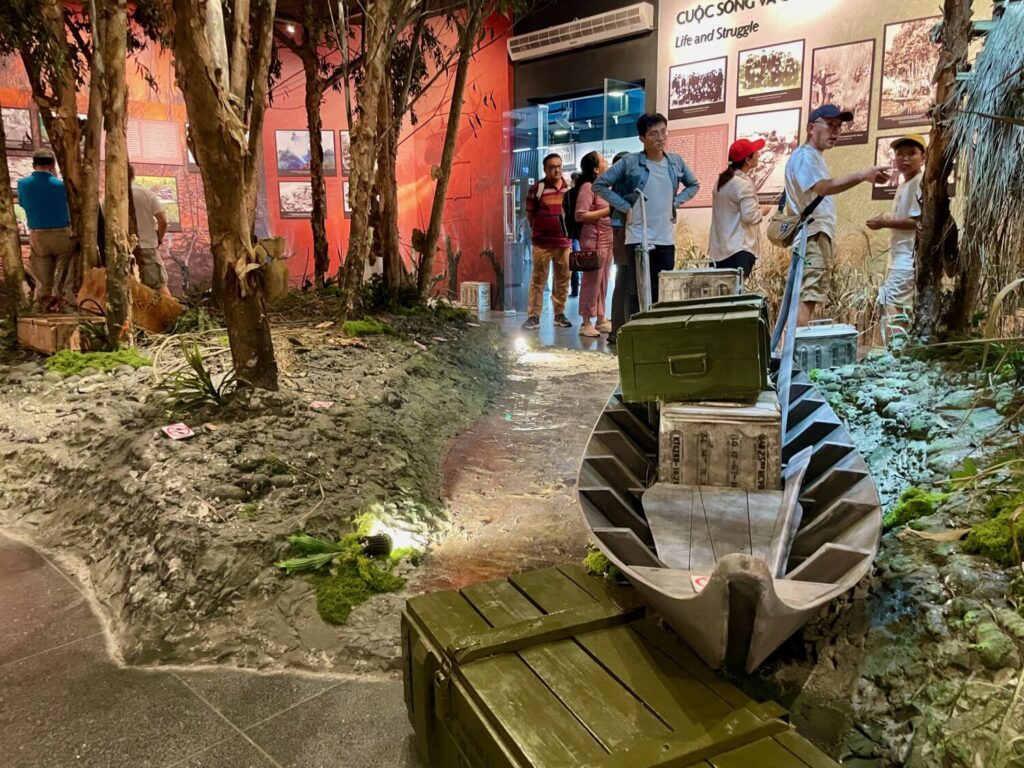
A new external prison system exhibit has been added, with very graphic content, along with a few temporary exhibitions. During my visit, I saw exhibitions on how Viet Cong soldiers transported weapons and supplies through forests and rivers, as well as one dedicated to Madame Binh.
Inside, you should visit the museum from the top floor down, following a thematic order. It begins with the most graphic aspects of the war. Then, it gradually shifts towards its wider impact on society and global opinion. Each level focuses on a different side of the conflict, but the tone remains consistently intense throughout.
Some of the most striking sections include photographs of massacres, the effects of Agent Orange, and iconic images such as the girl running from a napalm attack. The Agent Orange room, in particular, was very difficult for me. The images of children with severe deformities were overwhelming, and I ended up leaving the room.
Other areas focus on war crimes, presenting photographic and documentary evidence in a very direct and uncompromising way. On the ground floor, the tone changes slightly, with exhibitions on international anti-war movements and global reactions to the conflict.
Vietnam War History Explained: From 1945 to the US War
The section of the museum dedicated to the history of the Vietnam War is particularly impactful. It does not focus on military strategy, but on what the war meant for people.
Through photographs, documents and testimonies, it tells the story of a conflict in which civilians paid the highest price. More bombs were dropped on Vietnam than during the whole of the Second World War.
The historical narrative begins in 1945, when Ho Chi Minh declared Vietnam’s independence. After the end of the Second World War, the country became a battleground shaped by colonial legacies and Cold War tensions. The French were defeated, but the division of Vietnam and the fear of communism led to deeper American involvement, including extensive bombing campaigns that also affected civilian areas.
Requiem Exhibition: Tim Page and Vietnam War Photographers
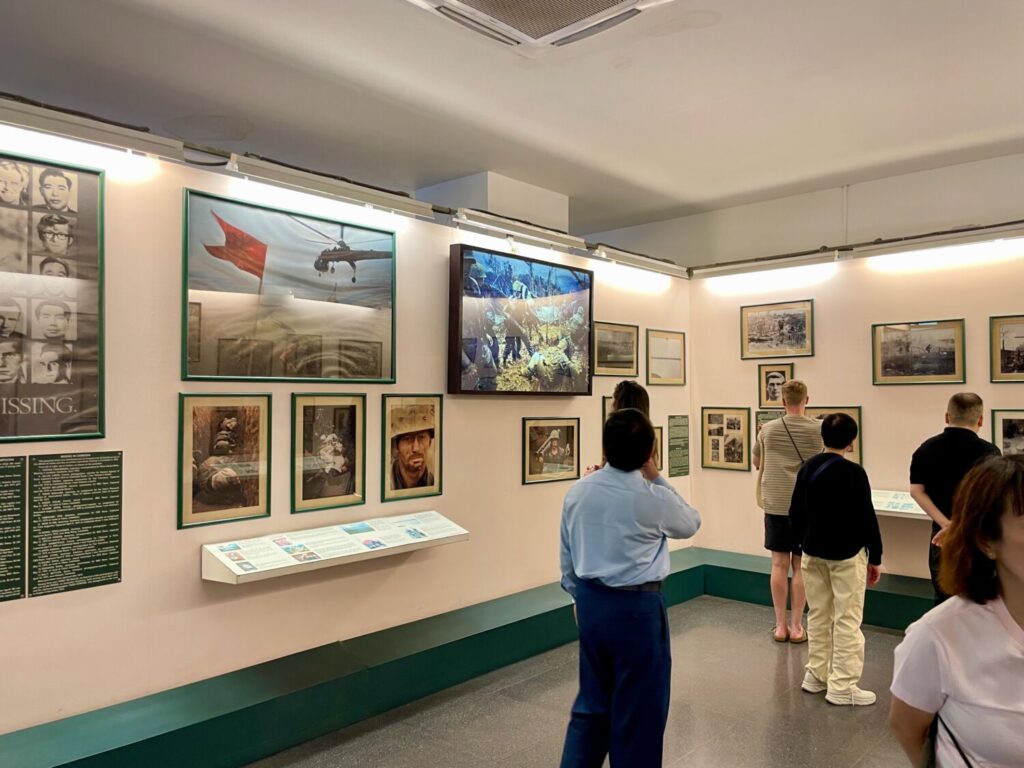
The Requiem exhibition, curated by British photographer Tim Page, is dedicated to the journalists and photographers who documented the Vietnam War. There is a long list of photographers who were killed or went missing. This gives the exhibition a strong sense of memory and tribute.
The exhibition brings together powerful images from photographers of different nationalities, alongside original material such as Life magazine covers. Some photographs show wounded soldiers, prisoners and combat scenes. Others focus on civilians caught in the middle of the conflict. One image that struck me shows a young medic, Thomas Cole, treating injured soldiers despite being badly wounded himself.
What makes this section different from the rest of the museum is the perspective. Here, the focus shifts from accusation to documentation. The war is still present in all its brutality. Yet, it is filtered through the eyes of those who witnessed it rather than through political narrative.
For me, this was one of the most accessible sections of the museum. The images are still powerful, but they feel more like a historical record than a shock display. They also help you understand how photography shaped global perception of the war.
Agent Orange in the Vietnam War: Impact and Long-Term Effects
The War Remnants Museum shows the scale of chemical warfare used during the Vietnam War, with a strong focus on Agent Orange. I found this section overwhelming and had to leave. It is one of those moments where you realise that reading about history and actually seeing its consequences are two very different things.
Between 1961 and 1971, millions of litres of herbicides containing dioxin were sprayed across large areas of Vietnam, exposing millions of people. These defoliants were used to destroy the jungle where Viet Cong forces were hiding. Yet, they had a devastating and largely unforeseen impact on the health of entire generations of Vietnamese people.
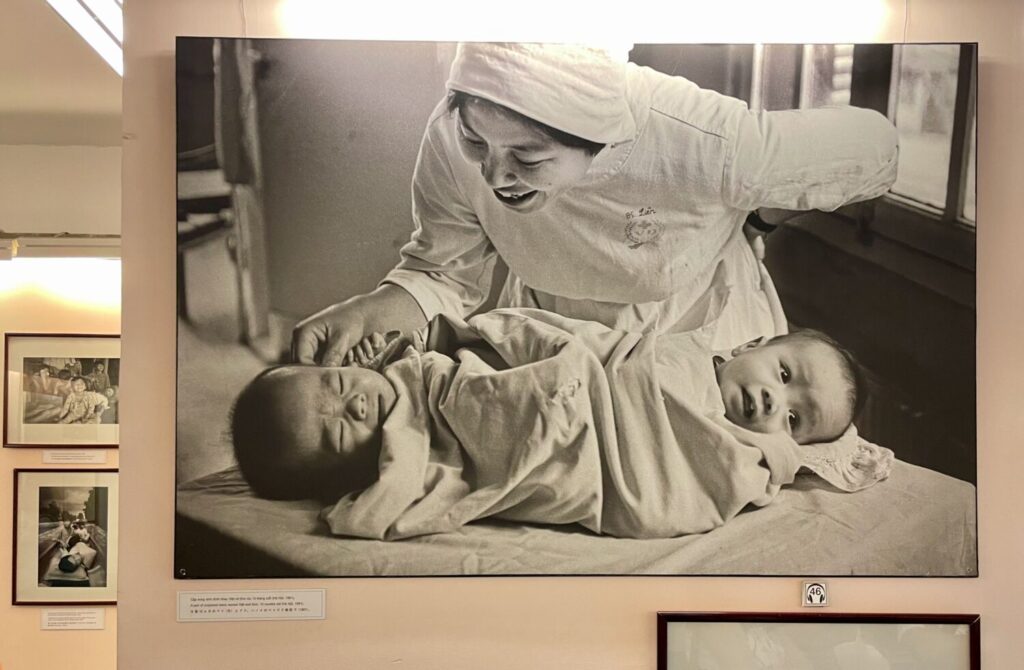
The impact is presented through photographs, medical records and survivor testimonies. Many of the images are extremely hard to look at. The exhibition does not hold back, including some of the most striking cases of children born with severe malformations. It also shows how the effects did not end with the war, but continued across generations. There are ongoing health issues and environmental damage still visible today.
These effects are still part of everyday life for many people in Vietnam. For this reason, this section is quite difficult to process. Not all stories, however, end in tragedy. The one I chose to hold onto is that of the conjoined twins Viet and Duc Nguyen, born in 1981. After their separation, Duc was able to build a life, have a family, and move forward in a way that feels almost impossible after everything they went through.
Global Anti-War Movements and International Reactions
On the ground floor, the focus shifts away from the battlefield to how the rest of the world reacted to the Vietnam War. After the intensity of the upper floors, this section felt different, almost like a pause, even if the subject remains serious.
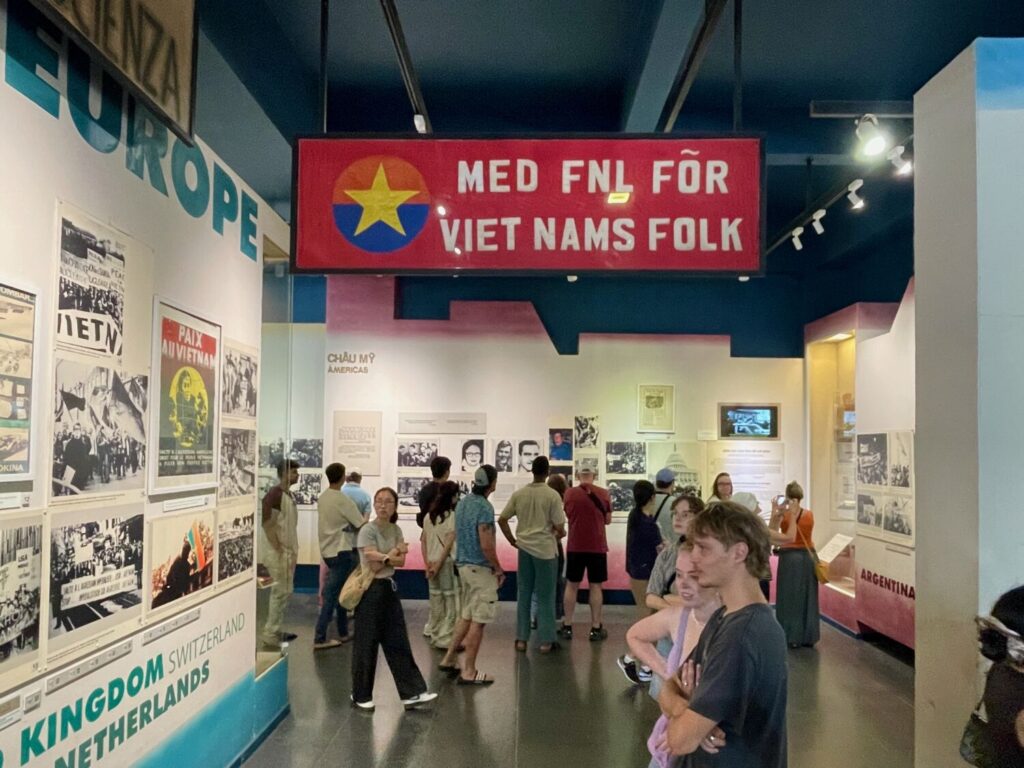
What I found most interesting was the anti-war movement. Through photographs, posters, newspaper clippings and publications, the exhibition shows how people across Europe, Asia and the Americas protested against the conflict. Many of these demonstrations took place in the United States itself, which adds another layer to how the war was experienced and contested.
Outdoor Exhibition at the War Remnants Museum in Ho Chi Minh City
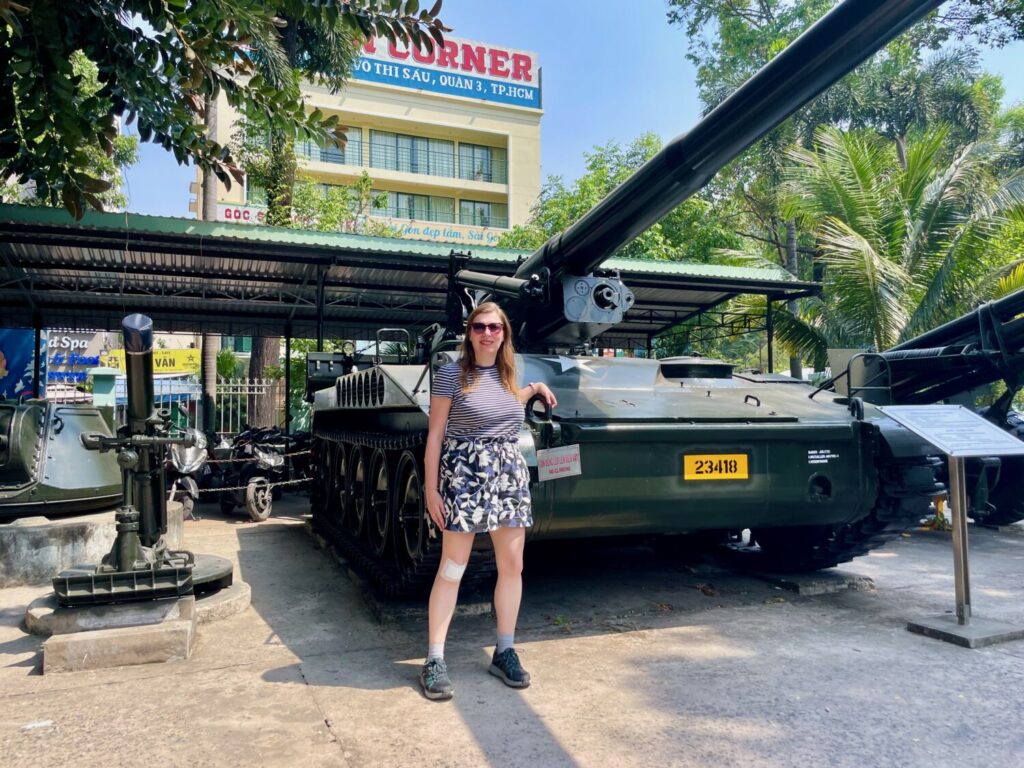
Outside, you walk past tanks and aircraft used during the war, alongside the Peace Bell made from a bomb casing. There are also reconstructions of prison systems, including the so-called tiger cages. Here too, there are very raw and graphic references to detention and torture. These displays are immediately impactful and mirror the intensity of the exhibitions inside the museum.
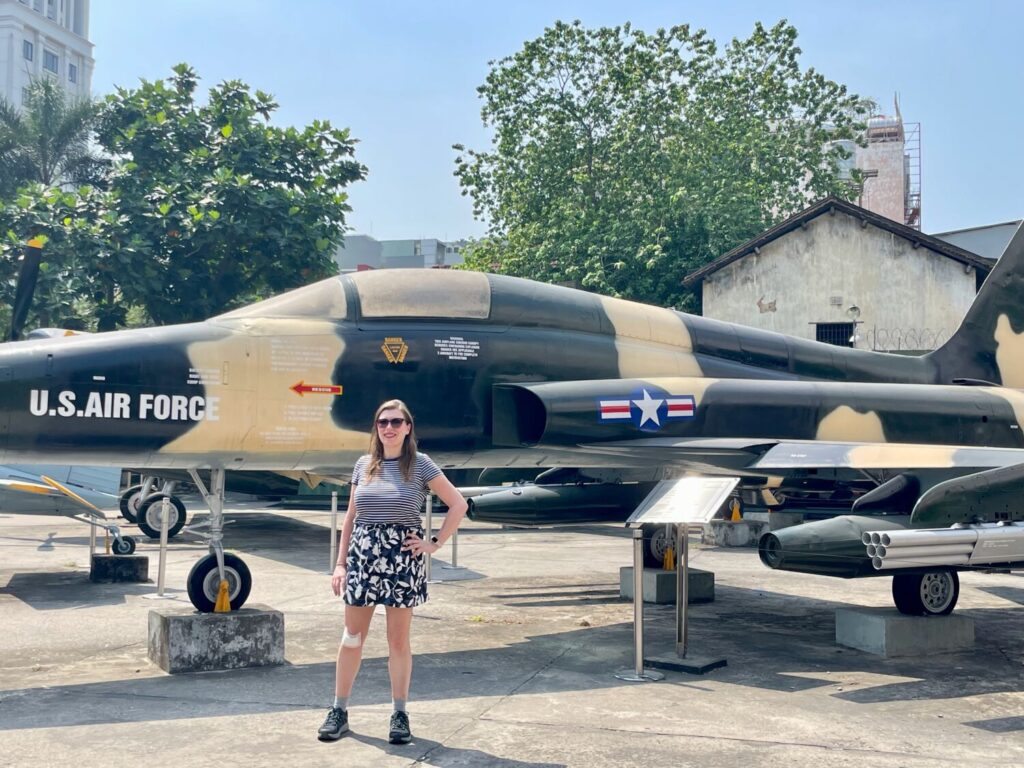
Tanks and Aircraft at the War Remnants Museum
Displayed in the open courtyard are large military vehicles and weapons used during the Vietnam War. You can see UH-1 Huey helicopters, M48 tanks, Skyraider aircraft, jeeps and heavy artillery. Seeing these machines at close range was probably intended to help visitors understand the scale of the conflict and the technology involved.
In reality, after the intensity of the images inside and the detailed accounts of torture in the prison exhibition, this area felt unexpectedly lighter. Walking among jeeps, aircraft and tanks, I found myself thinking more about familiar scenes from films like Good Morning, Vietnam than about the war itself.
Here you finally breathe a sense of relief, almost thinking you are already out of the museum. What you end up doing is taking photos in front of aircraft and tanks. It feels like a way to process everything you have just seen.
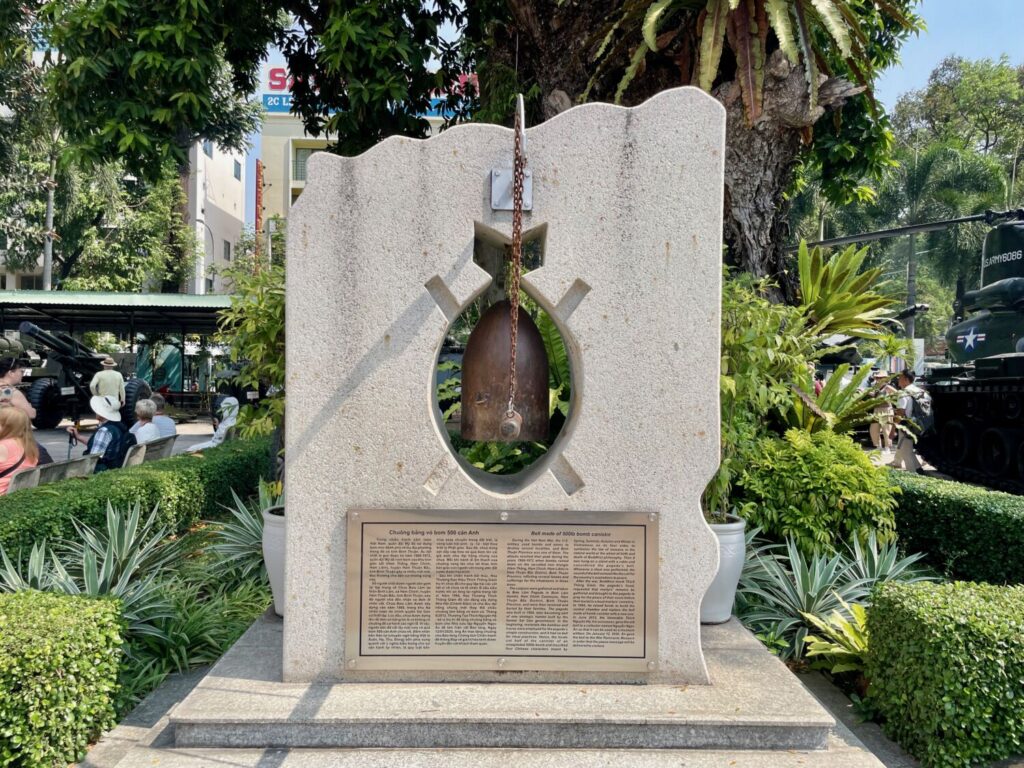
The Peace Bell: From Bomb to Symbol of Peace
One of the most unexpected objects in the outdoor area is the Peace Bell, made from a 500lb bomb canister. Knowing where it comes from changes the way you look at it. This was not just a piece of metal, but part of the weapons used during the war.
What I found most interesting is how it was reused. Something created for destruction became part of a spiritual space. In Binh Thuan Province, local people cut the bomb shell in half and turned it into a temple bell for the pagoda where corpses were gathered and buried. They engraved symbols representing the seasons and the cycle of life, giving it a deeper meaning beyond its original purpose.
Today, seeing it here in the museum feels quieter compared to everything else around it. It does not shock you in the same way as the images inside, but it stays with you. It is one of the few objects that speaks more about transformation than about violence. Ringing the Peace Bell was a touching moment, as if I had managed to erase for a moment the horrors of war seen in the museum exhibits.
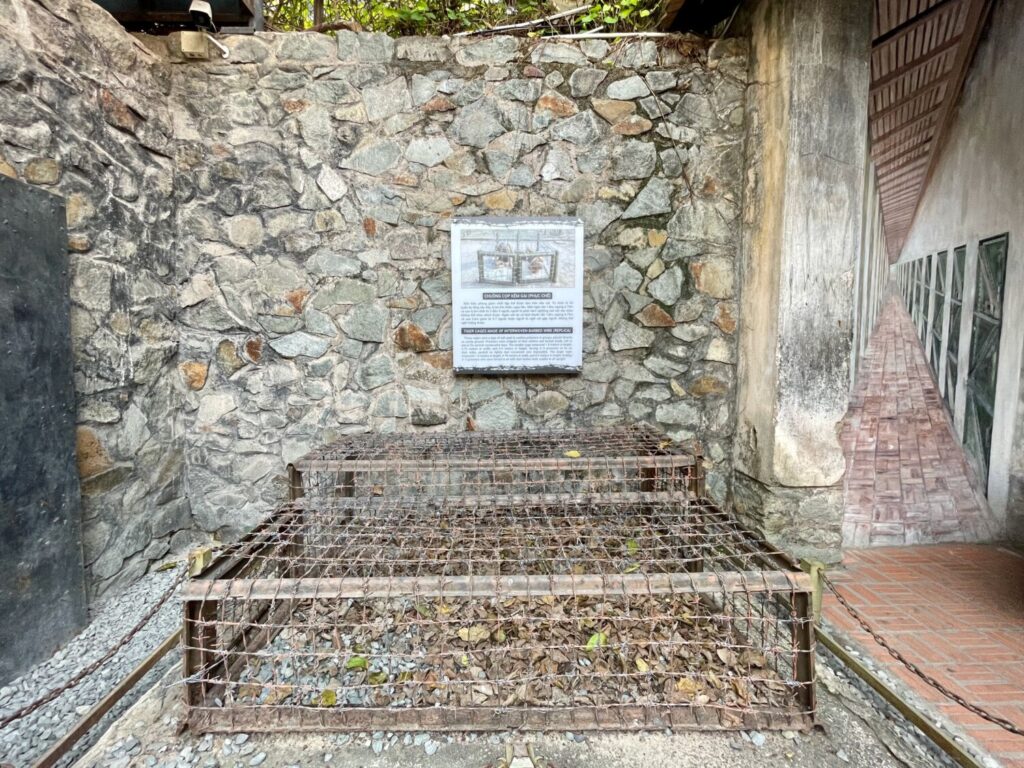
Vietnam War Prisons: Tiger Cages and Detention System
At the back of the courtyard, a series of containers hosts a multimedia exhibition on the prison system used during the Vietnam War. This is where you find the reconstructions of the so-called tiger cages, originally built by the French and later expanded under the South Vietnamese government with American support.
The displays explain how prisons such as Con Dao and Phu Quoc were used to detain political prisoners, often in extreme conditions. Over time, these facilities became places of systematic torture, forced labour and overcrowding, holding thousands of people. Some estimates suggest that tens of thousands of prisoners died during their operation.
What makes this section particularly difficult is the level of detail, which is genuinely disturbing. The recreated cells, historical photographs and written testimonies describe daily life in a very direct and explicit way, including torture methods and conditions of extreme deprivation. Walking through this area, it is hard not to imagine what those conditions must have felt like.
Practical Information for Visiting the War Remnants Museum in Ho Chi Minh City
The War Remnants Museum is one of the most popular attractions in Ho Chi Minh City, and it is almost always busy. On my last visit, it was pretty crowded, with tour buses constantly arriving and long lines at the ticket office.
Inside, it is packed with travellers focused on taking in the large amount of intense and confronting material on display. Every information board has English translations and there are English-speaking guides available. However, this makes the museum more accessible, but does not reduce its emotional impact.
In the past, most visitors were from Europe and North America, but this has changed over time. Today, the audience is much more varied, especially since Vietnam eased visa requirements for ASEAN countries. Walking through the museum, you notice a wide mix of nationalities and ages, all engaging with the exhibitions in different ways.
To make the visit more manageable, I recommend arriving early in the morning. Weekdays tend to be quieter than weekends, although it is rarely empty. Large groups can also make it difficult to read the displays.
Why the War Remnants Museum Is Totally Not Suitable for Children
Inside the War Remnants Museum there is a small play area for children, but I would not recommend bringing them here at all. Children are naturally curious, and it would be very easy for them to wander into one of the exhibition rooms and see something they are not ready to process.
Personally, I would never take my seven-year-old son here. We have visited several Cold War museums together around the world. Still, none of them, not even places like Bunk’Art in Tirana, showed such explicit images. The level of visual detail here is on a completely different scale.
From a Western perspective, one of the biggest differences is the lack of filtering. Museums in Europe or North America would not display this kind of raw material so directly. This is something to be aware of. Not just for this museum, but also if you are travelling with your family more broadly across parts of Southeast Asia.
War Remnants Museum Opening Hours
The War Remnants Museum is open daily from 7:30 am to 5:30 pm. The ticket counter closes at 5:00 pm, so it is best to arrive with enough time to complete your visit.
War Remnants Museum Tickets and Prices
The War Remnants Museum entrance fee is 40,000 VND per person per visit, a bit less than €1.50. Children under six years old can enter for free, while students are eligible for a 50% discount.
You can buy tickets directly at the museum, but you may find a long line because the War Remnants Museum is a very popular museum. Yet, based on my experience, visiting with a guide can help you skip the line.
My visit was organised by Travel Sense Asia, including a local guide in Saigon who accompanied my group through the museum. If you are travelling independently, you can easily find guided tours online that include the War Remnants Museum.
How to Get to the War Remnants Museum in Ho Chi Minh City
The War Remnants Museum is within walking distance of Ho Chi Minh City centre, or you can easily reach it using Grab. It is close to Independence Palace, Saigon Notre-Dame Cathedral and the Central Post Office. For this reason, it is a good idea to combine your visit with a walking tour of Saigon through nearby colonial streets and local cafés, like I did.
War Remnants Museum – Bao tang Chung tích Chien tranh
Phuong 6, District 3, Ho Chi Minh 700000, Vietnam
Final Thoughts on Visiting the War Remnants Museum
Visiting the War Remnants Museum is not something you simply tick off a list. It is an experience that stays with you, sometimes in uncomfortable ways, and it may take time to process. Feel free to share in the comments how you felt about the War Remnants Museum in Ho Chi Minh City, whether you have been here or visited similar museums.
