
The Imperial Citadel of Hue, in central Vietnam, was the imperial capital of the Nguyen dynasty for over a century. Its monumental complex, recognised as a UNESCO World Heritage Site in 1993, includes the Citadel, the Imperial City, the Forbidden Purple City, and the emperors’ tombs. In this guide, you can explore the urban structure of the Citadel and the private spaces of the emperor and the royal family, designed according to principles of power and hierarchical organisation.
Table of Contents
Why Hue Imperial Citadel is a UNESCO World Heritage Site
One of the main reasons to visit Hue is to experience its imperial complex in person, recognised as a UNESCO World Heritage Site in 1993. Hue is one of the few former feudal capitals in Asia where the overall structure is still largely visible, despite the damage caused by time and war.
PLAN YOUR TRIP TO VIETNAM – 5% discount on your eSIM and travel insurance
For getting around Vietnam with ease, choose a Holafly eSIM: you get unlimited internet, perfect for using Google Maps, Grab or other navigation apps, booking transport on the go, and sharing photos and videos in real time on WhatsApp without worrying about local SIM cards or extra charges.
For extra peace of mind, pair connectivity with Heymondo travel insurance, which covers you in case of medical emergencies, delays or cancellations. A practical solution that lets you focus on exploring Vietnam, rather than dealing with unexpected setbacks.
The Imperial Citadel of Hue is part of a complex urban system that also includes the Imperial City and the Forbidden Purple City, designed according to principles of harmony, hierarchy, and cosmology rooted in both Vietnamese and Chinese traditions. Rivers, walls, palaces, temples, and even the Nguyen emperors’ tombs follow precise symbolic rules that reflect imperial power and order.
Hue Imperial Citadel Layout: Structure and Organisation Explained
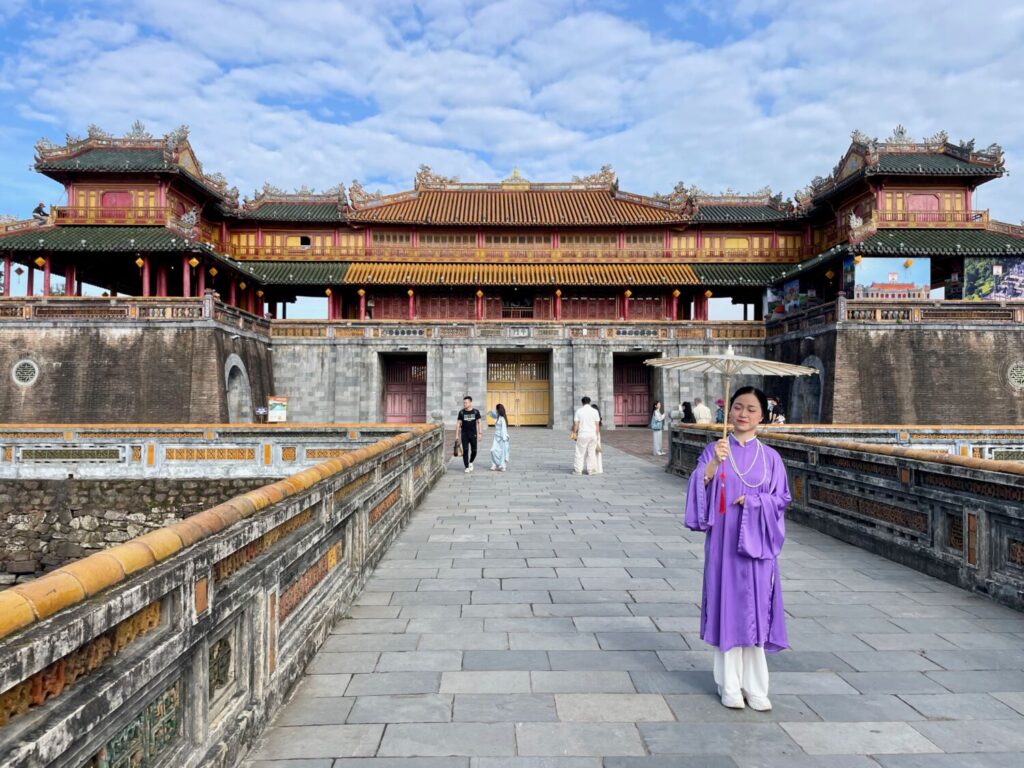
The Hue Citadel is the outermost and largest part of the entire imperial complex, recognised as a UNESCO World Heritage Site in 1993. It is a true fortified city, surrounded by walls and moats, built in the early 19th century under the Nguyen dynasty. Within the Citadel lie the Imperial City and, further inside, the Forbidden Purple City, all organised according to a precise hierarchical structure.
The Citadel forms the outer layer, where officials, soldiers, and part of the population lived. Administrative buildings and main access points were also located here. The Imperial City was the political and ceremonial centre, reserved for the court and the mandarins. Deeper inside lies the Forbidden Purple City, the private space of the emperor and the royal family, with extremely restricted access.
Today, you can explore much of the Hue Citadel, although time and war have destroyed many buildings, while others have been reconstructed. Inside the walls, you will find imperial palaces, ceremonial halls, temples, canals, and ponds. A network of water channels runs through the complex, playing a fundamental role in its design. A less historical but enjoyable detail is the fish in the canals, which you can feed using food from nearby dispensers.
The imperial complex is vast, and each space had a precise hierarchical function, which is why visiting with a guide can makes a significant difference. I learned much of what I share here thanks to my guide. Vietnam’s imperial history is long and complex, with many rulers, traditions, and architectural styles that are not easy to recognise at first glance.
Imperial City of Hue: What to See Inside the Citadel
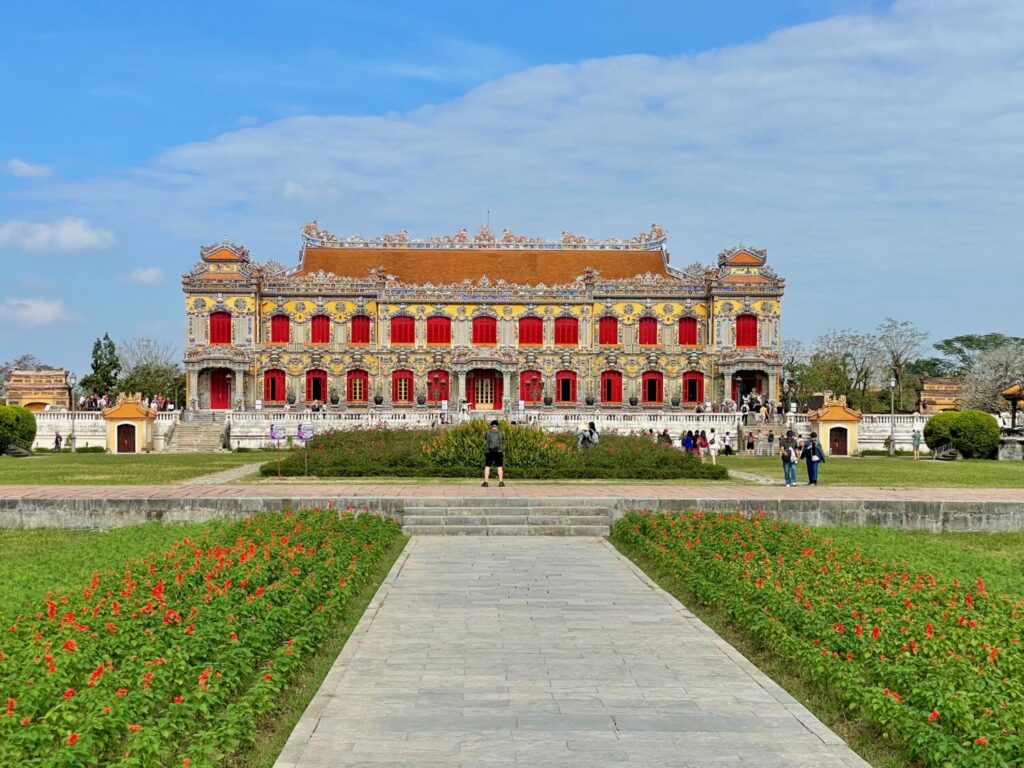
Inside the Citadel lies the Imperial City, the political and ceremonial heart of the Nguyen dynasty. This is where official functions took place and where the main representative buildings were located. The Imperial City was the centre of power, accessible only to the court and authorised officials.
Walls surround the entire complex and five gates provide access. Only the emperor used the central gate, while mandarins used the side gates. There were no gatese for women as they were not allowed in public areas and remained within the inner sections.
During the Vietnam War, the area was heavily bombed. Today, only about 30% of the original structures remain. Despite this, the site is still vast and requires several hours to explore. You may not notice the damage immediately, as restoration in Vietnam often focuses on reconstruction rather than preserving ruins, so many buildings appear perfectly intact.
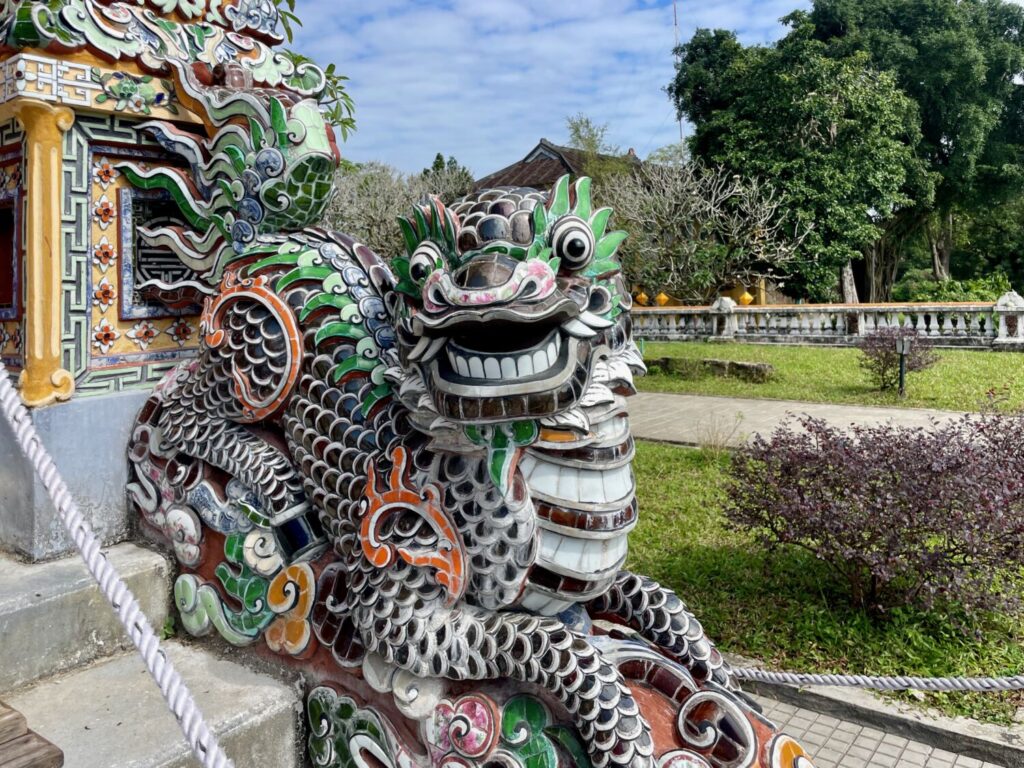
Several buildings now host exhibitions about the Vietnamese imperial family. Near the entrance, you can see royal seals, gold objects shaped with lion heads and dragon bodies, used to validate official documents.
Further inside, the Imperial Palace, built in 1921 under Emperor Khai Dinh, is one of the most impressive buildings. Ceramics in red and gold, symbolising fortune and imperial power, decorate its facade. The interior, restored between 2020 and 2022, hosts an exhibition on the last two Nguyen emperors, Khai Dinh and Bao Dai, with captions in Vietnamese and English.
Forbidden Purple City of Hue: The Emperor’s Private Residence
The Forbidden Purple City of Hue, inspired by Beijing’s Forbidden City and reserved exclusively for the royal family, lies within the Imperial City, forming a citadel within the Citadel. Time and war destroyed much of it, and many wooden structures did not survive. Other buildings reflected an eclectic style with French and Chinese influences.
At the time of my visit, only the Queen Mother’s Palace had been fully restored. Inside, you can see an exhibition with photographs of Vietnamese empresses and insights into the final years of the empire. During the reign of the last emperor, Bao Dai, the complex even included a tennis court.
During the Vietnamese empire, strict rules limited access to the emperor’s residences, his wives, concubines, and the inner court. Our guide shared several details about court life, where luxury and strict hierarchy defined everyday life.
One detail that stayed with me was the emperor’s daily routine of up to 36 meals, made up of small portions rather than full dishes. The only male attendants allowed inside the Forbidden City were eunuchs, considered not to pose a threat to the concubines.
Among the Nguyen emperors, Minh Mang is often remembered for having over 140 wives and concubines and more than one hundred children. Emperor Tu Duc, despite numerous wives, had no biological heirs and devoted himself to building his elaborate mausoleum, with his infertility often linked to illness in his youth. The last emperor, Bao Dai, had only one wife, the empress Nam Phuong.
Hue Imperial Citadel Visitor Guide: Practical Tips and Planning
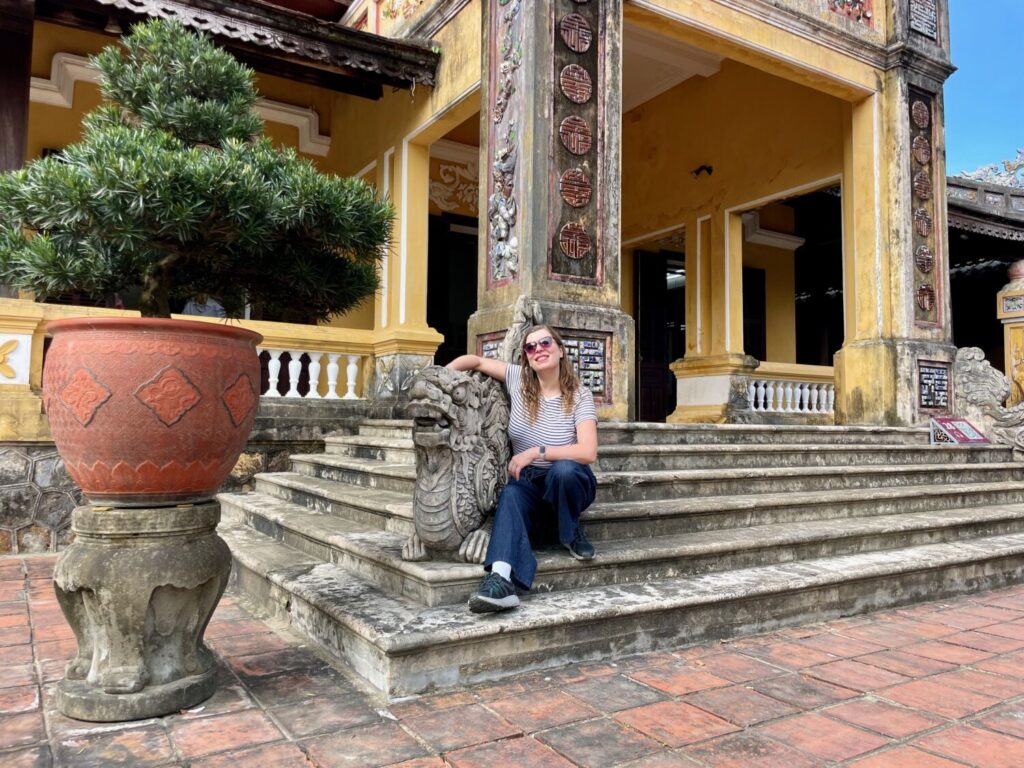
Visiting the Hue Imperial Citadel requires some planning, especially when it comes to timing, heat, and the size of the complex. In the following sections, you will find practical information on how to visit, including guided tours, tickets, and opening hours, along with a few useful tips to make your experience easier.
If you visit the Citadel as part of an organised tour, as I did during my trip with Travel Sense Asia, your driver and guide will usually pick you up directly from your hotel. If you are travelling independently, you can easily reach the entrance by taxi or ride-hailing apps such as Grab.
Especially in summer, it is best to avoid the hottest hours of the day and bring water with you. Tours often include at least one bottle of water, but if you visit independently, you will need to organise this yourself. Having an extra bottle is a good idea, as there is a lot of walking involved.
How to Visit Hue Imperial Citadel: Guided Tour or Independent Visit
You can visit the Hue Imperial Citadel independently, but it is a very large complex and there is limited information on site to help you navigate it. If you want to understand more about Vietnam’s imperial history, joining a guided tour is the better option. On your own, you may miss much of the meaning behind what you are seeing, unless you already have some background knowledge.
There are many guided tours available online in English. If you choose this option, it is worth checking reviews carefully, as the quality of guides can vary. Alternatively, using a local tour operator allows you to tailor the experience more closely to your preferences. During my trip across Vietnam, for example, my itinerary already included the imperial tombs and the incense village, making the experience much more complete.
Hue Imperial Citadel Tickets: Prices and Where to Buy
Entry to the Hue Imperial Citadel requires a ticket. At the time of my visit, the price without a guide was 200,000 VND, approximately $8. In recent years, prices have increased significantly, more than doubling compared to my first trip to Vietnam, but it still remains very affordable.
The ticket office is near the main gate and is easy to recognise by the queue. If you join a guided tour, you do not need to worry about buying tickets yourself, as your guide will take care of it. Depending on the tour, tickets may be included or not, but you will usually avoid queuing at the ticket office. Having a guide in Vietnam is often an effective way to skip lines.
Hue Imperial Citadel Opening Hours and Best Time to Visit
The Hue Imperial Citadel is generally open daily from 08:00 to 17:30. Before your visit, it is always best to check opening times and ticket prices with your hotel or guide, as they may change. I recommend visiting the Imperial Citadel in the morning, when temperatures are lower and the site is less crowded. Plan to spend at least a couple of hours exploring the main areas of the complex.
What to See in Hue Beyond the Imperial Citadel
Beyond the Imperial Citadel, Hue offers a range of experiences that help you understand its role as a former imperial capital. The Nguyen emperors’ tombs, Thien Mu Pagoda, and the Perfume River are not isolated attractions, but part of the same UNESCO-listed landscape. Exploring these sites together gives you a clearer sense of how the city was designed, where political power, religion, and daily life were closely connected.
The Imperial Tombs, in particular, are spread across the countryside and each reflects the personality and vision of a different emperor. Thien Mu Pagoda, set on a hill overlooking the Perfume River, adds a spiritual dimension to the visit, while the river itself once played a central role in connecting the entire imperial system.
Feel free to share your thoughts in the comments about the magnificent Imperial Citadel and the life in Vietnam during the Nguyen dynasty.
