
Returning to Ha Long Bay after years wasn’t the experience I imagined. Although the majesty of its 1,600 karst limestone islands remains unique, the context around it has changed radically. While I loved the food and comforts of modern luxury cruises, I didn’t think I’d come to regret the rough organisation of the past. Today the bay is a complex tourism ecosystem, divided between modern infrastructure and amusement parks, as you can read in this article.
Table of Contents
Ha Long Bay UNESCO World Heritage Site: What Makes It Unique
Ha Long Bay is a global symbol of Vietnam thanks to the incredible 1,600 limestone stacks rising from the sea. These rocks have over 500 million years of evolution behind them, forming a unique ecosystem that led UNESCO to declare it a World Heritage Site.
PLAN YOUR TRIP TO VIETNAM – 5% discount on your eSIM and travel insurance
For getting around Vietnam with ease, choose a Holafly eSIM: you get unlimited internet, perfect for using Google Maps, Grab or other navigation apps, booking transport on the go, and sharing photos and videos in real time on WhatsApp without worrying about local SIM cards or extra charges.
For extra peace of mind, pair connectivity with Heymondo travel insurance, which covers you in case of medical emergencies, delays or cancellations. A practical solution that lets you focus on exploring Vietnam, rather than dealing with unexpected setbacks.
Our guide compared the limestone formations to a dragon. Every island seems to have its own animal shape. Ha Long Bay hides several karst caves within its cliffs. You can visit some by boat, but others stay underwater.
The UNESCO recognition in 1994 helped preserve its fragile ecosystem, but also made the bay a top global destination. This accelerated mass tourism that is difficult to manage. Although the beauty of Ha Long remains indisputable, the experience feels very different now.

Overtourism in Ha Long Bay: How the Experience Has Transformed
During my first trip in 2012, the bay already held UNESCO status, yet the atmosphere felt profoundly different. Returning today, I noticed how tourist infrastructure evolved radically, transforming the rhythm of the visit into something frenetic. I saw a quiet landscape turn into a bustling, industrialised hub.
Some aspects improved, such as safety and stricter environmental regulations, but the impact of mass tourism remains evident. I felt as if I stepped onto an assembly line where the sense of discovery vanished completely. The journey now follows a rigid pattern that leaves little room for spontaneity.
The change in Ha Long City truly impressed me, as new buildings and entertainment areas continually pop up. The Queen Cable Car carries passengers to the Mystic Mountain from the boarding area. This site forms part of the Sun World Ha Long amusement park. It’s the same complex that transformed the landscape of Ba Na Hills.
Aggressive urban expansion clashes with the nature of the stacks, turning a quiet starting point into a chaotic destination. Our guide explained that only a tiny fraction of Western tourists chooses to stay on the mainland. Most travellers prefer cruises, depriving the local community of a real economic and cultural return beyond the organised tour.
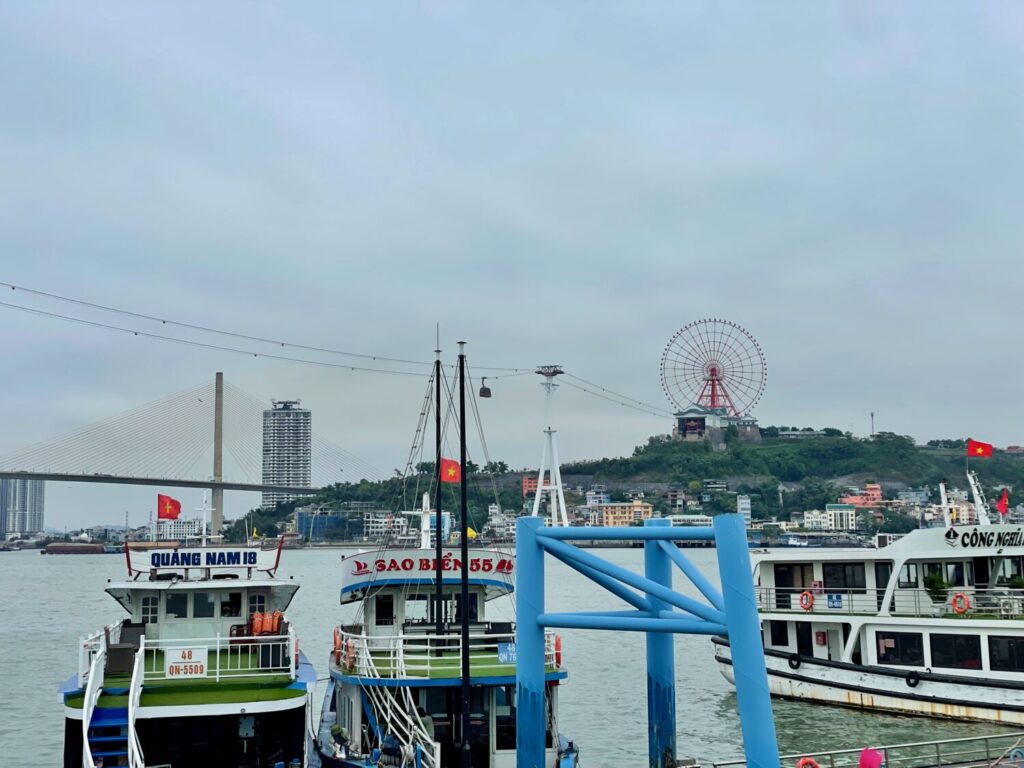
Everything revolves around the Ha Long International Cruise Port, a monumental terminal in the Bai Chay district. Architect Bill Bensley designed the building to centralise boarding operations for thousands of people across more than 7,000 square metres.
Ha Long Bay Cruises and Tours: Choosing the Right Option and What to Expect
To visit the bay today you can opt for a daily cruise or a two-day, one-night itinerary. However, forget the romantic image of the old wooden junks I remembered from my first trip in 2012. The absence of traditional boats is the result of a precise strategy by the Vietnamese government to increase safety.
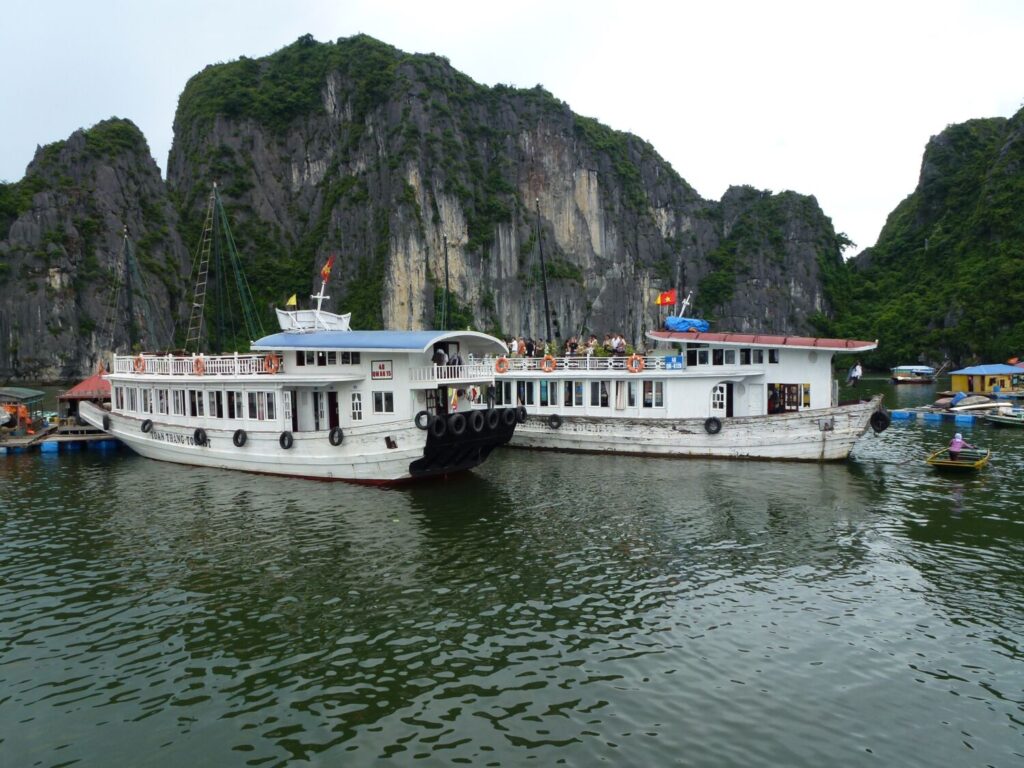
Following some serious accidents in the past, authorities imposed very strict regulations on navigation. Since 2021, the use of wood for new ships has been practically banned, pushing companies towards metal hulls. This led to the replacement of wooden ships with modern cruise ships and fibreglass boats for excursions.
Even the departure point has changed compared to a few years ago. Today you board from the Ha Long International Cruise Port. The management of visitor flows has now become almost industrial. This makes boarding and tender movements a core part of the trip, for better or worse.
Ambassador Cruise II Review: Luxury, Comfort and a Fast-Paced Itinerary
On my last trip I visited Ha Long Bay with a day cruise on board the Ambassador Cruise II. The tour involves boarding a cruise ship, whilst a small boat, the tender, takes you to the various excursions. Honestly, I liked the onboard experience a lot because the food is excellent. We started with a phở-based breakfast, followed by a buffet lunch with barbecue.
My group was assigned cabins with balconies, equipped with every comfort. Consider, however, that the perception of luxury changes according to habits. A travel companion found the ship a bit dated compared to five-star hotels. As far as I’m concerned, it’s a perfectly good option for a short cruise.
Inside the ship there is also a spa offering massages at almost European prices. I couldn’t use it due to the frantic pace of the excursions. The rhythm is relentless and you barely have time to put down your fork after lunch. You must run and get changed because the tender leaves in five minutes.
Excursions feel like a continuous race between one cave and another. Every stop is timed to make room for the next group. The entertainment on board follows this slightly frenetic style. I admit that in some moments the atmosphere was truly peculiar.
I witnessed almost surreal scenes with an audience of older Japanese ladies. They were dancing enthusiastically whilst tipping a singer sporting a Vietnamese Shakira look. This is part of the new face of Ha Long. It is a mix of quality services and decidedly picturesque international tourism.

How to Plan a Trip to Ha Long Bay: Transport, Ports and Practical Advice
You can reach the bay from Hanoi in about two and a half hours via the new motorway. Most travellers choose a private transfer or a tourist bus, often included in the cruise package. As I am passionate about aviation, I asked our guide for information and discovered you can fly over the area by seaplane. The panoramic flight offers an incredible view, although fog often forces authorities to cancel trips.
If you want to see the bay with more time, you can sleep in Ha Long City or on board. Most Westerners prefer the charm of waking up amongst the stacks, making the boat the best option. You must rely on official tours authorised by the government to explore this UNESCO site. This rigidity guarantees safety but definitely limits the freedom of independent travellers. I learned from our guide that you cannot rent private boats from the nearby fishing village.
The only real independent alternative remains the public ferry connecting Tuan Chau island to Cat Ba island. The ferry crosses part of the bay, offering beautiful views for about 80,000 VND (around €2.5).
This option simply provides the panorama without including caves or specific tourist activities. The sailing schedules are available in Vietnamese on the official website of the parent company, Tuan Chau Group. The English tourist website, on the other hand, is offline at the time of writing.

What to See in Ha Long Bay: Top Caves, Islands and Cruise Excursions
Slow navigation amongst the limestone stacks remains the most iconic experience to do in Ha Long Bay. The excursions included in the package let you explore impressive caves and viewpoints. From the majesty of Sung Sot Cave, the largest and most monumental cave in the bay, to the tiring yet rewarding climb up Ti Top Island, every stop offers a different perspective on this unique ecosystem.
Excursions in Ha Long Bay have also become forced stops on a tight tourist circuit. There is little room for solitary contemplation. On the cruise ship, outings are announced via loudspeaker, with staff trying to funnel tourists onto the tender as quickly as possible.
We went from stuffing ourselves at lunch to running for the excursion five minutes later, without any warning. Curiously, many Japanese tourists seemed to appreciate this efficiency. They managed to see everything while still enjoying the full buffet experience.

Sung Sot Cave: Highlights, Crowds and What to Expect
The visit to Sung Sot Cave shows the monumental dimension of karst caves. Still, be prepared for an experience that is anything but intimate and emotional. Everything is designed for mass tourism, with concrete walkways, photo spots, and fast flows. The route is about one kilometre long with 400 steps. Whilst not difficult, I advise against it for those with knee problems or older visitors.
The caves are huge. The ceiling seems moulded from clay, due to wave erosion when the caves were internally submerged. However, constant artificial lighting has driven away the bats, depriving the cave of its original fauna. In their place, you find designated spots for souvenir photos, which you will see again at the exit as prints, magnets, and keyrings.
Amongst other unexpectedly un-eco-friendly practices in a UNESCO Heritage site, there is a lucky stalagmite where visitors leave small cash offerings after touching it. Our guide explained that this gesture is slowly destroying the rock, which risks disappearing within a few years due to constant human contact.
Despite the cave suffering heavily from overtourism, there is no cap on numbers and authorities allow entry to as many tourists as possible. Even in January, theoretically low season, the crowd was such that it was difficult to stop and take a photo. My advice is to visit early in the morning, hoping to anticipate the flows that in the afternoon turn the path into a single, uninterrupted river of people.
Ti Top Island: Iconic Viewpoint, Soviet History and Modern Development
Ti Top Island owes its name to the Russian cosmonaut and pilot Gherman Titov. The impact upon arrival for me was really unsettling because I remembered a free beach where I could swim in total complete freedom. Today the island appears heavily concreted, with tiled structures that have almost entirely replaced the natural aspect.
The name Ti Top is in fact the simple transliteration of the surname Titov into Vietnamese. Ho Chi Minh himself renamed the island after meeting Titov here in 1962, when relations between the USSR and Vietnam were at their best. Today, an enormous statue of Titov remains in front of the docking pier.
Even at Ti Top Island everything is organised to manage large numbers where authenticity has given way to mass tourism. In the half-hour excursion, you can choose whether to rent a deckchair on the beach or walk the path up to the viewpoint. The climb to the viewpoint of Ti Top Island offers the most famous view of the bay. Still, you must be ready to share it with hundreds of other people pushing to grab the best glimpse. I dread to imagine what the situation might be like during summer. In January, during low season, the flow of people was staggering.

Luon Cave by Kayak or Bamboo Boat: A Realistic Guide to the Excursion
Cruise ships are so large for the dimensions of Ha Long Bay that, for the excursion to Luon Cave, we had to change vessels. To reach the departure pier for the bamboo boats, we did not take the tender but boarded a smaller ship. The same pier is used by those who want to rent kayaks. Despite the commercial name, bamboo boats are fibreglass barges that only retain the shape of traditional ones.
The entire experience follows a forced and ultra-organised route designed to channel tourists into the correct queue to put on life jackets before boarding. You’ll find yourself in orderly lines, wedged between another 10,000 visitors. Every trace of the adventure you might expect from a boat ride in Ha Long Bay disappears almost immediately.
The excursion to Luon Cave lasts just five to ten minutes in a decidedly overcrowded setting. Only Japanese tourist groups seem able to enjoy the experience, shouting and chanting, instead of enjoying the nature in silence.

Things to Do Near Ha Long City Beyond the Cruise
The only positive aspect of this rush to mass tourism is that now, in the surroundings of Ha Long Bay, you can have unusual and interesting experiences. A classic stop is a visit to the oyster farms. Alternatively, you can end the day with a dinner inside the Dragon Pearl Cave, accompanied by a dance and music show.
Dragon Pearl Cave Dinner Show: A Unique Experience Inside a Limestone Cave
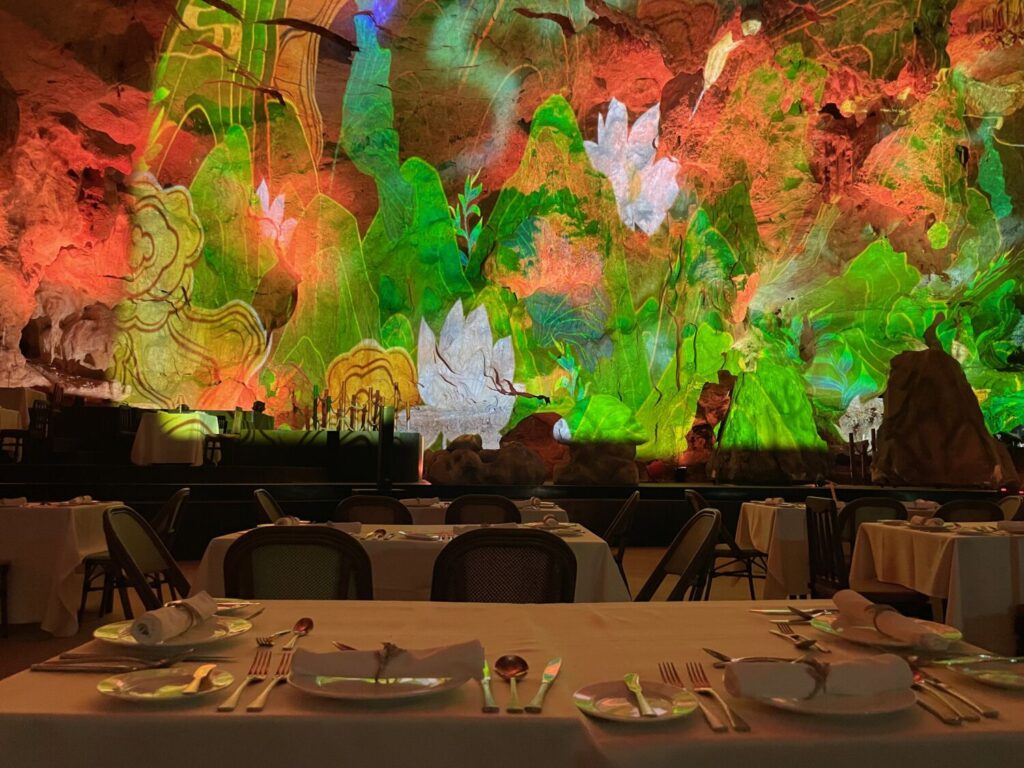
A truly incredible experience is the dinner with a show at the Dragon Pearl Cave, Ngoc Rong Cave in Vietnamese. Dinner is worthy of a Michelin-starred restaurant. Through video mapping, dance, and music, the show The Quest for the Sacred Pearl tells a millennial Vietnamese legend.
The Dragon Pearl Cave is totally beautiful, with many geological layers, making it very similar to Sung Sot Cave. It is the only cave in the world to simultaneously host a restaurant and a live show. The manager proudly explained to us that this record distinguishes it from other caves in Spain that host “only” restaurants.
Besides the dinner and the show, I greatly appreciated the attention to the sustainability of the site. For example, the kitchen and toilets were positioned strictly outside the site. The internal setting is very well curated, but the cave hasn’t been concreted for the benefit of tourists. All structures are in fact removable. This detail finally restores that sense of authenticity and respect for the environment that I was looking for on this trip amongst the limestone stacks.
Pearl and Oyster Farms in Ha Long Bay: How Cultured Pearls Are Made
Around Ha Long City, within the UNESCO protected site, six pearl villages still remain. In Vietnam, oysters are cultivated for small white pearls and for larger black pearls with golden reflections. In Vietnam, oysters are widely consumed, as they are believed to support health and improve sleep.
Almost all organised tours to Ha Long Bay include a short stop at the Legend Pearl to discover this tradition. The stop is highly touristy and more of a shop than a museum. Shop assistants speak almost any language fluently in order to sell pearls and necklaces. The demonstration on how pearls are created and extracted through a meticulous manual procedure is genuinely interesting.
In nature, pearls form when a grain of sand enters the shell and the oyster produces layers of mother-of-pearl to protect itself. Industrial production follows the method invented by the Japanese Kokichi Mikimoto. The process is a true surgical procedure carried out with antibacterial solutions. It involves the manual insertion of a spherical nucleus made from mother-of-pearl shells into the reproductive organ of the receiving oyster.

Alternatives to Ha Long Bay: Lan Ha Bay, Bai Tu Long and Cat Ba Island
The surroundings of Ha Long Bay offer quieter alternatives compared to the classic circuit. Lan Ha Bay is the younger sister of Ha Long and boasts the same rock stacks, but with waters that are currently decidedly less crowded. Not far away lies the island of Cat Ba, which hosts a national park where you can go trekking.
If you are looking for that silence that by now in Ha Long seems a distant memory, you can also explore Bai Tu Long Bay, where mass tourism has not yet arrived with the same destructive force. Visiting lesser-known zones allows you to rediscover that authenticity that overtourism has unfortunately erased in Ha Long Bay.
Ha Long Bay Today: Pros, Cons and What to Expect from Your Visit
During my last visit to Ha Long Bay I constantly asked myself if it is still worth visiting, accepting a compromise between natural wonder and commercial reality. The extraordinary beauty of the stacks remains indisputable, but the experience has profoundly changed compared to a few years ago. Overtourism has made everything highly regulated, transforming natural wonders into obligatory stops on a tourist circuit that leaves little room for spontaneity.
Ha Long Bay is also a victim of Instagram-driven tourism. Where you see deserted photos or selfies with a view of the bay, do not imagine silence. It simply means that whoever took them waited patiently for their turn in the queue, or somehow cropped out the other thousand people around.
If you expect to be able to contemplate Ha Long Bay in silence, immersed in nature, you will surely be disappointed by the concrete and the constant crowd. However, navigating amongst the limestone stacks of Ha Long Bay remains a unique experience. Despite the evident limits, the beauty of the karst nature still manages to win over the noise of the tourists.
The secret is not to expect authenticity, but to let yourself be fascinated by a landscape unique in the world that still takes your breath away. If you have visited Ha Long Bay recently or are planning to go, share your experience or your doubts in the comments.
